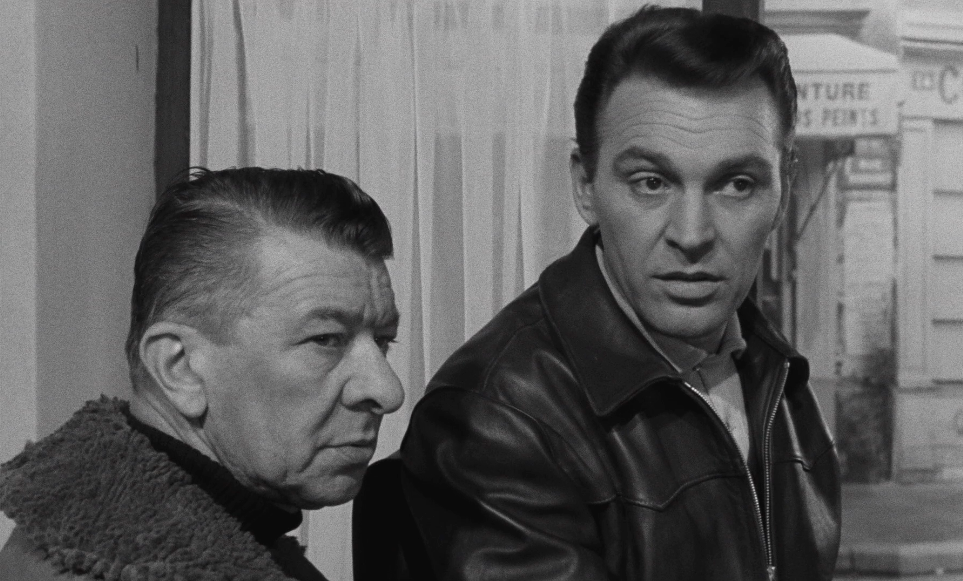
The German Blu-ray label Anolis Entertainment GMBH recently released a very nice, uncut and English-friendly disc of Viktor Trivas' Die Nackte und der Satan (1959), better known abroad as THE HEAD. In addition to the familiar English dub, it includes the original German soundtrack with English subtitles, which makes it possible for the rest of us to appreciate the talented cast's performances on an entirely new level. I was honored to be asked to provide an audio commentary for the set, which is presented with optional German subtitles, and there is a German commentary as well by Anolis' resident cult film experts Into Strecker and Mirko Rekittke. The disc has been released in a choice of different covers, including two standard covers and a keep case edition. Best news of all: unlike some of the other Anolis titles, it is region-free.


Produced by Gene Corman and executive produced by Roger Corman, ATTACK OF THE GIANT LEECHES is presented by Anolis as a two-disc media book with the B-picture pressed on Blu-ray (where it runs 63m) and on DVD (where it plays at 25 f.p.s. ad runs only 60m). Obviously, it's a B-picture but Kowalski—whose previous AIP features were HOT CAR GIRL and NIGHT OF THE BLOOD BEAST (both 1958)—does an extremely capable job of filling that length with earnest actors, memorable characters, an appreciably early ecological message, and some of the most lurid, unforgettably gruesome and perversely erotic imagery of the 1950s.
Ken Clark (SOUTH PACIFIC, who later starred in Mario Bava's THE ROAD TO FORT ALAMO) has the lead role as Steve Benton, the warden of a Florida everglades preserve, whose swamplands become the site of various disappearances. When local grocer Dave Walker (Bruno ve Sota) pursues his two-timing wife Liz (ATTACK OF THE 50-FOOT WOMAN's Yvette Vickers) and her lover Cal (Michael Emmet) out there with a shotgun, he sees them attacked by giant monsters with human-like arms lined with suckers. The police don't believe Dave's story, charging him with murdering the couple, who have in fact been dragged down to an underwater cave where they and others become the centerpieces of an ongoing feast. Steve has a vocational commitment to preserve the wildlife at the location, so others take the problem into their own hands.
Scripted by actor Leo Gordon and scored by Alexander Laszlo with the same grating electric keyboard he brought to NIGHT OF THE BLOOD BEAST, ATTACK OF THE GIANT LEECHES is notable for Clark's eloquent leadership and manly central presence; those who appreciate such things would probably favor his bare chest over William Holden's in PICNIC any day. However, it's really the eerie atmosphere and the solid character performances of ve Sota, Gene Roth (as a smug and boastful sheriff), Jan Shepard (KING CREOLE, as Clark's fiancée), and especially Vickers (never more sultry than when modeling her nylons or submitting to the monsters' voracious sucking) that rivet the viewer. Doing much of the heavy lifting behind that atmosphere is art director Daniel Haller, who at this point had been working with Roger Corman since 1958's WAR OF THE SATELLITES. His creepy underwater cave may have been high school play-level stuff in its actual substance, but DP John M. Nickolaus (who later shot Corman's THE TERROR and several of the most memorable OUTER LIMITS episodes, including "The Zanti Misfits") lights it like gangbusters, turning it into its own panoramic level of Hell.
Here in America, GIANT LEECHES is a public domain title, which has consigned its fate to a series of ignoble DVD releases and enrollment in MYSTERY SCIENCE THEATRE 3000's Hall of Shame. This anamorphic 1.66:1 presentation isn't likely to knock anyone's socks off, but when we see how sharp the main titles are (long with a handful of later individual shots, possibly post-production inserts), it becomes evident that whatever visual shortcomings we notice are the fault of the original film stock and inadequate location lighting. Suffice to say, if this is a title that matters to you, you won't find better elsewhere. The optional German soundtrack is vintage. The extras include a German commentary by Ingo Strecker and Alexander Iffländer (no subtitles), a US trailer, a poster gallery, and a colorful illustrated booklet (including UK and Mexican posters and lobby cards) with German text by Strecker.
Bert I. Gordon's TORMENTED, based on an original script by George Worthing Yates and Gordon, was Mr. B.I.G.'s first venture outside the giant monster territory he'd carved out for himself at Allied Artists and then AIP. Set on an unnamed beach with a disused lighthouse poorly matted into the scenery, it stars 1950s science fiction stalwart Richard Carlson as Tom Stewart, "the world's greatest jazz pianist," who sounds like your run-of-the-mill cocktail piano player and has somehow attracted the romantic interest of two statuesque blondes, the self-described "second rate songstress" Vi Mason (Amazonian cover girl Juli Reding) and the born-into-money Meg Hubbard (Lugene Sanders) to whom he's newly engaged. The blonde getting the largest share of screen time is actually little Susan Gordon, the filmmaker's daughter, who plays Meg's nine year-old sister Sandy, who's got a crush on Tom and discovers that he had something to do with Vi's death when she threatened to tell Meg of their love affair. As the day of the wedding approaches, Tom is beset by a series of hauntings by Vi, which take the form of footprints in the sand, voices on the breeze, a severed taunting head, and even a disembodied hand that ambulates across the rug like a tarantula to claim the ring he intends for his bride.
For all its novelty in Gordon's early catalogue, this is basically the umpteenth retread of the Poe idea of a man haunted by a guilt that manifests tailor-made torments only he can perceive. For some reason, the script doesn't entirely blame Vi's death on Tom, who simply hesitates too long on a scary precipice and fails to rescue her from a fall he had no part in. The filmmakers probably thought this would help to make Carlson a more sympathetic protagonist, but there's nothing likable about him; it's hard to imagine him being any less likable had he actually pushed Vi to her doom and cackled about it. Carlson was probably the costliest item on the budget, but his performance offers little than some melodramatic eye-darting when others catch him in lies, and overplayed reactions to his hauntings which always involve him hiding his face behind both hands. We hear a lot about "jazz" in the dialogue but the only real jazz is in the dialogue of actor Joe Turkel (PATHS OF GLORY) who plays a jive-speaking incidental who sets out to blackmail Tom. The storyline is further padded with Mrs. Ellis (Lillian Adams), a blind housekeeper who is last shown at the end of the picture gawking like everyone else at the surprise washed up on the beach. The movie's primary source of interest, without exaggeration, is Juli Reding as the first character to be done away with; she's an absorbing sight in her sheer voluptuousness and hardly someone a story should be quick to disembody. The scene where Tom recovers her body from the sea only to watch her breathless abundance as it turns into a heap of seaweed is a scrap of fetishism at its finest. While Susan Gordon earns every bit of her screen time with a performance more competent than those of many of her more experienced elders, the character of Sandy feels shamelessly written to order for her and is anything but to the film's ultimate advantage. As the film goes on, it begins to end sections of the film with fades to black which give the film the feel of a failed TV pilot or early TV movie. Even Sandy's accidental witnessing to one of Tom's murders, which should add to the film's dramatic tension, fails to generate any real suspense because it's all-too-obvious that the film is playing everything too safe to venture into actual child endangerment. It's worth noting that the performance of Harry Fleer as Meg's father Frank (who disapproves of Tom, as well he might) is rather obviously dubbed by Paul Frees. It's hard to imagine how bad his line readings must have been to make such glaring voice-over work seem preferable.
Anolis' 1.66:1 presentation of the B&W film utilizes an archival German print with a different title sequence than appears on the Allied Artists prints we're used to seeing. It's not a 2K or 4K restoration but the gain of pictorial detail over other available sources is noticeable and the audio quality is fine. The German audio option is sourced from the print seen and is, once again, vintage. The 75m feature is accompanied by an audio commentary by Ing Strecker and Mirko Rekittke, a nice 6m interview with Susan Gordon (who died in 2011), German and American trailers, a Mick Garris TRAILERS FROM HELL commentary, and various galleries.
I've saved the best news of all for last. Also on Anolis' roster of recent releases is BESTIEN LAUERN VOR CARACAS ("Beasts Lurk in Caracas"), better known to us as Hammer's THE LOST CONTINENT (1968). While a very nice Blu-ray of this title was recently issued in the States by Shout! Factory, including an excellent audio commentary by LITTLE SHOP OF HORRORS editor Richard Klemenson, Anolis's release—available in a choice of no less than four different cover designs (see below)—represents an outstanding and utterly unexpected restoration of the film, extending the picture from its US theatrical running time of 87m 4s and its extended UK length of 97m 3s to an international composite running time of 99m 52s!
The additions—nearly all of which involve some form of mayhem, eroticism or sexual suggestion—were reportedly found in a surviving 35mm German print and carefully inserted into the HD master. There is a slight but noticeable degradation of quality in that this footage was derived from an archival print instead of the original camera negative, but it's nice to be able to readily identify what has been restored and from where; there are some shots added to the scene of the crew moving the explosive PhosB canisters out of wet storage that were evidently only used in the German release print. In these bits, the dialogue is subtitled in English as no English soundtrack exists for these moments. Anolis has done an outstanding job of including this material without disrupting the musical soundtrack, and their composite version is the most fun I've ever had with THE LOST CONTINENT, a beloved Hammer title since my first viewing of it in August 1969.

Needless to say, this German disc release (like all other Anolis releases) is Region B, unplayable on Region A players—in fact, I've found myself unable to provide my usual frame grabs for any of these titles with my present set-up. If you're an ardent fan of THE LOST CONTINENT, as I am, you can consider BESTIEN LAURERN VOR CARACAS an essential double (or triple) dip and—since it goes beyond mere cosmetology to include more than 12m of footage never before shown on US theater screens—one of 2022's most important film restorations.
(c) 2022 by Tim Lucas. All rights reserved.
Subscribe to Tim Lucas / Video WatchBlog by Email
If you enjoy Video WatchBlog, your kind support will help to ensure its continued frequency and broader reach of coverage.