Wednesday, September 25, 2019

The Return of the VIDEO WATCHDOG Round Table!

Brad Pitt gets some slobbering love from Brandy the Dog in ONCE UPON A TIME IN... HOLLYWOOD. 


If memory serves, and it doesn't always, the last VIDEO WATCHDOG Round Table Discussion was in VW #136, when Stephen R. Bissette, Shane M. Dallmann, Kim Newman and I discussed Quentin Tarantino and Robert Rodriguez's self-styled double feature GRINDHOUSE - at great length. After I turned in my recent essay on ONCE UPON A TIME IN... HOLLYWOOD, the folks at the New Beverly Cinema site asked me if I might reunite that particular round table to have a go at Quentin's latest and, happily, everyone was willing, able and excited to take part. Within a few days of starting, the four of us had amassed a highly loquacious - and, we hope, insightful - conversation spanning more than 10,000 words - and it's now available for you to read and enjoy at the other end of this link. 

(c) 2019 by Tim Lucas. All rights reserved.

Monday, September 16, 2019

ONCE UPON A TIME IN... HOLLYWOOD Under the Tim Scope

Quentin Tarantino recently invited me to review ONCE UPON A TIME IN... HOLLYWOOD for the New Beverly Cinema's website. That's not a request that comes along every day, nor one I was likely to turn down, but what came out after a week of intensive, enjoyable exploration turned out to be less a review than an essay or an analysis. It's fairly lengthy but I could have gone on even longer, and perhaps someday I will - but, in the meantime, there's a lot here and it just goes to show that the real test of a good movie is how many ideas and how much of a dialogue it generates. Click on this exact spot to gain access! 

(c) 2019 by Tim Lucas. All rights reserved.

Thursday, September 12, 2019

Anthony Perkins, PASSWORD Player


For the past several months, Donna and I have been revisiting episodes of WHAT'S MY LINE? at dinner time, but we recently broke our pattern to enjoy some classic episodes of PASSWORD. Here's a treat from March 5, 1964 (see above)...

The celebrity players are Paula Prentiss (plugging the bound-for-immortality MAN'S FAVORITE SPORT?) and Anthony Perkins (who's plugging future hard-to-see cult item THE FOOL KILLER). But they are promoting these films by being themselves, in competition, not by talking them up - and you come away at the end feeling like you've spent some real time with them, gaining a better appreciation for who they are, or were, as real people. Perkins particularly comes across as friendly, worldly, and also fiercely competitive. 

The earlier 9/16/63 episode with Perkins and Carol Burnett (see below) is particularly interesting, with surprising revelations of their past sharing of a theatrical dressing room without ever meeting, and Perkins getting into a dispute with host Allen Ludden, who rightly forbids "a certain four-letter word" ("pimp") as a prompter for "gigolo." At another point in the episode, Perkins offers "mescaline" as a clue for "drugs" in a lightning round!


There are several Anthony Perkins PASSWORD episodes to be found on YouTube, so check 'em out.

(c) 2019 by Tim Lucas. All rights reserved.

Wednesday, August 28, 2019

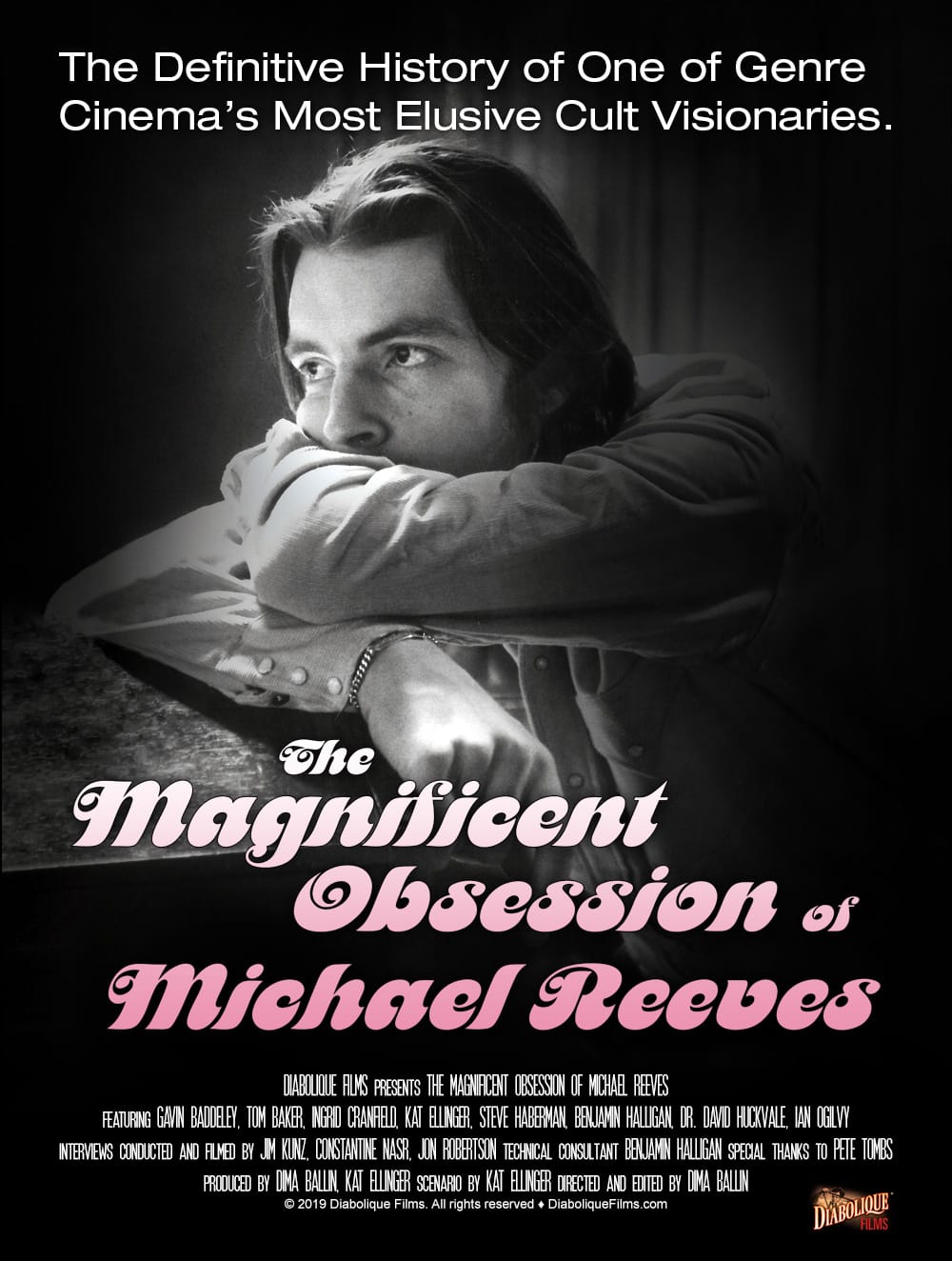
Review: THE MAGNIFICENT OBSESSION OF MICHAEL REEVES (2019)


Premiering this past weekend at FrightFest in the UK was THE MAGNIFICENT OBSESSION OF MICHAEL REEVES, the first stand-alone documentary feature produced by Diabolique Films, under the direction of DIABOLIQUE publisher Dima Ballin. Ballin previously collaborated with his co-producer, DIABOLIQUE editor Kat Ellinger, on some similarly ambitious documentary extras included on the German Blu-ray releases of Hammer's DRACULA HAS RISEN FROM THE GRAVE and TASTE THE BLOOD OF DRACULA; this new work is their first to focus on the entire career of an individual filmmaker within a feature-length (86m) framework.

Two particular challenges arise from making director Michael Reeves (1943-1969) the subject of such a film: his legacy really consists of only three completed films - THE SHE BEAST (1966), THE SORCERERS (1967), and WITCHFINDER GENERAL (aka THE CONQUEROR WORM, 1968), each wildly unlike the others in terms of competence and technique; and this modest, irregular output demands assessment through the lens of Reeves' most likely accidental death at the age of only 25. CINEFANTASTIQUE once called him "The James Dean of Horror," but it might be fairer to call him Horror's Christopher Marlowe. His filmography dies screaming. It's impossible to watch his three films, each one representing a leap in quality, without reflecting on his loss, his potential, and feeling so bereft of unmade work that we start looking at the completed work for more than actually resides there.

Wretchedly shot in 16mm, with second unit comedy relief material shot by Corman cohorts Charles B. Griffith and Mel Welles, THE SHE BEAST anticipates WITCHFINDER GENERAL with a savage witch-dunking sequence but doesn't offer a great deal else. It stars Barbara Steele, who was hired for one day and worked all twenty-four hours of it. The underrated THE SORCERERS (paid special attention here, rightly so) is one of the genre's earliest meta-scenarios but may well owe its complex substance to screenwriter John Burke, not to mention the fine performances of Boris Karloff and Catherine Lacey. WITCHFINDER GENERAL is a legitimate masterpiece, though realistically a minor one, which few people point out was not the film Reeves envisioned; it was cast against his wishes and he fought on set with its star Vincent Price every single day. People credit him rather than Price with the performance the actor finally gave, but it's really nothing that Price hadn't previously done in Roger Corman's THE HAUNTED PALACE. If there's one thing we know about Michael Reeves as a director, from on-set testimony, it's that he had no idea how to direct actors toward a preconceived performance. Make no mistake, it's remarkable that anyone could die at 25 having already made three internationally distributed features, but it's the film he made in spite of his vision that makes the whole of his achievement seem almost preternaturally significant; the films he didn't make that make those he did rise in stature.

The lionizing of Reeves began with a remarkable chapter in David Pirie's landmark study A HERITAGE OF HORROR: THE ENGLISH GOTHIC CINEMA 1946-1972, continued with a well-researched CINEFANTASTIQUE cover story by the late Bill Kelley, and continued with two substantial biographies written by John B. Murphy and Benjamin Halligan, respectively. In contrast to these painstaking literary studies, this well-organized assortment of interviews with various colleagues and genre commentators is not exactly the "definitive history" promised; it recovers (and to some effect, refreshes) the ground these others first ploughed. There is no faulting the contributors, who include personal friends and collaborators Ian Ogilvy, Tom Baker, and Ingrid Cranfield, biographer Ben Halligan, and genre authorities Kat Ellinger, Steve Haberman, David Huckvale, and Gavin Baddely, but there is an impersonal feeling about the whole suggesting that its own vision was shaped by the content of its interviews, rather than vice versa. In other words, while it's technically a documentary, it's ultimately more of an appreciation composed of archival photos, film clips, and a neat set of bracing, upbeat and sometimes wistful insights and annotations. It's the kind of smart, illustrated programming one would wish for as the prime extra in a Reeves box set. In the days when magazines ruled, we called these in-depth articles.

The ideal audience for THE MAGNIFICENT OBSESSION OF MICHAEL REEVES would be those viewers who have seen one or two of his films and want to know more about who made them. A younger viewership seems specifically entreated, in that there's a concerted effort toward the end to give Reeves some contemporary relevance by identifying WITCHFINDER GENERAL as a forerunner of "folk horror." This is a stretch. Set in the 17th Century, it has a rural setting but its implied machinations extend to the most civilized seats of power extant at that time; in its way, it's really no more "folk" than ALL THE PRESIDENT'S MEN. Like Ken Russell's THE DEVILS, WITCHFINDER's greatest horror is that it's based on actual historical accounts and shows us in chilling detail the extremes of which ambition, whether political or sexual, is capable. At the time it was made, it was clearly seen as a film addressing its own times, when Church and State were becoming more brazen in collusion, and rich old men were packing young men off to die in a war whose ultimate purpose was unknown to them. 

Perhaps because his premature death was initially reported as a likely suicide (subsequently discounted), Reeves has endured as precisely the kind of brooding Romantic figure that we see on the poster above. Though this film omits some personal detail best left to the books, Ballin's film is to be commended for establishing a more practical, less romanticized reading of Reeves' troubled character (he seems to have had all the advantages and fragilities of a wealthy background) and his personal investment in the horror genre. There is a consensus of opinion here that - had Reeves lived - he probably would have abandoned the horror genre to embrace the kind of big action movies that were made by his mentor, Don Siegel. Who knows? Given a few more years, Reeves' magnificent obsession might have been to direct MAGNUM FORCE.

(c) 2019 by Tim Lucas. All rights reserved.  


Saturday, August 03, 2019

50 years Ago: THE LOST CONTINENT (1968)


50 years ago today, I spent the afternoon in the welcoming dark of my beloved Plaza Theater with one of my all-time favorite Saturday matinee experiences - so good, I went back the next day to enjoy a double dip! Meanwhile, across town at the 20th Century, it seems that attendance was disappointing for arthouse Poe, and a switch of program was already in the cards after only three days of play. Philistines!


I was so thoroughly entertained by THE LOST CONTINENT that, after that second viewing, I worked up the courage to ask the theater's manager if I could buy, or perhaps have, the poster for the film when they were done playing it. (As I recall, the poster for PLANET OF THE APES was already spoken for.) He kindly let me have it for the princely sum of 75 cents, and, when I was 13, this one-sheet was displayed for awhile on the wall of my room. Everywhere I have moved since then, it has come along with me but it has spent most if not all that time folded and in storage. Realizing that it's actually been 50 years today since my first encounter with this underrated Hammer production - and that I still own this artifact from the theater where I saw it (and most of the films I saw through my early teens) - I couldn't resist showing it the respect it deserves by popping it into a frame - an enduring tactile connection to a memory and place from half a century ago.


(c) 2019 by Tim Lucas. All rights reserved. 


Wednesday, July 24, 2019

Discovering Akio Jissôji


I want to thank my friend Jean Guerin for bringing my attention to Episode 38 of ULTRAMAN DYNA, directed by the remarkable Akio Jissôji. Jean had previously brought to my attention the fact that Jissôji had directed the 22nd episode of the original ULTRAMAN series, employing a somewhat jarringly unusual visual style influenced by the works of Jean-Luc Godard. It was yet another of the six episodes of the series that Jissôji directed that Hayata reached for his Beta capsule and pulled a spoon from his pocket instead - a surreal joke that reportedly worried the show's producers but went on to become a favorite moment with fans.

I had never before seen an episode of ULTRAMAN DYNA, which ran in 1997. I tend to find it difficult connecting with the later ULTRAMAN series, particularly those shot digitally, because they are somehow too clean, too transparent, too antiseptic to feel filmic. That said, I recommend that everyone watch this episode, because - despite its digital origins - it’s one of the trippiest, most cinematic experiences I’ve had in a long time.


Akio Jissôji and friend.
In addition to the 22nd episode of ULTRAMAN, Jissoji also directed four episodes of ULTRA SEVEN in 1967-68, and one episode of ULTRAMAN DYNA's direct predecessor, ULTRAMAN TIGA. Before you watch, think of the basic requirements of any ULTRAMAN series episode, and then marvel to how much more Jissôji imports: Pirandello-like musings on reality and fantasy, Biblical imagery, theatricality, alchemy, flashing reflective surfaces, Kaspar Hauser, sex dolls; he even resorts to imparting information through bending, refracted imagery and somehow makes it work. It’s blatantly experimental work in an arena that wouldn’t seem to permit this - and yet it absolutely succeeds in telling a highly concentrated story that would make even Philip K. Dick bust his buttons with pride. Mark my words and check this out.

I see from his IMDb listing that Jissôji also directed the Edogawa Rampo adaptation THE WATCHER IN THE ATTIC (1993) and also a segment of the anthology feature RAMPO NOIR in 2005, the year before his death at age 69. As coincidence would have it, next month Arrow Video will be releasing a box set of Akio Jissoji's THE BUDDHIST TRILOGY. Definitely a filmmaker worth studying more closely.


(c) 2019 by Tim Lucas. All rights reserved.

Sunday, July 21, 2019

RIP Greg Shoemaker (1947-2019)

I'm very sorry to learn of the passing, two days ago, of Greg Shoemaker - a fellow Ohioan and, for 17 years and forever more by reputation, the editor-publisher of THE JAPANESE FANTASY FILM JOURNAL. Launched in 1968 with an issue devoted to Ishiro Honda's GODZILLA (1954), it was the first English language magazine to seriously document the fantasy films of Toho, Daiei, and other Japanese studios. It also had an initial print-run of only 25 copies, which I did not know when I read an enthusiastic mention in the pages of CASTLE OF FRANKENSTEIN. It was the first horror-related fanzine I ever sent away for and received in the mail.


I was surprised to find inside the envelope a hand-written letter of apology from Greg, informing me that #1 had sold out (I imagined a warehouse suddenly emptied of boxes by popular demand!) and that he was sending me the latest issue in its stead. It was JFFJ #4, featuring the second half of their FRANKENSTEIN CONQUERS THE WORLD coverage. It was printed on white paper, mimeographed with a photo-offset cover. I was initially disappointed (you try reading the second half of an article and imagining what came before!) but, in the days and weeks that followed, I devoured that issue again and again. 


I was one who preferred to exchange my money for items acquired on the spot, so for years, JFFJ #4 was the only issue I would ever see. I've been able to collect the last several issues, when the once-ditto-pressed, hand-stapled mailing had evolved into a handsome offset publication, well-written and -illustrated with a reported circulation of 1,000. It ceased publication in 1985, and I sorely wish I'd supported it all along.


It is hard to express what its example meant to me: it was the first time I'd seen Japanese fantasy films written about without derision, and it also presented me with a very early pre-CINEFANTASTIQUE glimpse of what might be possible to do with my own life. I wish the issues missing from my collection were easier to come by. Individual copies occasionally turn up on eBay with starting bids that are both so much higher than they should be, yet indicative of how cherished they are by the kogunosenti.

(c) 2019 by Tim Lucas. All rights reserved. 

Tuesday, July 16, 2019

THE PERFECTION (2018): A Considered Response

Logan Browning and Allison Williams as the lovers and competitors of Richard Shepard's THE PERFECTION.
THE PERFECTION (Netflix) is a beautifully designed and shot film for the most part, one that builds to a nicely kinky tableau that is half ingenious and half absurd and thus lingers in the memory; unfortunately, its scenic pluses made me all the more upset with its coarse, overplayed minuses. Its narrative rewind gimmick reminds us twice that we’re just watching a movie, while also indirectly telling us that what we see on the first pass isn't the whole story, hence can’t be trusted at face value. The gimmick also detracts from what could have been a more genuinely clever arrangement of the narrative with simple fades to an earlier moment. It begins so well and goes so wrong, even giving us some glimpses of the movie it might have been. 

I think Michael Reeves and George Romero would agree with me on this: if you’re going to make a horror film to take a serious, defiant, political stand about something (say, rich white men and child abuse), do your audience a favor and find a metaphor. Furthermore, never make your heroes dubious (much less crazy and borderline evil from the get-go); if you must villainize something, make it something bad rather than something admirable like education and achievement; and finally - if blood must have blood - never leave your audience chuckling smugly. 

(c) 2019 by Tim Lucas. All rights reserved.
Thursday, July 11, 2019

Sleeper Alert: THE LIGHT AT THE EDGE OF THE WORLD (1971)

Kirk Douglas as the embittered, withdrawn hero, William Denton.


Last night, I made a spontaneous decision to go back and check out LIGHT AT THE EDGE OF THE WORLD, an early (1971) Alexander and Ilya Salkind production made in concert with Kirk Douglas' company Bryna Productions. It's based on Jules Verne's THE LIGHTHOUSE AT THE END OF THE WORLD, one of Verne's last novels, one of his few to be written in the 20th century, when he was recovering from an attempt on his life by a family member and in his most cynical and disillusioned state of mind. To find Verne's name emblazoned on the advertising for any post-1960s film is usually shorthand for cheesy family entertainment - but, suffice to say, LIGHT is anything but.

If anything, it's a counterpart to the savage streak found in other contemporary releases, ranging from Cy Endfield's SANDS OF THE KALAHARI (1965) and Elliot Silverstein's A MAN CALLED HORSE (1970) to Sam Peckinpah's STRAW DOGS (1971), while also anticipating the even greater extremes of Umberto Lenzi's THE MAN FROM DEEP RIVER (1972) and other Italian adventure films to follow. To condense a gratifyingly intense and complex response, it was nothing like what I expected. 

The film opens very slowly - indeed, I would have to say it feels juvenile and borderline asinine for its first 10-15 minutes, with that stale sense of remove one feels with some cheaply post-produced international co-productions. I was actually on the point of reconsidering my decision to watch when the film suddenly bit down hard, refusing to let up for the remainder of the sometimes hallucinatory, often harrowing adventure.


Douglas (and monkey companion Mario) sights unwelcome visitors. 
In short, it’s a film about a man named William Denton (Douglas) who has retreated from life due to a broken heart, who has retired to an isolated island to serve as an assistant lighthouse keeper with two other men, one of them a retired sea captain played by Fernando Rey, speaking English in his own voice for a change. His idyllic, monastic evasion of life is then suddenly challenged by the arrival of a ship of pirates, led by the serenely imperious Captain Jonathan Kongre (an implacable Yul Brynner, whose birthday it is today). His band of raucous cut-throats (including future Jess Franco repertory players Aldo Sambrell, Luis Barboo, and Tony Skios, Jean-Claude Druout as a flamboyantly decadent gay member, and Victor Israel to boot!) cruelly overtake the island, which Kongre intends to use as an ideally placed base from which to misguide, wreck, and plunder other ships.


Douglas makes the acquaintance of his island captor.
To say more would ruin the surprise of the often horrific shifts that take place in the narrative. Suffice to say, this is a sometimes shockingly perverse and Sadean adventure, that includes one moment of CANNIBAL HOLOCAUST intensity that I presume was faked but does not play that way - and is one of several reasons why this film should be kept away from children. I've learned that Verne himself did not shy away from animal violence in his novels of survival, and also that his reputation as a writer for all ages was largely rooted in the often barbarically reductive translations of his work - so the content of this film may well be a plausible adaptation of his original novel - for a long time available here only in a more child-friendly version revised by Verne's son, Michel. 


Yul Brynner with Samantha Eggar.
Much like Burt Lancaster in THE TRAIN, this film presents a 50-something Douglas in most impressive physical condition, doing many of his own stunts in a highly physical performance shot entirely on location. The film finds its dramatic crux when the wreckers overtake a ship whose unfortunate passengers include a lookalike for Will's lost love (Samantha Eggar), a subplot that - rather admirably - plays out in a manner quite opposite to what we may expect, further confirming the hero’s disillusionment with mankind. The flashbacks to this backstory stylistically evoke the similar structure of Sergio Leone’s FOR A FEW DOLLARS MORE (1965), and director Kevin Billington's handling of the picture - photographed by Henri Decaë (PURPLE NOON), with second unit special effects photography by Cecilia Paniagua (LISA AND THE DEVIL) - evokes Leone more than once. The score by the usually reliable Piero Piccioni is frankly uninspired, not one of his best.


Original US half-sheet.
All in all, though admittedly erratic and downbeat, THE LIGHT AT THE EDGE OF THE WORLD is a nonetheless strangely rousing and uneasily shaken adventure, worthy of rediscovery. I understand this film's current US DVD release is quite poor in quality and a must to avoid; alternately, there is a region-free Spanish DVD import with optional English audio with 2.1 stereo sound which Amazon user comments seem to think is quite good, though it's reportedly missing a few seconds involving a vicious stunt overturning a horse. Clearly, a definitive Blu-ray edition is much needed.

In related news, please be aware that Walt Disney has finally just issued their classic 1954 film of Verne's 20,000 LEAGUES UNDER THE SEA, starring Kirk Douglas, on Blu-ray. Though it's Disney Movie Club exclusive, it is also available from various eBay sellers for those with aversions to membership.

(c) 2019 by Tim Lucas. All rights reserved. 

Wednesday, July 10, 2019

20 Years, 100 Commentaries

What I've assembled here is a newly updated list of my audio commentary work, numbered for the first time. It's been awhile since I've amended the list originally posted here; in fact, as I started working on this post, I thought I'd be using it to announce the fact that I was now working on my 100th commentary assignment - but as I looked the list over more carefully, I realized that I'd failed to number one of the titles, so my count was off! I'm presently at work on my 101st and missed my opportunity to celebrate! 

The order presented is more or less in the order I recorded them, but I can't promise the ordering is absolutely true. It's certainly truer with the most recent releases, but some earlier ones were dragged from the year they were recorded to that in which they were released. I've numbered each commentary except for those listings that denote reissues of earlier commentaries; there may be some international reissues of which I'm unaware. I have also highlighted the various awards and recognitions that various of the commentaries have received or been part of.

Please note this list includes titles due for imminent release, and a few that have been done but - for various reasons I can't explain - are presently "on hold." If there are any DVD or Blu-ray releases from regions around the world that you know of, which are not listed here, please drop me a line at tim@videowatchdog.com. 

I'd like to thank my principal employers - Bret Wood and Frank Tarzi of Kino Lorber, and Francesco Simeoni of Arrow Video and his team of ace disc producers (James Blackford, Michael Mackenzie, Ewan Cant, and Anthony Nield) - for their ongoing custom and encouragement, and also my late and much-missed friend Michael Lennick, who - twenty years ago, in the late summer of 1999 - recorded my first two commentaries up in Bala, Ontario, thereby setting me on the path to a side-career at which he would have excelled himself. 

Here's a guide to my first 100 titles. Thanks for your good words of encouragement.  

1999

1. Black Sunday, Image Entertainment 
2. Kill, Baby... Kill!, Image Entertainment (unreleased)

2000

3. Blood and Black Lace, VCI Entertainment (reissued 2005)
4. The Whip and the Body, VCI Entertainment, Kino Lorber (2014)

2005

5. Danger: Diabolik, Paramount DVD - with John Phillip Law
6. Monster Kid Home Movies, "The Gentle Old Madman" - with Tom Abrams, PPS Productions

2007


7. Kill, Baby... Kill!, Dark Sky Films (2007, withdrawn)
8. The Girl Who Knew Too Much, Anchor Bay Entertainment
9. Black Sabbath (international version), Anchor Bay Entertainment
10. Knives of the Avenger, Anchor Bay Entertainment
11. Rabid Dogs, Lucertola Media (Germany)
12. Black Sunday, Anchor Bay Entertainment

2008

13. Baron Blood, Anchor Bay Entertainment
14. Lisa and the Devil, Anchor Bay Entertainment
15. Bay of Blood, Anchor Bay Entertainment
16. Erik the Conqueror, Anchor Bay Entertainment - with excerpts from Cameron Mitchell interview

2009

17. Thriller: The Grim Reaper, Image Entertainment (with David J. Schow and Ernest Dickerson)
18. Thriller: The Premature Burial, Image Entertainment (with David J. Schow and Ernest Dickerson)

2012

Bay of Blood, Arrow Video (UK)
19. Das Geheimnis des Doktor Z (The Diabolical Dr. Z), Subkultur Entertainment (Germany)
20. Hatchet For The Honeymoon, Kino Lorber

2013

Black Sunday, Kino Lorber, Arrow Video (UK)
21. Five Dolls for an August Moon, Kino Lorber
22. The Awful Dr. Orlof, Redemption
23. Nightmares Come At Night, Redemption
24. A Virgin Among the Living Dead, Redemption
Baron Blood, Arrow Video (UK)
Lisa and the Devil, Arrow Video (UK)
Black Sabbath (international version), Anchor Bay Entertainment
Black Sabbath (international version), Arrow Video (UK)

2014


25. The Girl Who Knew Too Much, Arrow Films (UK)
Rabid Dogs, Anchor Bay Entertainment
Rabid Dogs, Arrow Video (UK)
26. Trans-Europ-Express, BFI (UK) - 26 - 30 are collected in the BFI box set ALAIN ROBBE-GRILLET: SIX FILMS 1963-1974
27. L’Immortelle, BFI (UK)
28. The Man Who Lies, BFI (UK)
29. Eden And After, BFI (UK)
30. Successive Slidings of Pleasure, BFI (UK)
31. Pit and the Pendulum, Arrow Video (UK)
32. Dr. Phibes Rises Again, Arrow Video (UK)
33. The Whip and the Body, Odeon Entertainment (UK - new revised recording)
34. Planet of the Vampires, Kino/Scorpion Releasing 

2015 

35. Tales of Terror, Kino Lorber 36. Blood and Black Lace, Arrow Video (new revised recording)
37. Evil Eye with The Girl Who Knew Too Much, Kino Lorber - 2007 commentary with new added material
38. X - The Man with X-Ray Eyes, Kino Lorber (includes trailer commentary as Easter Egg)
39. The Erotic Rites of Frankenstein, Redemption
40. Videodrome, Arrow Video (UK)
41. Eyes Without a Face, BFI (UK)
42. Black Sabbath (AIP version), Kino Lorber - different to the 2013 International Cut commentary 

2016

44. Valentino, Kino Lorber (US), BFI (UK) - minor editing differences between the two
45. Journey to the Seventh Planet, Kino Lorber
46. Death Walks On High Heels, Arrow Video (in the Death Walks Twice box set)
47. Death Walks At Midnight, Arrow Video (in the Death Walks Twice box set)
A Maldiçao do Demônio/Black Sunday, Versatíl (Brasil)
48. Blood Bath (Arrow Video), "The Trouble With Titian - Revisited" audio essay
49. Daughter of Dracula, Redemption
50. Destiny, Kino Classics
51. Dr. Orloff's Monster, Redemption
52. The Skull, Kino Lorber
53. One Million Years B.C., Kino Lorber

2017  

54. Lifeboat, Kino Lorber - Winner of the 2018 Saturn Award for Best Classic DVD/BD Release
55. Caltiki the Immortal Monster, Arrow Video
Baron Blood, Koch Media (Germany)
Lisa und der Teufel, Koch Media (Germany)
Die drei Gesichter der Furcht/Black Sabbath, Koch Media (Germany)
56. Der Mude Tod / Destiny, Eureka!/Masters of Cinema (UK) - a re-recording of 2016 Destiny commentary with minor alterations in content
57. Compulsion, Kino Lorber
58. Die Toten Augen des Dr. Dracula / Kill, Baby... Kill!, Koch Media (Germany) - new revised commentary
59. Erik the Conqueror, Arrow Video - new revised commentary 
60. Kill, Baby... Kill!, Kino Lorber - new revised commentary
Kill, Baby... Kill!, Arrow Video UK - new revised commentary
61. Vibrations (Film Movement) 
62. The Good, the Bad and the Ugly (Kino Lorber Studio Classics)
63. Sin In The Suburbs (Film Movement)
64. Confessions of a Young American Housewife (Film Movement)
65. Moonlighting Wives (Film Movement, on hold)
66. The Witches / Le Streghe (1967; Arrow Academy)
67. Roy Colt & Winchester Jack (Kino Lorber)
68. The Incredible Shrinking Man (Arrow Video)
69. The Outer Limits, Season 1: "The Production and Decay of Strange Particles" (Kino Lorber)

2018

70. The Diabolical Dr. Z  (Redemption/Kino Lorber (re-edited version of 2012 commentary) 
71. The Outer Limits, Season 1: "The Invisibles" (Kino Lorber) - Both OUTER LIMITS SEASON 1 and 2 were Winner of the 2018 Rondo Award for Best DVD Extras
72. The Outer Limits, Season 1: "The Forms of Things Unknown" (Kino Lorber)
73. The Outer Limits, Season 1: "The Zanti Misfits" (Kino Lorber)
74. The Outer Limits, Season 1: "The Bellero Shield" (Kino Lorber)
75. The Outer Limits, Season 1: "ZZZZZ" (Kino Lorber)
76. Neurosis/Revenge in the House of Usher (Kino Lorber, on hold)
77. A Fistful of Dollars (Kino Lorber)
78. Death Smiles on a Murderer (Arrow)
79. Jack the Giant Killer (Kino Lorber)
80. "2" - I, A Woman Part II (Film Movement)
81. The Outer Limits, Season 2: "The Duplicate Man" (Kino Lorber)
82. The Outer Limits, Season 2: "The Premonition" (Kino Lorber)
83. The Night Stalker (Kino Lorber) Winner of the 2018 Rondo Award for Best Audio Commentary
84. The Night Strangler (Kino Lorber)

2019

85. Four Times That Night (Kino Lorber)
86. Vampire gegen Herakles/Hercules in the Haunted World (Koch Media - Germany)
87. Knives of the Avenger (Kino Lorber) - new revised recording with excerpts from Cameron Mitchell interview
88. For A Few Dollars More (Kino Lorber)
89. Scream and Scream Again (Kino Lorber)
90. The Beast with a Million Eyes (Scorpion Releasing, on hold)
91. The Possessed (Arrow Video) Winner of 2019 Il Cinema Ritravato DVD Award for Best DVD Extras
92. Whirlpool (Arrow Video - BLOOD HUNGER: THE FILMS OF JOSE LARRAZ box set)
93. Dead of Night (1946; Kino Lorber)
94. Double Face (Arrow Video)
95. Fantomas (1964, Kino Lorber) 
96. Attack of the Robots (Redemption/Kino Lorber)
97. Lost Highway (Kino Lorber, withdrawn) Go to https://videowatchdog.blogspot.com/2019/07/hear-my-lost-lost-highway-audio.html for link to free commentary
98. Alphaville (Kino Lorber, forthcoming)
99. Last Year at Marienbad (Kino Lorber, forthcoming)
100. Blackmail (1929 sound version, Kino Lorber, forthcoming)

(c) 2019 by Tim Lucas. All rights reserved.

Monday, July 01, 2019

Hear My Lost LOST HIGHWAY Audio Commentary

Last Tuesday, June 25th, Kino Lorber released David Lynch's LOST HIGHWAY (1997) on Blu-ray. For some reason, the disc is proving hard to find on Amazon, but you can use this link to order directly from the Kino Lorber website where the disc is currently on sale at substantial savings. 

I'm very happy to report that - despite David Lynch's forewarnings of a release that did not meet his standards - early reviews of the disc have been extremely enthusiastic, with Gary Tooze of DVD Beaver calling it "the definitive edition" of the film, and Dr. Svet Atanasov of Blu-ray.com noting that "the technical presentation is vastly superior" to prior releases both here and abroad. Dr. Atanasov also notes, "Most unfortunately, there are no supplemental features to be found on this release."

As you may have heard, or read here previously, supplementary materials had originally been planned for this release. I recorded a feature-length audio commentary that - along with some other materials - had to be scrapped at the last minute, owing to discovered contractual agreements made between Universal and Mr. Lynch that forbade any such supplementation.

Since the rights to my work have reverted to me, and since my time and effort have been remunerated, I've decided to make the unused track freely available as an mp3 download, which can be synched up to the Kino Lorber disc by anyone who may be interested.  

Here is a link (right click, download linked file) to a zip file of my commentary, as well as a separate text file with some background and instructions. 

Enjoy.

(c) 2019 by Tim Lucas. All rights reserved.

Wednesday, June 26, 2019

RIP Édith Scob (1937 - 2019)


Farewell to "Our Lady of the Fantastique" - the sublime Édith Scob (b. Édith Vladimirovna Scobeltzine), who has left this world at age 81. More than any other actress, she epitomized for me the essence of the Uncanny onscreen. She is the very avatar of what my own writing about the fantastic cinema has always sought to celebrate. 

Unforgettable in the works of Georges Franju, including HEAD AGAINST THE WALL, EYES WITHOUT A FACE (her signature role), JUDEX and THÉRÈSE DESQUEYROUX, as well as Luís Buñuel’s THE MILKY WAY, Christophe Gans’ BROTHERHOOD OF THE WOLF, Pitof’s VIDOCQ, and most recently, Leos Carax’s THE LOVERS ON THE BRIDGE and HOLY MOTORS. If a filmmaker needed a figure of enchantment, they went to her - but she could be much more than the characters who, as she said, walked with their feet somewhat above the ground. She also took fierce pride in playing strong, capable, down-to-earth women, as she did in Patrice Leconte’s MAN ON THE TRAIN, Andrzej ZuÅ‚awski’s FIDELITY, and Olivier Assayas’ SUMMER HOURS. Her filmography amounts to nearly 120 titles in film and television and she also had grand successes onstage.

Most preciously to me, she became a friend and intermittent pen pal after I conducted her longest-ever print interview for VIDEO WATCHDOG #107 with the help of my long distance friend and colleague, Frédéric Albert Levy. Here is a look back at the cover of that issue (featuring Charlie Largent's splendid cover art) and the essay I wrote to introduce her interview, on my short list of the top achievements from our 27-year publishing history.


Édith told me that she loved my introductory essay and invited me to visit her at her home, should I ever find myself in her part of the world. My deepest condolences to her husband, the composer Georges Aperghis, their children, and the grandchildren she so adored.

RIP Milady. 

(c) 2019 by Tim Lucas. All rights reserved.
VIDEO WATCHDOG 107 scans (c) 2004 by Tim and Donna Lucas.

Sunday, June 23, 2019

The Often Missing Face of the Three Faces of Fear

French poster for Mario Bava's I TRE VOLTI DELLA PAURA (1963), art by Boris Grinsson.
My ongoing studies of the TV and Movies pages of THE CINCINNATI ENQUIRER from 50 years ago brought to my attention that it was 50 years ago, this weekend, that I saw my first Mario Bava film on local television: BLACK SABBATH, aired on SCREAM-IN, WXIX-TV, Channel 19 on June 21, 1969. Though I didn't recognize it as such at the time, it was obviously a turning point in my life - the first of many that would take place in my 13th year.


US half-sheet.

US insert poster.
Something that has always perplexed me about this film - originally made as I TRE VOLTI DELLA PAURA ("The Three Faces of Fear") - is that, though Boris Karloff is the dominant figure of the film, in which he appears as both host and lead player, he almost never figured in the film's advertising world-wide. This is true for the original Italian release posters, including the set of fotobusta half-sheets generated for the film, in which I believe Karloff is pictured on only one sheet in the set, and even then obliquely. Here in the States, American International Pictures opted to focus on the misleading image of a decapitated horseman galloping along with (one assumes) his own severed head clutched in a free hand, frightening a bevy of voluptuous young women. AIP reserved Karloff's likeness for their insert poster, which focused on the (green) severed head of Karloff's "Wurdalak" character Gorka being lifted by a victorious fist. No such scene occurs in the picture, but there you have it. This image was also adapted to the UK's dayglo quad poster, which deprived the original art of its original impressive complexion.
Italian manifesto art.
All this would later change when I TRE VOLTI DELLA PAURA was reissued in Italy - Karloff is pictured as one of three component images on the poster dating from this period, and it's on a reissue fotobusta that we finally see the now-famous image of Gorka riding on horseback with his grandson Ivan in his arms. 


UK dayglo quad poster.


Italian reissue fotobusta.

Spanish poster art.
Likewise, there exists a Spanish poster for LAS TRES CARAS DEL MIEDO that pictures Karloff (not to mention a fanged woman who never appears), but it dates from a much-later reissue.

Boris Karloff - then, as now, widely recognized as the King of this particular genre - is unquestionably the dominant figure in BLACK SABBATH, hosting the three-segment anthology in a manner established by his earlier hosting of the popular NBC-TV series THRILLER, not to mention the other portmanteau series THE VEIL, OUT OF THIS WORLD, and COLONEL MARCH OF SCOTLAND YARD. Part of Karloff's exclusion from the film's international advertising can be explained by the fact that he represented the film's co-production arrangement with American International; it was also produced by Galatea of Rome and Lyre of Paris, who preferred to publicize their homegrown stars in the film's advertising. 

This consideration is most beautifully expressed in Boris Grinsson's French poster art for LES TROIS VISAGES DE LA PEUR, which shows us the faces of  Jacqueline Pierreux and Susy Andersen adorning that of the centrally placed Michèle Mercier, with all three faces encircled by a pair of menacing male hands. The hands might be Gorka's, or those of the threatening caller Frank in the "Telephone" segment, and Grinsson also takes care to incorporate the key source of unease in the film's most celebrated story, "The Drop of Water." As I noted in my book MARIO BAVA ALL THE COLORS OF THE DARK, it was Bava's intention with this film to document fear as it existed in three different periods of history and it seems to me that the French poster is the only one of the many generated by this film to honor that intention.

(c) 2019 by Tim Lucas. All rights reserved.