Thursday, November 10, 2022

Arrow's GOTHIC FANTASTICO #3: THE THIRD EYE (1965)

THE THIRD EYE
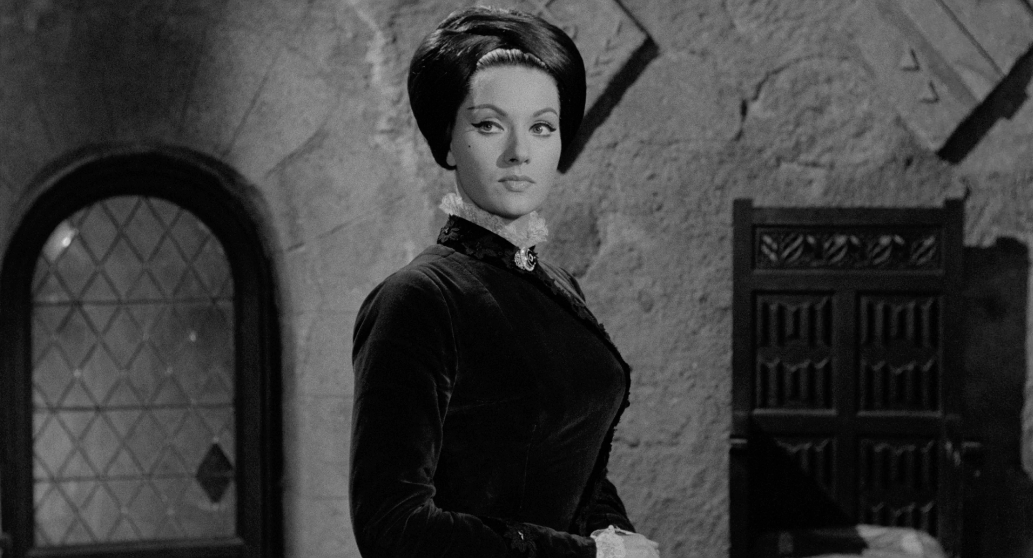
is yet another important Italian Gothic that somehow eluded international release and recognition till the last 15-20 years, at which time unsubtitled copies from an Italian TV broadcast began to appear on the US trading circuit. Even in Italy, the Mirko Guerrini film ("diretto di James Warren") had experienced a somewhat delayed impact. It was actually shot in 1965 and represented the first lead performances by theretofore supporting players Franco Nero and Erika Blanc; however, it was an usually candid film for 1965, a true turning point in the genre, and was found objectionable by the Italian censors and suppressed until certain cuts were made. Though the film has never been fully restored to its pre-release form, it remains a shocking picture for its time. 

Produced by Luigi Carpentieri and Ermanno Donati (who financed the first Italian horror film, 1957’s I Vampiri aka THE DEVIL’S COMMANDMENT), and given a second-hand musical score by Francesco de Masi (lifted from the partnership’s other production THE GHOST, which adds to its dark obsessive undercurrent), the story concerns the domestic problems of Count Mino Alberti (Nero, acting as "Frank Nero"), a handsome taxidermy buff whose engagement to Laura (Blanc, acting as "Diana Sullivan") is overcast by his morbid Oedipal attachment to his mother (Olga Solbelli, acting as "Olga Sunbeauty"), who finds the beautiful blonde unworthy of a man of his station.


Station is also an all- consuming issue with the household maid Marta (Gioia Pascal) who is also biased against Laura as an obstacle to her dreams of marrying Mino herself and earning a place in the family she has served since childhood. Marta sabotages Laura’s sportscar (her cutting of the cables cleverly intercut with Mino’s tearing a large bird open manually) leading to the drowning death of Mino’s fiancee before his eyes, a trauma compounded in parallel by the death of his mother after a private showdown with Marta. Mino becomes unhinged and begins to act out his psychosis, which involves luring strippers and prostitutes back to the family villa to be seduced in a double bed whose veiled neighboring mattress holds the corpse of Laura, necessary to inspire him sexually. (His revelation of the corpse beside them is reserved for the right psychological moment, as with the mirror attachment of Karl Boehm's mirrored camera attachment in Michael Powell's PEEPING TOM, 1960). Marta assists his murders and their clean-up in exchange for the power of position, but Mino's promise to marry her is forgotten at once when Laura’s lookalike younger sister Daniella (also Blanc) arrives at the villa.


If the scenario (written by Carpentieri under the name of 15th century serial killer Gilles de Rey) sounds familiar, this is because Joe D’Amato later remade it as BEYOND THE DARKNESS (Buio omega, 1980), one of the most gruesome and flagrantly sexual Italian horror films of the 1980s. In this earlier incarnation, which omits any graphic representation of the acid baths awaiting Mino’s cold conquests, the black-and-white film is still startling for its violent and erotic candor; it would never have been considered by a US distributor at the time because it’s in no way suitable for children. It's also the most pronounced of the four features in this collection as an elegant segue from classic Italian Gothic into contemporary, bloodletting horror.


While Guerrini’s direction of suspense sequences is appropriately baiting and alluring, sometimes recalling the best of Hitchcock, he is less attentive to character development. If we watch the film in English, the characters (each of whom takes center stage as a protagonist at some point) parade their shallow make-up all the more. Laura, who should be the film’s heart, isn’t part of the film long enough for us to know her, nor is her replacement Daniella cultivated in any sort of personable way, which prevents us from feeling any empathy for them or for Mino’s trauma or psychosis. Nero’s performance has its moments and works best in Italian but in the third act, as he flees the villa with Daniella in tow, his rantings sail way over-the-top and become ludicrous, especially in English. In an interesting thwarting of expectation, cinematographer Alessandro D’Eva (working as "Sandy Deaves") strives to make the film terrifying in settings of broad daylight, without the usual emphasis on eerie shadows, and this too seems part of the film’s decisive move outside the traditional realm of Italian Gothic. In addition to a single startling split diopter shot, the climactic image of the police flashlights spilling over the hillside and tumbling down the beachfront like so many fireflies is particularly impressive.


When I first saw THE THIRD EYE many years ago, in Italian without subtitles, I was startled by how far it went, how much it prophesied Italian Gothic's future propensities for shock and eroticism, which became so much more pronounced in its silver and bronze ages. Alas, as time has passed, and as the film itself has acquired subtitles and revealed all its narrative meaning, I find that its initial shocks have dimmed slightly while its camp value has become much more obvious. This aspect resides mostly in Nero's performance which, while silly and laughably demented at times, also has a few boldly iconic moments—such as his bold advance toward nightclub dancer Marina Morgan, whose eyes are as accentuated by makeup as his are naturally. His character has obvious antecedents in Mark Lewis (PEEPING TOM), Norman Bates (Anthony Perkins, PSYCHO) and Charles Campbell (Grant Williams, THE COUCH), but if we look at the similar characters that would follow in Italian and especially the Spanish Gothic for the next 20-30 years, like John Harrington (Stephen Forsyth, HATCHET FOR THE HONEYMOON) or Juan (Renaud Varley, A BELL FROM HELL), it is Nero's performance the later roles most seem to invoke. 


Rachael Nisbet has recorded a very useful commentary for the film, which puts all the contributors into their proper context and speaks persuasively about the film's qualities while acknowledging its few detriments - which include its title, Mino's subjective description of his own experience of his ritual murder sprees, which she admits is poorly developed. (The film would have done well to stick with its original title, THE COLD KISS OF DEATH.) Lindsay Hallam provides the film's visual essay, "Necrophilia Becomes Nostalgia" (12m), which focuses on the film's narrative, its several debts to PSYCHO, and how the rise of all forms of Gothic cinema took place in historic parallel to the social anxieties surrounding changing gender roles in the 1960s. There is also a 15:14 second interview with Erika Blanc, who recalls her involvement in the film with strong and amused memory, noting for example that she was required to wear purple lipstick to make her lips look more luscious in monochrome. She explains the story behind her "Diana Sullivan" alias (which she chose herself), her good rapport with her fellow players and co-workers, and Franco Nero's solitary nature on the set as he studied English between scenes because he wanted to go to America ("Mamma mia! He did what he set out to do"). There is also an image gallery, though this is a rather grandiose way of describing one German still and one Italian locandina. 

Taken as a whole, these extras form an effective bouquet that enhances the main feature—an arresting, if ultimately imperfect distillation of the Italian Gothic's most passionate excesses.


(c) 2022 by Tim Lucas. All rights reserved.

Subscribe to Tim Lucas / Video WatchBlog by Email

If you enjoy Video WatchBlog, your kind support will help to ensure its continued frequency and broader reach of coverage.


Wednesday, November 09, 2022

Arrow's GOTHIC FANTASTICO Part 2: HORROR aka THE BLANCHEVILLE MONSTER (1963)

The second film
 collected by GOTHIC FANTASTICO  was (like LADY MORGAN'S VENGEANCE) denied a US theatrical release, albeit for different reasons. Alberto de Martino’s derivative but beautifully-made THE BLANCHEVILLE MONSTER (which was first given a modest UK theatrical release under its original title, HORROR) alleged that it had a narrative basis in the works of Edgar Allan Poe; this led American International Pictures—as they did with other Poe pictures made in other countries during this period—to acquire and then downplay (if not suppress) the title, either by shelving it or sending it directly to television, in order to preserve and protect Roger Corman’s and AIP’s reputations as the contemporary cine-stewards of Poe’s good name.

Newspaper records show that THE BLANCHEVILLE MONSTER (which includes elements from “The Premature Burial” and Poe’s hypnosis tract “A Tale of the Ragged Mountains”) made its first US TV appearance, courtesy of AIP-TV syndication, on Monday, October 26, 1964 in the New York-New Jersey region, at which time Corman had just completed THE TOMB OF LIGEIA and announced his intention to retire from the Poe series. This release marks the first time it has ever been accessible in the US from 35mm elements. On a visual level alone, it is a revelation with powerfully dimensional deep focus photography by Alejandro Ulloa (THE MONSTER OF THE OPERA, THE VIRGIN OF NUREMBERG, THE DIABOLICAL DR Z).


Something that distinguishes THE BLANCHEVILLE MONSTER from its companions in this set is that, despite sharing the same screenwriter as LADY MORGAN’S VENGEANCE (Giovanni Grimaldi, again writing as "Jean Grimaud" and aassisted by Bruno Corbucci as “Gordon Wilson, Jr.”), it was actually an early Spanish-Italian co-production. Though unmistakably an Italian Gothic, it leans heavily on its Spanish side due to its familiar Spanish locations (including the Monasterio de Santa Maria la Real de Valdeiglesias in Madrid, later featured in FRANKENSTEIN’S BLOODY TERROR, TOMBS OF THE BLIND DEAD, and THE LORELEY’S GRASP) and sets (I noticed a familiar staircase and room from THE AWFUL DR. ORLOF, 1961). It also features a predominantly Spanish cast: Gerard Tichy (a Spanish actor of German descent who was later featured in Bava’s Spanish thriller HATCHET FOR THE HONEYMOON), Leo Anchoriz, Paco Moran and, in her first of many memorable horror film appearances, the marvelously elegant and imperious Helga Liné. At the same time, some of its interiors appear to have been filmed in the same twin-staircased villa previously used as the setting for Bava’s THE WHIP AND THE BODY (La frusta e il corpo, 1963). 


The setting of the story differs, depending on whether you're watching the film in Italian or English; a Spanish option is not included. In Italian (HORROR), the story is set in England, 1884, according to the opening caption, and the family name is Blackford—“one of the oldest and noblest families in Scotland.” In English (THE BLANCHEVILLE MONSTER), the family name is de Blancheville and the villa and its grounds are somewhere in northern France, or Brittany. This is the only instance known to me when a name was altered in the English dubbing to make it sound less English. Curiously, in the titles of both versions, the Spanish actors are credited by their real names while the Italian artists languish under Anglo-Saxon aliases.


As the film opens, the blonde and vivacious Emelie (Ombretta Colli acting as “Joan Hills”), newly graduated from college, is traveling by coach in the company of two friends, the siblings Alice (Iran Eory, a Spanish and Iranian-born actress) and John Taylor (Vanni Materassi acting as “Richard Davis”), who have given up their plans to return to Dublin to accompany Emelie to her ancestral castle in Scotland. There, they are warmly greeted by Emelie’s older brother Rodéric (Tichy, who is given to ponderous solitary poundings of his harpsichord) whom she has not seen since childhood. Emelie will turn 21 in one week, thus inheriting the castle and its surrounding properties, which pretty much telegraphs any and all explanation needed of the unusual events attending her return. Home is not quite as Emelie remembers it; her father has died, the avuncular family butler she remembers has retired, and her beloved maid Dorothy has been gone to reside with relatives, and been replaced by the younger, colder, darkly beautiful Eleonore (Line). As if the new gangster-faced butler Alistair (Moran) wasn’t enough, a mysterious Dr. Atwell (Anchoriz, a Spanish Vincent Price if you will, paying nominal homage to actor Lionel Atwill) puts in a first-night appearance and engages Miss Eleonore in hushed conversations they don’t wish anyone, including Rodéric, to overhear. 

For Emelie and John, the next days lend themselves to courtship. Meanwhile, dark and stormy nights, corridor creepings à la candelabra, clocks tolling the midnight hour (twice!), and unexplained cries ensue as Alice, in a billowing see-through nightie, somewhat eclipsing Emelie as our most essential heroine, seeks her brother’s room in the depths and heights of the castle - where the breaths of the actors is frequently visible. She accidentally stumbles upon the shocking sight of Eleonora administering a sedative to a horribly disfigured monster. Fainting into Rodéric’s arms, Alice is later persuaded that she saw no such thing, though the lord of the manor soon makes the admission that his and Emelie’s (supposedly dead) father still lives, maddened and burnt beyond recognition from a house fire, and has now escaped somewhere into the woods enveloping the castle. Emelie determines to find him, to bring him home, till Rodéric breaks the news that she is the one he most wants to kill. Evidently, it’s an old Blackford legend that the family is foretold it will perish in its tenth generation when the last female descendant turns 21. The only way to perpetuate the family bloodline is to do away with the only Blackford capable of giving birth—how’s that for a Catch-22?


In a magnificent sequence, truly the atmospheric and poetic equal of anything in Bava’s BLACK SUNDAY (La maschera del demonio, 1960), Emelie is awakened by her monstrous father and led to the family’s astounding crypt (the previously noted Monasterio, nicely anticipating the abbey ruins of Corman's THE TOMB OF LIGEIA, 1965) where she's told to entomb herself for the good of the family. She reads the legend carved into the crypt wall and faints, whereupon she’s found by Dr. Atwell and Alistair, who carry her back to the castle. When John and Alice later discover Emelie walking in her sleep toward the crypt and snap her out of it, John begins to suspect Dr. Atwell of controlling the lady of the house through Mesmer's newfound practice of hypnosis, despite his being in the clear when attempts on Emelie’s life are made. This causes a rift between John and his sister, who has begun to feel romantically inclined toward the doctor. Emelie’s troubles culminate in her being discovered dead, to all appearances, despite her inner voice beseeching the guests at her funeral to realize that she’s still alive. The film's climactic sequence recalls Dreyer’s VAMPYR by way of Corman’s THE HOUSE OF USHER and PREMATURE BURIAL but it has its own sense of melodramatic grandeur, paid off with a special demise for its unmasked villain.

While HORROR/THE BLANCHEVILLE MONSTER can’t be called one of the best Italian Gothics, it’s directed, played, and also edited with appreciable style and sensitivity, and will be filed away by many as a special comfort food. In the world of Italian Gothic, presence is often equal—if not more important—to performance. Though this film is very well cast and acted with sincerity, even with some delicacy (particularly in the Italian version), Helga Liné dominates this one in a way she would few other films. She’s mostly familiar to fantastic cinema buffs for her work with Paul Naschy and Amando de Ossorio in the 1970s, but she's almost a different actress when filmed in black-and-white—a purer, higher creature of cinema. The Italian version works better than the English one with more clearly crafted dialogue that dissolves all the little confusions which sometimes arise when meaning is less important than matching lip movements. The score by Carlo Franci (Freda’s THE WITCH’S CURSE, HERCULES AGAINST THE MOON MEN), reportedly augmented with cues by Giuseppe Piccillo) is notably lacking in the usual obsessive melodic motifs found in such films, but it does its job in its own low-profile way. 


HORROR was produced by Italo Zingarelli, one of Mario Bava’s oldest friends in the film business and one of the very few who attended his very private funeral. While the film’s special effects are credited to Emilio Ruiz del Ruiz, Bava was rumored to have been responsible for the film’s miniature and matte effects of Castle Blackford, filmed in post-production back in Rome. The daylight long shot of the carriage rolling onto the grounds of the castle early in the film, reprised as the coach leaves at the end, is a beautifully rendered matte shot lent additional verisimilitude by a foregrounded veil of tangled birch wood. Other trick shots based nearer the castle are well designed and sold with a careful alignment of visual elements, though their bonding with double exposures of simulated rainfall falls short of being convincing in the same ways as similar shots in Bava’s DR. GOLDFOOT AND THE GIRL BOMBS (I due mafiosi dell’ FBI, 1966).

The extras are led by a relaxed and sometimes humorous audio commentary by Australian filmmaker (producer, director, editor, cinematographer) Paul Anthony Nelson, who establishes a comfortable familiarity with Italian Gothic, its many classics and practitioners. His talk offers welcome career details about the various principals (a few of whom passed away at fairly young ages) and likens the film not only to Corman’s Poe pictures but also earlier works by Bava and Freda, and to JANE EYRE and some novels of Jane Austen. There’s also a 20m visual essay on the film by pop culture historian Keith Allison, well-scripted and spoken, that explores the feature’s relationship to Corman’s reinvigorated approach to Poe and explores how other films in the early 1960s fostered more psychological, even experimental approaches to macabre storytelling. Author and filmmaker Antonio Tentori holds court with a nearly 14m discussion of Alberto de Martino’s work, HORROR in particular, and additionally perceives a strong connection to the work of Riccardo Freda. Also included are an eyesore representation of the film’s AIP-TV US credits, only moderately changed from the original, as well as an Italian trailer and an image gallery consisting of only two poster images.

NEXT UP: THE THIRD EYE!


(c) 2022 by Tim Lucas. All rights reserved.

Subscribe to Tim Lucas / Video WatchBlog by Email

If you enjoy Video WatchBlog, your kind support will help to ensure its continued frequency and broader reach of coverage.


Monday, November 07, 2022

Arrow's GOTHIC FANTASTICO Part 1: LADY MORGAN'S VENGEANCE (1965)

GOTHIC FANTASTICO: FOUR ITALIAN TALES OF TERROR

1963-1966, Arrow Video (UK & US)
Disc One: LADY MORGAN’S VENGEANCE (La vendetta di Lady Morgan, 1965), 86m 1s
Disc Two: THE BLANCHEVILLE MONSTER (Horror, 1963), 88m 07s
Disc Three: THE THIRD EYE (Il terzo occhio, 1966), 87m 07s
Disc Four: THE WITCH aka THE WITCH IN LOVE (La strega in amore, 1966), 109m 22s

With the release of this thematic four-disc set, Arrow Video takes a significant leap toward the complete representation of classic Italian Gothic cinema on disc. If we take all past and present international DVD and Blu-ray releases into account, very little of the genre’s golden age now remains out of reach, the most notable omission being Riccardo Freda’s THE GHOST (Lo spettro, 1963). While the B&W titles collected here aren’t quite front rank material, nor is any directed by one of the genre’s most valuable players, all four are bristling with the stuff that makes this genre so endlessly attractive and fascinating: ornate and often familiar villa settings, potent character casting, rich psychological subject matter, and romantic, often perverse storylines whose recurring motifs, chambers, and corridors suggest mirror reflections into other films and situations.


The films are not presented chronologically, though their chronology is only slightly askew. They start with Massimo Pupillo’s LADY MORGAN’S VENGEANCE, the third and last of a troika of horror pictures directed by Pupillo (as “Max Hunter”) in 1965; it was preceded by TERROR CREATURES FROM THE GRAVE (Cinque per un medium, also by “Hunter”) and BLOODY PIT OF HORROR (Il boia scarlatto, credited to “Ralph Zucker”). It was scripted by Giovanni Grimaldi, who had previously written the important Italian Gothics THE BLANCHEVILLE MONSTER and CASTLE OF BLOOD (Danza macabra, 1964). I suppose all of the films gathered here could be said to hail from the latter days of classic Italian horror, but LADY MORGAN has remained stubbornly and undeservedly obscure; not only was it deprived of a US or UK theatrical or television release, it was never accessorized with an English dub. 

It stars Italian Gothic veterans Paul Muller (NIGHTMARE CASTLE), Erika Blanc (KILL, BABY… KILL!) and Gordon Mitchell (BLOOD DELIRIUM) in villainous roles, while the virtuous central character of Lady Susan Blackhouse is played by Barbara Nelli. The young, dark-haired Susan is in love with a young seaman, Pierre Brissac (Michel Forain, pictured above), but her father Sir Neville (Carlo Kechler) has arranged her marriage to another nobleman, Sir Harold Morgan (Muller). When Pierre is lost overboard (in fact, thrown overboard by Harold’s evil associate Roger, played by Mitchell), he is assumed dead and Susan submits to the marriage, so long as she is allowed the time to properly accept Harold as her husband. Naturally, her acceptance ironically coincides with the recovery of Pierre from the sea, his amnesia forestalling things until Harold, Roger, and their icy blonde hypnotist confederate Lillian (Blanc, in a beautifully modulated early performance) have gaslighted the new Lady Morgan into escalating states of self-doubt, induced madness and finally suicidal depression, in hopes of sharing the opulent spoils of the Blackhouse estate.


LADY MORGAN'S VENGEANCE was shot at the same blocky villa later used as the sanatorium setting of Fernando di Leo’s SLAUGHTER HOTEL (La bestia uccide a sangue freddo, 1971), and also, given its use of the name Blackhouse, it could be said to complete a Giovanni Grimaldi trilogy of “Black” supernatural tales with the original Horror version of THE BLANCHEVILLE MONSTER and CASTLE OF BLOOD, which respectively involve the Blackford and Blackwood families, perhaps acknowledging the inspiration of the metaphysical writings of Algernon Blackwood as much as Edgar Allan Poe. 


What's most remarkable about LADY MORGAN’S VENGEANCE is its unusual structure, which has the recovered Pierre return to the Blackhouse villa precisely halfway through the film, where Lady Susan greets and seduces him, only to reveal (roughly 17 minutes later) that she is in fact dead, the victim of the three villains who in turn were killed by her vengeance and now haunt the castle as vampires. This sets up an enjoyably wild last act, in which Muller, Blanc and Mitchell portray some of the most unusual vampires ever to be given screen time; there is nothing traditional about them, as they skulk almost comically around in their hollow-eyed bloodthirst, and they beat Udo Kier to the act of lapping up spilled cruor from the cold marble of Italian villa floors by nearly a decade. Ultimately, no one here gets out alive but there is ultimately a heartfelt reunion beyond the grave for Pierre and Susan, so the tragedy resolves in a happy and just ending. Luciano Catenacci (who subsequently played the bald burgomeister Karl in Bava’s KILL, BABY… KILL!, 1966, as “Max Lawrence”) appears in two brief scenes as the Blackhouse family’s doctor.


All three of Pupillo’s horror pictures are good fun, with scenes that offer equal appeal to viewers in search of craft or camp. That said, he was in no way committed to the genre and reportedly abandoned it when approached by a producer who admitted he was told that his script could only be funded if Mario Bava or he agreed to direct it; to Pupillo, this was no compliment. Nevertheless, there is a good deal of craftsmanship here, with all the actors reaching deeply into themselves for their performances—with the exception of Mitchell, whose performance wins one over anyway with its Jack Balance-Level of brazen, face-rattling grotesquerie. 

The film was often strikingly photographed by Oberdan Troiani (“Dean Troy,” whose other favorites include THE GIANT OF METROPOLIS, also with Gordon Mitchell, and HERCULES AGAINST THE MOON MEN) and includes some delicious trick shots in which the vampiric ghosts interact with solid victims. It also features the first horror score of Piero Umiliani, who had previously composed the music for Mario Monicelli’s BIG DEAL ON MADONNA STREET (1958) and Mario Bava’s baroque western THE ROAD TO FORT ALAMO (1964). While much of the score is derived from a simple if insistent romantic theme reprised on guitar, harpsichord and with orchestra, the film’s most important scenes are enlivened by some uncanny electronic cues. I also noticed small jabs of familiar, frenzied accompaniment that may have been sampled from another soundtrack. (Riz Ortolani's THE VIRGIN OF NUREMBERG, perhaps?) 

It should be mentioned that all four films in this collection have been treated to 2K restorations from their original camera negatives. This doesn’t mean that all four are equal in visual quality, given the variables of cinematography and elements preservation in each case, but they are all better than any other copies in prior circulation. In the case of LADY MORGAN’S VENGEANCE (whose Italian title is subtitled as THE VENGEANCE OF LADY MORGAN onscreen), it's presented in anamorphic 1080p 1.85:1 with Italian audio in mono and optional English subtitles.

The nature of LADY MORGAN’s screenplay and the lurid detail invested by Pupillo allows audio commentator Alexandra Heller-Nicholas to build an academic response to the picture with emphases on its relevance to such timely topics as gaslighting, domestic violence and female agency within Italian Gothic constructs. There’s also a nicely complementary video essay by Kat Ellinger that digs well down below the picture’s surface to prove there is more going on here than mere entertainment. More than twenty minutes are spent in the company of actor Paul Muller (who recalls much of his early adventures in theater and film, but nothing really about the movie at hand—except that he didn’t really enjoy kissing actresses) and a half-hour archival audio interview with the elusive Pupillo, who sounds more humble and cultured than you might expect the director of BLOODY PIT OF HORROR to be. He explains the facts behind his confusing “Ralph Zucker” alias, and also discusses his non-horror filmography. We also get the first of two generous visits with actress Erika Blanc, who looks back on her film career with awe, wonder and no small amount of humor. She recalls that she was still newly married to husband Bruno Gaburro when this film was made, and wasn’t happy about having to kiss  Paul Muller and Gordon Mitchell. I was delighted to hear her comments on a fresh viewing of this film, particularly her seasoned admiration for the work she obviously put into her performance as Lillian. A cineromanzo fumetti comic of the film, originally published in the April 1971 issue of SUSPENSE, is also included, along with a modest image gallery.

NEXT UP: THE BLANCHEVILLE MONSTER!


(c) 2022 by Tim Lucas. All rights reserved.

Subscribe to Tim Lucas / Video WatchBlog by Email

If you enjoy Video WatchBlog, your kind support will help to ensure its continued frequency and broader reach of coverage.


Monday, October 31, 2022

INCREDIBLY STRANGE FILMS Redux

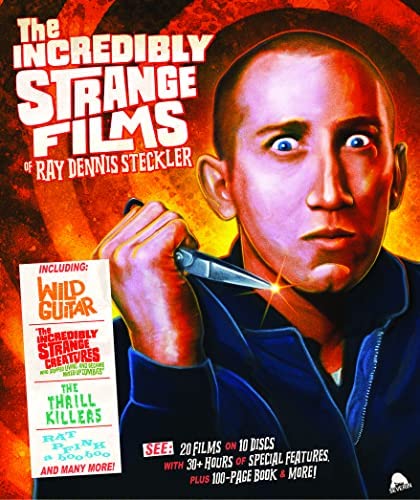
The following collects my notes on the other major features gathered together in Severin Films' impressive and absorbing box set, THE INCREDIBLY STRANGE FEATURES OF RAY DENNIS STECKLER. I've already covered the earlier WILD GUITAR and THE INCREDIBLY STRANGE CREATURES WHO STOPPED LIVING AND BECAME MIXED-UP ZOMBIES (the latter in five-part detail); the others in the set are THE LAS VEGAS SERIAL KILLER (1986); the X-rated hardcore titles THE MAD LOVE LIFE OF A HOT VAMPIRE (1970), NAZI BROTHEL (1970), LOVE LIFE OF HITLER'S NAZIS (1971), COUNT AL-KUM (1971), DR. COCK LUV (1970), THE SEXORCIST'S DEVIL (1974), RED HEAT (1981); and three latter-day shot-on-videotape projects, SUMMER FUN (1997), the 257m homeward documentary READING, PA (2006), and ONE MORE TIME (2008), the last being a supposed sequel to THE INCREDIBLY STRANGE CREATURES... I've tried to tackle the last disc of films but I just couldn't stick with them at this time. Likewise, I'm not feeling drawn to the hour-long-or-less adult titles (which, incidentally, were made by a guy who allegedly turned down Bernard Fein's invitation to work on HOGAN'S HEROES because he felt it wrong to depict Nazis humorously) but may check them out at some future date.    
 

THE THRILL KILLERS
(1965, 69:57, 1.85:1): In the wake of THE INCREDIBLY STRANGE CREATURES…, Ray Dennis Steckler stepped away from the juvenilia of carnival, monsters and rock ‘n’ roll with this startling shift into brutal criminality and violence—perhaps prompted by his erstwhile partner Arch Hall Jr.’s surprise drive-in hit THE SADIST. The story, which opens à la WILD GUITAR with starstruck visits to Hollywood landmarks, is fairly simplistic: an ambitious, out-of-work Hollywood actor (Joe Bardo) and his sexy wife (Liz Renay) are having marital problems when they run afoul of a surplus of deranged killers who have escaped jail (Gary Kent, Herb Robins, axe-wielding Keith O’Brien and “Cash Flagg” as Mort “Mad Dog” Click) and dispatch other characters early on. Carolyn Brandt, playing yet another long-legged damsel in distress, brings a striking sense of dance choreography to her action scenes, and—past a certain point—the action scenes are virtually non-stop, interrupted only by appropriate preludes of suspense. Filmed in 35mm by the ISC team, in mildly stylized black-and-white, this is undoubtedly Steckler’s best-looking film, graced with impactful cutting and an impressively consistent forward drive. The climax includes a remarkably effective dummy death and an audacious, improvised stunt sequence wherein “Mad Dog” Click takes to horseback like a natural to flee a pursuant motorcycle cop, despite Steckler’s avowal that he’d never been astride a horse in his life. Also making a potent impression is Laura Benedict (Gary Kent’s girlfriend at the time) in her only screen role as the manager/cashier at a lone truck stop restaurant with the usual Stecklerian décor; she never made another picture though she leaps off the screen like a west coast Juliette Gréco. There are self-referential moments peppered here and there, with brazen (and not particularly flattering) cameos by the film's producer George Morgan and erstwhile producer Arch Hall, Sr., and a wham-bam swan song appearance by the unforgettable Atlas King. 


RAT PFINK A BOO BOO (1966, 67:05, 1.85:1): The first 40 minutes or so of this celebrated silliness is dead serious, depicting a woman being bullied after dark by another trio of psychotic toughs - very much a continuation of what Steckler was doing with THE THRILL KILLERS, but then pulls what must be the screen's most abrupt whiplash switcheroo. When rock ‘n’ roll star Lonnie Lord (Ron Haydock, introduced signing autographs for three female fans with his right hand outside the Capitol Records building, while holding his guitar in the other) learns that his girlfriend CeeBee Beaumont (Carolyn Brandt) has been abducted by these unhinged lunatics, he sits down with gardener Titus Twimbley (Titus Moede), plays a mopey song on his guitar (the lyrics confusingly frame the abduction as the girlfriend’s rejection of him), and then the two men go behind a locked door to emerge as the pervious-to-bullets superheroes Rat Pfink and Boo Boo. This film actually predated the ABC-TV hit series of January 1966 and was likely inspired by the 1965 “An Evening with Batman and Robin” reissue of the original BATMAN Republic serial, yet it’s very much attuned to what the TV show became. Carolyn Brandt, when showcased in joyous mode in romp sequences with Haydock, set to Haydock's own Gene Vincent-influenced music, is a revelation here; it wouldn't be out-of-line to liken her pop appeal and spontaneity to Anna Karina. The attraction of fun—which THE INCREDIBLY STRANGE CREATURES… seemed to warn against—gets the better of Steckler here, but that’s not to say it isn’t just as infectious to the viewer. If you've not seen this film, be advised it's more layered than you may be expecting and hard not to embrace. The wonderful Bob Burns guest stars as his gorilla alter ego, Kogar. 


THE LEMON GROVE KIDS! (1968, 78:15, 1.33:1): Also known as THE LEMON GROVE KIDS MEET THE MONSTERS. Steckler’s love letter to the Bowery Boys and his San Diego neighborhood was produced as three two-reelers (“The Lemon Grove Kids,” “The Lemon Grove Kids Meet the Green Grasshopper and the Vampire Lady from Outer Space” and “The Lemon Grove Kids Go Hollywood!”), then collected and released theatrically as a feature-length film. This is wholesome, wacky, fun-loving entertainment best suited to children, particularly the children of an earlier, simpler time—not unlike, say, Barry Mahon's kiddie matinee fodder if notably smarter. Made when Steckler’s own kids were young (and already acting onscreen), I suspect he made these shorts mostly for their pleasure, as something to perhaps infect them with the movie bug as he had been, and also to preserve the magic of that time of young parenting for Carolyn and himself. This is probably his most personal work yet, of all the material in this set (despite the return of Rat Pfink and Kogar in COLOR), I relate to it least though it does reveal another, warmer side of the artist: his deep love of people, neighborhoods, community - and of course, filmmaking. In his commentary, Steckler relates a heartbreaking story about his admiration for East Side Kids/Bowery Boys actor Huntz Hall, whom he briefly befriended, invited into his life, and wanted very much to feature in one of his movies. The cast includes Carolyn Brandt (as the Vampire Lady, and reprising her RAT PFINK role of CeeBee Beaumont), Ron Haydock, Bob Burns, Titus Moede, and the final credited appearance of Cash Flagg. Steckler’s direction credit is shared with Peter Balakoff and Ed McWatters.


BODY FEVER (1969, 77:45, 1.85:1): Ever since Arthur Conan Doyle admitted to Sherlock Holmes’ predilection for a seven-percent cocaine solution, the private eyes of detective fiction have been designed according to their personal eccentricities. John D. Macdonald’s Travis McGee, for example, headquarters on a houseboat and, one year before he first came to the screen in the person of Rod Taylor in Robert Clouse’s DARKER THAN AMBER (1970), Steckler made this film, starring (under his own name, this time) as downtrodden LA gumshoe Charlie Smith, who worships Bogart and wiles away his down time aboard a sailboat called the Rogue. Though this film, like his others, was made on a negligible budget and without a finished script, it has a pretty strong backbone thanks to the improvisational grit of experienced actors like Bernard Fein, Coleman Francis and Herb Robins. No one would ever mistake this as anything other than an American film yet it draws visual inspiration from Franju’s JUDEX (the ever-lithe Carolyn Brandt cat-burgles in a snakeskin leotard and mask), Lelouch’s A MAN AND A WOMAN (in its warm yet non-explicit sex scenes), and scenes of joyous, exuberant running whose roots may extend to Richard Lester’s Beatles films or perhaps Louis Malle’s ZAZIE. Shot in Los Angeles and Utah, most of the interiors were shot in Steckler’s and Brandt’s own home and the strangely measured naivete, humor and grit of the piece (about Smith’s risky attempt to recover and neutralize a large bag of stolen heroin) gives this one a somewhat Frenchified, Cassavetes-like feel and pegs this one as the KILLING OF A CHINESE BOOKIE of his filmography. 


SINTHIA THE DEVIL’S DOLL (1970, 77:04, 1.85:1): Scripted by actor Herb Robins, Steckler photographed and directed this highly experimental skin flick as “Sven Christian,” an alias that hints at the Bermanesque elements in the storyline. In psychoanalysis, Cynthia Kyle (Shula Roan aka moonlighting schoolteacher Bunny Allister) struggles to come to terms with an emotionally confused past in which she, sexually jealous of her mother, killed both her parents en flagrante by setting their bed afire. Instead of telling the story in a straightforward way, Steckler (and Robins) opt to delve inside Cynthia’s psychosis, opening up in a feverishly, color-saturated mindscape recalling earlier works by Bergman (THE MAGICIAN, THE HOUR OF THE WOLF), Roger Corman (THE TRIP), Curtis Harrington (NIGHT TIDE), numerous Jess Franco titles yet to come (EUGENIE DE SADE, THE OTHER SIDE OF THE MIRROR, etc), and particularly the shorts of Kenneth Anger. The supporting cast features Gary Kent and Maria Lease (familiar from her appearances in Joe Sarno and Al Adamson films). Dumped as it was onto the sexploitation circuit, this daring and surprisingly accomplished psychodrama went unrecognized as anything exceptional but this is one of the outstanding examples of the kind of art film that could and should have been sanctioned more often by the then-new X rating. 


BLOOD SHACK / THE CHOOPER (1971, 55:10 / 70:10, 1.33:1): With its direction credited to “Wolfgang Schmidt” (because Steckler had determined that he could no longer even “give away” any film he’d properly signed), this picture was reportedly filmed produced for “about $500” in Death Valley, California. Carolyn Brandt plays herself, albeit as a down-on-her-luck horror movie star who, after two unhappy marriages and a stalled career, inherits some sparse desert ranch property from the beloved “Uncle Jim” who produced her past matinee hits. (The dead uncle’s office is this film’s shrine to past Stecklermania, and by the time we reach this feature in Severin’s box set we realize that these pressbooks and photos taped to the walls in all Steckler features were his way of anticipating this digital compendium.) A stone’s throw from her inheritance is the shell of a dumpy, supposedly 150-year old house with nothing more than a hideously soiled mattress inside; the barren, birch-veined property is said to be the host of a terrible Indian curse. Whenever someone enters the place, a murderous shadow figure known as “The Chooper” is manifest to claim their lives with (I guess the first weapon that came to hand) an Excalibur-like sword. 
    Co-written with Ron Haydock (who essentially authored Brandt’s voiceover narration and also stars in the one-note role of Tim Foster, a neighboring landowner who wants to buy her allegedly water-rich property), the lack of a real script is more noticeable here than in other Steckler pictures yet his camera eye finds intermittent beauty and wonder in the scenic desolation; he somehow succeeds in creating Hellmanesque western cinema from its confluence of random visual action (including documentation of at least one local rodeo) and improvisational business between the actors, including his two young daughters Linda and Laura. Even without a script, Steckler manages to allude to rising tensions between corporate and native America as it approached its "Bicentennial" year, juxtaposing the ancient curse with images of a rodeo flag “that never looked more American” and the star-striped, red-white-and-blue slacks that Brandt sports in the last act.
    BLOOD SHACK is the tighter, more polished presentation with a more traditional orchestral score, but THE CHOOPER is more fascinating, being ultimately more personal, more meta, in its candid references to the filmmaker’s earlier work. At 12:15, this film actually made me jump when the actress engulfed in black shadows (Laurel Spring) brings her own hand suddenly into the light. 
    Aaron AuBouchon’s commentary is a well-argued defense of THE CHOOPER. Steckler’s own commentary is unexpectedly lazy and mechanical and also disingenuous when he boasts of subconsciously borrowing from THE MISFITS while elsewhere denying that he took anything from PSYCHO, when the otherwise unnecessary character of property caretaker Daniel (Jason Wayne) is presented as a likely schizophrenic who invites the Chooper to keep on choppin’ ‘em down and he’ll keep buryin’ ‘em. In the end, he’s nothing more than a red herring, while the real Scooby Doo villain behind the Chooper turns out to be the most obvious suspect. If only Steckler had embraced his tendency to self-myth-making and revealed himself (or Uncle Jim) to be the Chooper, pretending to kill people to have something to make a film about! Also, try to count how many times the male characters lose their hats on the windy locations. It’s virtually a subplot. Worth noting is Steckler’s comment about seeing this film ideally on a big screen “in widescreen,” as it’s correctly represented here in 1.33:1 and would have been miserably cropped in even the most lenient widescreen ratio.


THE HOLLYWOOD STRANGLER MEETS THE SKID ROW SLASHER (1979, 70:52, 1.33:1): Also from “Wolfgang Schmidt,” this badly-titled, no-budget, essentially silent picture actually serves up an interesting idea: in Los Angeles, a middle-aged man (Pierre Agostino) mourning the loss of a loved one, poses as a photographer to gain intimate access to a series of models and hookers, whom he sees as the artifacts of a world in moral decline; he is surprised to find himself attracted to a severe-looking woman (Carolyn Brandt, divorced from Steckler by this time) who manages a miserly used book shop next door to the Flick Theater (showing DEEP THROAT and THE DEVIL IN MISS JONES)—when not moonlighting as the city’s other serial killer, who goes around knifing drunks and vagrants for much the same angry, disillusioned reason. Again, Steckler’s refusal to properly script the film (binding everything together with elliptic narration) prevents this idea from achieving its full potential, but as seen in the context of this retrospective box set, the film conveys a powerful illustration of Hollywood’s 15-year decline from the days of his earliest pictures, with their awestruck depictions of the Capitol Records building and the handprints outside Grauman’s Chinese Theater now replaced by porn theaters, liquor stores and escort services. By extension, the film holds up a judgmental mirror to the plummeting standards of American exploitation cinema and mourns Steckler’s earlier sense of artistic vitality and creative hope with a souring, if still diligent, sense of craftsmanship. Agostino also stars in the subsequent THE LAS VEGAS SERIAL KILLER (1986, 76:11, 1.33:1), which plays like a half-hearted postscript to this film, recycling a couple of scenes from the earlier picture (as well as rodeo footage from THE CHOOPER) while vainly pursuing the former glitz of Hollywood to Las Vegas. By this time, Carolyn Brandt had moved on and Steckler had lost the glue that held his cinematic universe together. 

The INCREDIBLY STRANGE FEATURES box set contains a veritable banquet of extras on each of its 10 discs; for a complete breakdown of the contents, and for the best available price on the set, I recommend you go directly to Severin Film's official store here. I will mention, however, that all of the films listed above (with the exception of SINTHIA, unfortunately) are accompanied by Steckler's own (previously released) personal commentaries, which are relaxed, playful and consistently informative. Also provided are feature introductions and commentaries by Joe Bob Briggs, which are highly listenable and well-organized but generally poke fun and repeat Steckler's anecdotes. THE THRILL KILLERS features a commentary by Christopher Wayne Curry, author of THE INCREDIBLY STRANGE FEATURES OF RAY DENNIS STECKLER (a book heretofore unknown to me), while BODY FEVER offers a track by DEAD EYES OF LONDON blogger David Dent. These both feature a lot of spirited play-by-play and are addressed to fans in search of entertainment and background trivia rather than critical insight. My own tastes favor the commentary tracks for RAT PFINK A BOO BOO and THE CHOOPER, which are the work of Aaron AuBuchon, a professor of film studies at Webster University in St. Louis. Of all the set's commentators, he has the most catholic grounding in myriad cinematic reference points; he doesn't anchor Steckler to genre, or make fun of him, even when calling into question some of his creative quirks and decisions. He finds it all very stimulating and his stimulation is infectious. My only regret is that he wasn't tapped to talk over every movie in the set. I hope he's working on a book. 


(c) 2022 by Tim Lucas. All rights reserved.

Subscribe to Tim Lucas / Video WatchBlog by Email

If you enjoy Video WatchBlog, your kind support will help to ensure its continued frequency and broader reach of coverage.


Wednesday, October 12, 2022

IMPORTANT ANNOUNCEMENT

DONNA MARIE GOLDSCHMIDT LUCAS

November 7, 1955 - October 10, 2022

AT PRESENT, VIDEO WATCHDOG IS NO LONGER ACCEPTING OR ABLE TO FILL PHYSICAL BACK ISSUE ORDERS. I BELIEVE THE DIGITAL EDITION SALES ARE AUTOMATED AND MAY CONTINUE. I WILL RETRACT THIS STATEMENT IF IT IS FOUND TO BE UNTRUE. 

PLEASE UNDERSTAND I AM SIMPLY NOT PREPARED TO HANDLE ANYTHING BEYOND AUTOMATIC TRANSACTIONS AT THIS POINT. 

VIDEO WATCHBLOG WILL CONTINUE AS SOON AS I AM ABLE TO RETURN TO MY WRITING. 

AS YOU KNOW, DONNA WAS ONE OF A KIND - IRREPLACEABLE. SHE AND I THANK YOU FOR YOUR MANY YEARS OF LOYAL ATTENTION AND ENTHUSIASM, AND THE LIFE YOU MADE IT POSSIBLE FOR US TO SHARE FOR SO LONG.

                                                              - Tim Lucas 

                                                                                                                               Photo by Linda Wylie.

My love of 48 years, the designer of MARIO BAVA ALL THE COLORS OF THE DARK, and the publisher and art director of every VIDEO WATCHDOG publication, Donna Lucas unexpectedly passed away Monday morning at Mercy Health - Anderson Hospital in Cincinnati, Ohio, becoming unresponsive during a routine test in preparation for later heart valve surgery. She served as the office manager to GENII Magazine for the last few years of her life. She is survived by two brothers and four sisters, their respective spouses, children and grandchildren and a vast number of people who loved her from up close and afar - none closer than me.

We hoped to correct her heart problem and keep this thing running for at least another twenty years, but she has been taken from us. Our talents dovetailed perfectly, but I do not have her gifts, so necessary to keep this website functioning. Do check back occasionally to see if our status has changed. 

Please forgive this sudden and unhappy ending to our story, but if you know anything about us at all, you know it was one of the most beautiful ever told. 


Thursday, October 06, 2022

Random Notes on Recent Viewings

I’m now up to the last disc in Volume 5 of THE ADVENTURES OF OZZIE AND HARRIET. Only a few appearances by neighbor Thorny (Don Defore) in this, his last season; the show is opening up to new friends like Lloyd Corrigan’s Wally Dipple, Lyle Talbot’s devilish Joe Randolph and Mary Jane Croft as the funny-voiced Clara, not to mention the fledgling musical performances of son Ricky Nelson. I’ve not said anything about these releases since the first two, where I found a number of episodes tampered with musically; it appears to have been done either to recover copyright of the restored elements or to cover periods of silence. However, this unnecessary revisionism stopped with the third volume and the restoration work has generally been sublime ever since. One of the real treats of having the entire series presented in original broadcast order is seeing, for the first time, a surprising number of episodes that disappeared from active rotation in syndication. The funny thing about these rarely seen episodes is that there is usually some content in them that may have later judged as distateful - for example, Hal Smith’s pre-Otis drunk character routines, Ozzie and Harriet trading cute kitchen banter about someday getting a divorce, some sexy appearances in several episodes by Joi Lansing, or Ricky making an off-hand reference to how Coke tastes even better with a little rum in it. (“How do you know that?” Ozzie inquires. “I, uh, read it in a book somewhere,” ad-libs the 16 year-old). Which just goes to show that the “wholesome” image that led to the show’s rejection by the counterculture in the 1960s was really only engineered in selective syndication.

Around the time of Season 4, the sponsors must have noted an absence of displays of affection between the family members; suddenly, Ozzie and the boys kiss Harriet whenever they leave the house or say good morning or good night. And in Season 5 there is a noticeable new emphasis on the family's musical heritage, with Ozzie and Harriet singing some sweet duets, the entire family banding together as a sort of barber shop quartet, and of course Ricky's coltish first attempts at rock 'n' roll. There are some real surprises too - like an episode I saw last night in which Harriet’s women’s club takes up sculpting. Ozzie assumes they’ve all shown up at the Nelson house to sculpt him, so he dresses up as a suitable model in classical Roman garb, only to return downstairs to the living room and find the women sculpting another live model - none other than a pre-Hercules Steve Reeves! Funny thing: when Reeves finally speaks, he’s dubbed (by the series’ frequent supporting player and radio announcer Jack Wagner)! I believe it's during Ricky's first singing performance of "I'm Walking'" that I spotted another bodybuilder in the audience: Brad Harris! Another episode, “The Duenna,” features the original Lina Romay, who was fun to see in this context. Halfway through the series, older son David’s maturing personality seems a little withdrawn, helped along by Ricky’s blooming talent and personality, while Ozzie has developed into a remarkable physical comedian and a pleasingly complex character: a sentimentalist but also a profoundly competitive and insecure man whose pride and boastfulness inadvertently set many plots in motion. This was also the season with show writer Jay Sommers (later the creator of GREEN ACRES) really stepped up to bat with many scripts according him top billing. Especially notable, I think, is “The Reading Room” in which Ozzie’s paternal editorializing about how today’s young people should spend more time reading the old classics leads to the family surprising him with a new reading room in the attic, which leads to fears that he may have outgrown his usefulness to the family - hilarious, but also a little existential and frightening, as Ozzie is once again hoisted on his own petard. Just great television.

* * *

When I learned the Criterion Channel was showing a new 4K restoration of Lou Reed and John Cale's SONGS FOR DRELLA performance, I watched it immediately. Originally shot in 16mm, it looks much better now than it used to, and it still sounds great. For me, the most powerful songs are up front ("Open House" always kills me), but the silent artistic connection and tension between Cale and Reed hold the viewer for the duration. What I wasn't prepared for is how young they both look. This was 1990, which doesn't feel that long ago; but Lou's been gone now for almost ten years. A stinging reminder that 30 years is nothing, and that's why I agree with Andy when he says "the most important thing is work."

* * *

We’ve spent the last several nights watching the Showtime limited series THE MAN WHO FELL TO EARTH. Some months back I saw a trailer for it and wasn’t attracted, but needing another series after SUCCESSION, we chose this one. Though allegedly based on the Walter Tevis novel, it’s actually a sequel to the Nicolas Roeg film with an (excellent) mostly black cast including Chiwetel Ejiofor, Naomi Harris and Clarke Peters, with Bill Nighy appearing irregularly as the elusive Thomas Jerome Newton, the character played in the film by David Bowie. Each episode takes its title from a different Bowie song, a structure which plays out surprisingly well. (Little winks to the Bowie mythos also turn up now and then.) There are little annoyances I could pick on, but most of these become surprisingly relevant to points raised by the story and illustrate the differences between basic alien and earthly temperaments. The important thing to say is that this show is a rarity among science fiction dramas of our time: a serious work of actual science fiction, not just a space opera, one that tackles the most pressing problems of our time; it’s also a worthy sequel though it does clear away some of the mystery that so nicely adhered to the obliqueness of Roeg’s storytelling. The show concludes in such a way that it could have a follow-up season if demanded, while also managing a satisfying closure on its own. Recommended.


(c) 2022 by Tim Lucas. All rights reserved.

Subscribe to Tim Lucas / Video WatchBlog by Email

If you enjoy Video WatchBlog, your kind support will help to ensure its continued frequency and broader reach of coverage.