Monday, July 20, 2020

Mondo Karloffo

Tiny rocker Franz Drago performs with Les Amants in MONDO BALARDO.

MONDO BALORDO (1964, 86m 45s; Severin Films/Something Weird): The title means "Crazy World" - and who am I to argue? The director of this Italian pseudo-documentary, Roberto Bianchi Montero, was a prolific filmmaker who seized upon the mondo craze launched by MONDO CANE with the jaws of a pit bull, cranking out ORIENT BY NIGHT, SUPERSPETTACOLI NEL MONDO, SEXY FOLLIE, AFRICA SEXY, MONDO INFAME, SEXY NUDO, SEXY NEL MONDO, UNIVERSO PROIBITO and this film within the two years following the Cavara-Jacopetti hit. What has caused this film to stand out in overviews of this genre is the fact that the American version - supervised by Albert T. Viola and released by Crown International Pictures - somehow obtained the dulcet narration services of Mr. Boris Karloff.

What I would love to know is whether or not Karloff recorded his track in Italy, as this would have coincided with his work on Mario Bava's BLACK SABBATH, or if he did the work for Viola stateside. There is no indication anywhere of who wrote Karloff's material, but it is so consistent with what one knows of his personal wit that one can easily imagine him rewriting (or even writing!) his lines at his leisure - though the mind boggles at his laboring this way over footage of diminutive rocker Franz Drago, witch doctors who cure others with a dancing frenzy culminating in the devouring of a live chicken (not graphic), white hunters who chase down manacled natives ("after all, it's the only form of hunting permitted by law"), and native women whose hair is dyed blonde with the miracle ingredient of camel urine fresh from the spigot. (It's so fake you'll want to share this clip with all your friends.)


Other, milder topics are also covered such as prostitution, opium dens, the sword-and-sandal film phenomenon (with glimpses of Brad Harris and Kirk Morris), the Asian S&M magazine business, lesbian parties, a montage of how some people resemble members of the animal kingdom, a blindfolded guess-the-kisser game, the Italian pastime of derrière-watching, and the third world appetite for cocaine ("a much dreaded word in decent society, but the staff of life to the people of Ecuador"). Karloff's guidance through this garden of the strange and uncivilized is actually quite literate and elegant, and even after seeing it one can't quite accept that it exists. The film's score adds to its disorientation value, veering from Bert Kaempfert-like brass ballads to recurrences of a manic Lou Monti-like theme song.

Bearing in mind that the film was compiled from loose material gathered from all over the world, the presentation - scanned in 4K from the original internegative - is as attractive as the content can be ugly, pointless, and even repulsive. Animal-concerned viewers should be forewarned of an elephant shooting and a brief sidebar on assembling the ingredients for turtle soup. PS: If you go looking for this film on the IMDb, try the title A FOOL'S WORLD.


Aside from a trailer, the film's only supplement is a bonus feature, THE ORIENTALS (MONDO ORIENTALE, 92m 44s), a cropped 16mm TV print bearing the Thunderbird Films logo. Directed by Romolo Marcellini in 1960, this title actually precedes the mondo craze, and it shows in a stronger fictional narrative bent. It's much closer to the Italian caroselli or portmanteau films that were in favor around this time, consisting of a half-dozen stories about young women in Egypt, Malaysia, Nepal, Thailand, Hong Kong and Japan. The film is something of a snoozer, best watched in an alienated mood, with the kind of bad dubbing that you know is lousy but feels strangely comforting when viewed in the wee hours. Surprisingly, THE ORIENTALS has a far greater pedigree than the main feature, being a Galatea production (the production house that brought you BLACK SUNDAY) -scored by Carlo Rustichelli, photographed by Aldo Giordani (ATOM AGE VAMPIRE, THE MONGOLS, and AMUCK), and narrated by Richard McNamara (you'll know his voice from countless peplum films)! Also in the film's favor is that the longest segment, set in Japan and lasting some 20m, is constructed around an early star turn by the beautiful Akiko Wakabayashi, best-remembered for her mysterious roles in Toho's DAGORA THE SPACE MONSTER, KING KONG VS. GODZILLA, and GHIDRAH THE THREE-HEADED MONSTER. The presentation is not definitive, given the compromised screen ratio, but the print is otherwise nice and colorful.

MONDO BALARDO streets on July 28.
(c) 2020 by Tim Lucas. All rights reserved.

If you enjoy Video WatchBlog, your kind support will help to ensure its continued frequency and broader reach of coverage.


Thursday, July 16, 2020

THE WAR OF THE WORLDS Reviewed


THE WAR OF THE WORLDS (1953, 85m 21s; Criterion): My apologies to Warner Archive's highly worthy MYSTERY OF THE WAX MUSEUM, but this 4K restoration of George Pal's classic production - with an optional 5.1 soundtrack remix by sound designer Ben Burtt - is the Blu-ray restoration of the year, thus far. 

Circa 1974-75, I had the privilege of seeing one of Paramount’s surviving Technicolor and Stereophonic prints when it was shown at a local repertory theater, and I have always remembered it as one of the most exciting theatrical experiences of my life. Contrary to common criticism, the wires supporting the Martian war machines could scarcely be seen on the big screen given the specific color timing and light levels of those first-generation prints, so the griping being heard from some quarters ("How dare they go back and erase the wires?") is uneducated, working from a knowledge limited to the brighter prints generated for television and early home video, which brought some of the film's secrets into open view.


As vivid an experience as theater goers got back in the day, this Blu-ray presentation is far sharper and more colorful without any distortion even when incendiary reds prevail. The Technicolor is Bava-level intense, and the 5.1 audio makes the paranoid terror of the proposed invasion all the more palpable and frightening. The original monaural track is also here, restored beyond anything we've heard before, after the immersive, heart-pounding experience of the 5.1 track, I don’t think I’ll ever go back to it. Funnily enough, the textural improvement of all its eye and ear candy also serves to heighten every other department rather than draw inordinate attention to itself - Byron Haskin's beautifully modulated direction, the velvety lighting of George Barnes' cinematography, the tight editing of Everett Douglas, and not least of all the performances; never before, not even in a theatrical setting, have I so appreciated the affecting dramatic detail that Gene Barry, Ann Robinson, Les Tremayne,  Russ Conway, Paul Birch and Jack Kruschen bring to this picture. More than half a century further on, this is a movie that's never lost its moxie; it remains the definitive dramatic adaptation of H.G. Wells' novel.


Some extras have been ported over from the previous 2005 Paramount DVD release, the audio commentary (featuring Joe Dante, Bob Burns, and the late film historian Bill Warren) and the making-of documentary short, "The Sky Is Falling." Fascinating new featurettes specific to the restoration are also included, as is the famous 1938 Orson Welles radio broadcast and a 1940 radio program interviewing Welles and the author of the original novel, H.G. Wells.

(c) 2020 by Tim Lucas. All rights reserved.

If you enjoy Video WatchBlog, your kind support will help to ensure its continued frequency and broader reach of coverage.


Wednesday, July 15, 2020

Dipping Into GUNSMOKE: Lucky Season 13

Ken Curtis and James Arness estimate the damages in "Vengeance." 
Donna and I have been immersing ourselves in a gift copy of GUNSMOKE Season 13, which is so far anything but unlucky. It starts out with Robert Totten/Hal Sitowitz's "The Wreckers" with Warren Oates headlining as a gunman heading a group of desperadoes who overturn stagecoaches for plunder and end up taking Matt and Kitty captive. This is one of Amanda Blake's finest showcases in my experience and Oates is already at his Peckinpah level - an outstanding episode... but don't watch the preview, which goes crazy with spoilers!

Directed by Gunnar Hellstrom and written by Clyde Ware, "Cattle Barons" is a tense showdown between landowners Forrest Tucker and Robert J. Wilke; it's first-rate until it builds to an overlong fist-fight involving just about every character in the show in the middle of Dodge's main street.

Bernard McEveety/Calvin Clements' "The Prodigal" features an excellent Lew Ayres as the doddering grandfather of a young gunman determined to learn the identity of the man who shot his father in the back, which is a secret guarded under law. Also written by Calvin Clements, Richard C. Safarian's two-parter "Vengeance" stars James Stacy at his peak as a former carnival trick-shooter out to avenge himself against steely-eyed landowner John Ireland, whose men killed his father and brother for relieving the pain of one of his wounded calves. This superb episode also features a truly fine, touching early supporting appearance by Kim Darby, an authoritative minor part for Paul Fix, and rural menace from Royal Dano and Victor French. Then Robert Totten returns to the director's chair for Ron Bishop's script "A Hat," with an amazing, over the edge performance by Chill Wills as an aging gunman whose son is killed in self-defense by a mountain man who finds the protection of Matt Dillon, thus putting all of Dodge into imminent danger. 

It's remarkable how often the same story elements and situations come into play, but there is never any sense of redundancy in the storylines. The only trouble with these early color episodes is that CBS really wanted to sell color television sets, so the color is BATMAN-lurid and sometimes hard to look past. I never imagined that Marshall Dillon's one and only shirt was lavender all these years! There's even some lavender lighting in the exteriors, and the green felt tabletops in the Long Branch Saloon look like enormous lime lollipops.

And then there's episode 12: "Death Train," written by Ken Trevey and directed by Gunnar Hellström. When a train passes through Dodge City carrying the luxury train car "Nimrod," one of its passengers (Dana Wynter), sneaks away from her millionaire husband (Morgan Woodward, an arrogant man who believes his position makes him invulnerable and above the law) and his hired hand (Norman Alden, looking a lot like Dennis Hopper in EASY RIDER, made two years later) to covertly notify Doc (Milburn Stone) that their butler is deathly ill. Doc follows her to the train and quickly confirms the mottled passenger as having spotted fever, a form of plague, and declares a quarantine. At Marshall Matt Dillon's order, the "Nimrod" is uncoupled from the main train, allowing the other cars to continue on unencumbered. Doc and Matt do their best to keep the word stifled, but it spreads through town anyway, given additional fearsome fervor by an evangelist determined to put the fear of God into the locals. Soon enough, frightened locals circle the train and when their attempts to build a barrier around it fail, they decide to try burning it down to purify the contagion.

The more GUNSMOKE episodes I see, the more Dodge City itself - beyond the main characters - seems rife with bad seeds and dangerous drifters who have to be regularly taught lessons about racism, violence, lust, alcoholism, and so forth. It carries a regular message (or reminder) that there are certain things that civilized people just won't, or shouldn't, stand for. As such, it's a very socially constructive program. We don't really have much of this now, and it's showing in the way we interact with each other in public. Watching this particular episode was a lot like holding up a mirror to the world we find ourselves in today, and it showed me that this is nothing new, that people have always been like this, at their most dangerous when they are scared; but what they had then that we don't have today is a genuine leader to stand up our worst instincts and show people the folly of their own fears, which are as endangering to them as they are to others. The mob in this episode initially wants to send the train on, which would carry its contagion to other states; then they want to burn it down, which would remove the barrier of the train itself from deadly contagion - these are not carefully considered solutions. They have no logic, no science to back them up; the prevailing thought is "get this away from me, and to hell with anyone else." The point made here, and in so many other episodes, is that guns, torches, mob violence, and ignoring or disavowing medical knowledge are not acceptable solutions to any problem. I makes me think we need to bring a stronger educational, precautionary bent back into our entertainment, and take heroism away from costumed freaks and return it to the exceptional common man. It may seem a backward step, but this country's in tatters and TV is where most people learn things.

(c) 2020 by Tim Lucas. All rights reserved.

Tuesday, July 14, 2020

THE EVIL OF FRANKENSTEIN Reviewed


THE EVIL OF FRANKENSTEIN (1964, 86m 36s; Scream Factory): Of the Hammer's half-dozen Frankenstein films starring Peter Cushing, this one has always been the bone of contention among its devotées. It is the only one not directed by Terence Fisher, and Freddie Francis' brief assumption of that chair (as Fisher was making THE HORROR OF IT ALL and THE EARTH DIES SCREAMING for Lippert) is a fascinating look at contrasting techniques in action.


Fisher worked his way up to director as an editor, Francis as an Academy Award-winning cameraman, and here there is a far greater assertion on the power of visuals, so much so that Francis indulges in a memorable six-minute flashback played entirely without dialogue. In contrast to Fisher's wry but never humorous work, which maintained a conservative presentation to all the better make the subversive subject matter pop, the visuals here sometimes err on the vulgar (see any scene involving David Hutcheson's burgomaster and his busty wife, Caron Gardner) and Francis' interests stray too far from Cushing's Baron to Peter Woodthorpe's barnstorming portrayal of the hypnotist Zoltan, whom the Baron recruits to make controlling contact with the damaged brain of the Monster (New Zealand wrestler Kiwi Kingston). While there are disappointing aspects, time has treated the film well; it's attractively produced, the ragged and poorly-designed Monster has become iconic despite itself, and the dynamic score by Don Banks is a refreshing "en garde" change of pace from James Bernard onomatopoeic scoring.


The extras are more than entertaining; the packaging literally cannot list them all. They amount to a multi-authored audio-book monograph on the film and are thus necessary to any serious Hammer enthusiast. Once again, Constantine Nasr's audio commentary provides a wonderfully detailed overview of the film as well as an enlightening production account that helps to explain (and sometimes forgive) its various flaws. Some of the other extras are ported over from a 2003 release, including a "making of" featuring Hammer authority Wayne Kinsey, while the new material includes a warm 30m reminiscence of Francis by his co-biographer Tony Walton and illuminating visits with assistant director Bill Cartlidge and actress Katy Wild, who plays the deaf-mute beggar girl. Cartlidge remembers Francis as being still a bit insecure at the time of filming, and Wild recalls him and producer Anthony Hinds confessing to her on the last day of filming that they had made her character deaf-mute to save themselves the trouble of developing an actual character! It shows just how much an actor stands to bring to a "nothing" role on their own watch; at the same time, the absence of an obviously missing account of the girl's sympathetic relationship with the Monster shows that Francis was frankly unaware of the elements most important to this material - the centrality of Cushing's Baron, and its subtle metaphor of his audience's attraction to monster movies.

As an extra, the similar TALES OF FRANKENSTEIN TV pilot (1960) is included, as is the padded 97m NBC-TV version (which premiered on January 1980), regrettably source from a "best available" 16mm print, which has turned all red and yellow. Had I known they needed it, I could have provided correct color copies of all the scenes exclusive to the TV version, which I recorded from a local station on Betamax in the early 1980s.


(c) 2020 by Tim Lucas. All rights reserved.


Monday, July 13, 2020

Groton and Grazbo Go Boating

From Bob Labar's terrific main titles sequence for DRACULA VS. FRANKENSTEIN.
DRACULA VS. FRANKENSTEIN (1971, 90m 47s) is the film for which Al Adamson will always be best-known, which is a shame; as the original cuts of his films in Severin Films' AL ADAMSON MASTERPIECE COLLECTION show, he was capable of doing much better when working in the genres that most engaged him. Horror, alas, was not one of them - and DRACULA VS. FRANKENSTEIN is yet another film that sprang out of initial detritus. It was originally filmed as THE BLOOD SEEKERS, initiated as SATAN'S BLOODY DEVILS, which followed upon the success of SATAN'S SADISTS as another biker picture with Charles Manson-like associations starring Russ Tamblyn. When this version (no longer extant) was screened, it was decided it didn't work, so Adamson and producer Samuel M. Sherman embarked on a two-year schedule of reparations.


Lon Chaney Jr. as Groton, before and after his injection.

What ultimately prevailed was a typically schizophrenic film with biker elements and hatchet murder elements struggling to incorporate biker elements. The new storyline posits the former Dr. Frankenstein (J. Carrol Naish) as hiding behind a carnival haunted house of illusions, with his pet moron Groton (Lon Chaney Jr.), whom he periodically injects with a formula that transforms the puppy-petting simpleton into an axe-swinging killer (dubbed with the heavy breathing of Brother Theodore from his MAD DOCTOR OF BLOOD ISLAND trailer session) along the Venice beachfront. The wheelchair-bound doctor then drains the victims of their terror-heightened blood to reshoot into Groton. If it sounds like Dr. Frankenstein is slumming, "Lord of the Manor of Carpathia" Count Dracula ("Zandor Vorkov" aka Roger Engel) materializes and blackmails the doctor, forcing him to resurrect the inert body of his monster (John Bloom) and thus ramp up the terror factor to yield some truly trippy blood for Dracula to drink. The doctor also uses the Monster as an agent of vengeance against his old colleague (actually considerably younger) Dr. Beaumont, quickly crushed to death and played by FAMOUS MONSTERS OF FILMLAND editor Forrest J Ackerman. 


Angelo Rossitto, whose film career dated back to FREAKS and earlier.
The carnival boardwalk is patrolled by the dwarf Grazbo (Angelo Rossitto), who has lines like "You see? You must open your eyes to see things!" while taunting a young hippie couple who, for some unexplained reason, have to walk through the haunted house "ride." 


Judith Fountain (Regina Carrol) and her Vegas stage act.
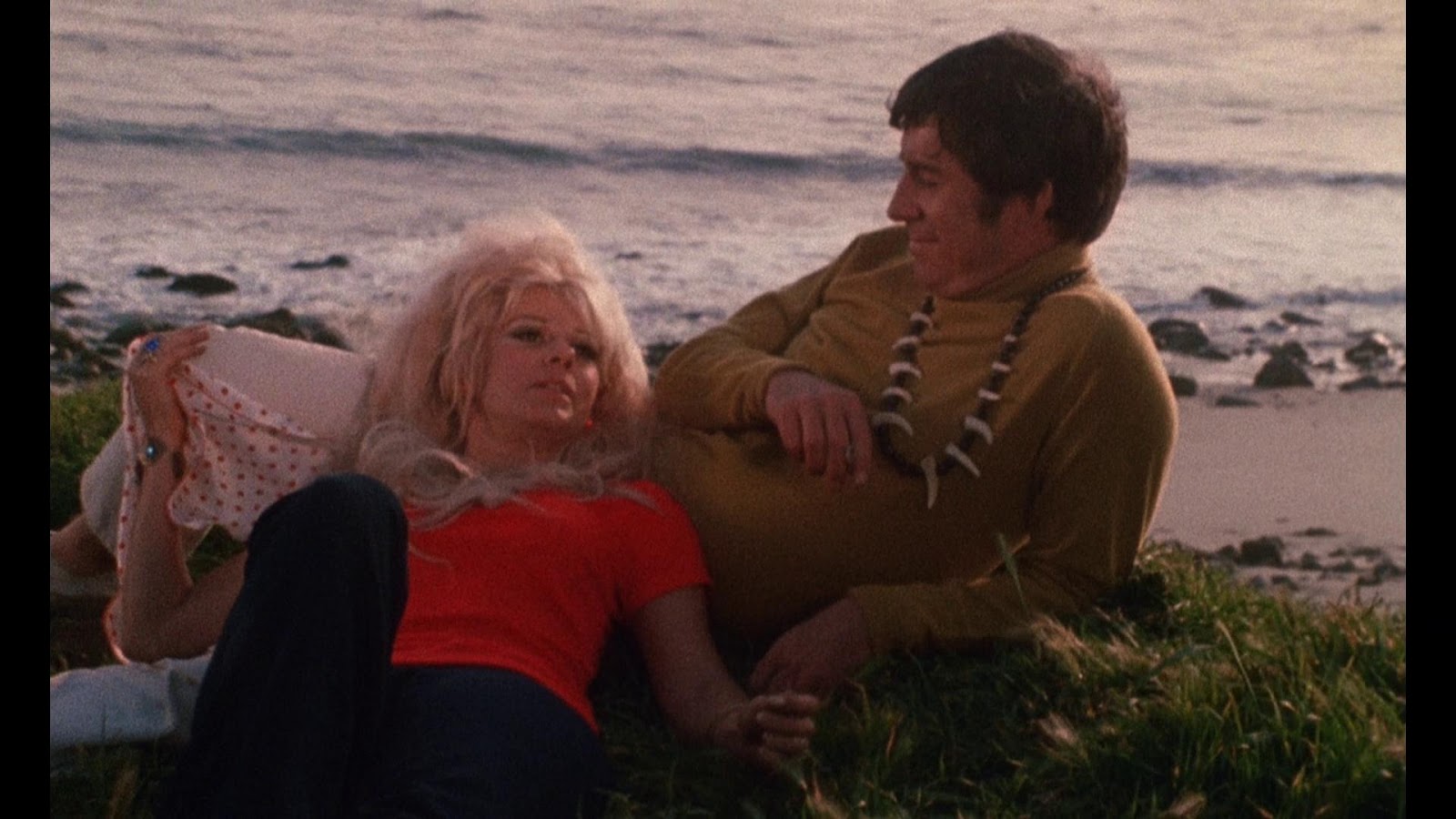
Tacked onto all this mayhem is a subplot carried over from THE BLOOD SEEKERS, in which Las Vegas performer Judith Fontain (Adamson's wife Regina Carrol, we see her singing to a thin crowd about overpacking her bags for a trip to the Hilton Mau Mau) comes to Venice in search of her missing sister Joanie (Joe Sarno veteran Maria Lease), who has actually been decapitated and then nonsensically recapitated before becoming repurposed as a blood donor for Groton. Crusty police detective Sgt. Martin (Jim Davis) isn't much help (though he does get the terrific line "Nobody but nobody understands the subconscious, not even ourselves"), and after Tamblyn's biker gang doses Judith with LSD, she gets the help she needs from Mike (Anthony Eisley), the straightest looking hippie you ever saw. (We know he's a hippie because he wears a turtleneck, a toothed necklace, and has a "pad.") As with the romance between John Gabriel and Erin O'Donnell in THE FAKERS, Mike and Judith's fall into limerence plays a lot like a Salem cigarettes commercial of the period. For a love story that takes so long to set up, it's over hilariously fast due to some laughable circumstances. 


"Let's not get involved": Regina Carrol and Anthony Eisley.
Apparently the climax of the original cut - titled THE BLOOD OF FRANKENSTEIN (not preserved) - didn't play too well, so Sherman conceived the new title and had Adamson shoot a hastily concocted battle royale between the two living dead icons in a dilapidated church location. Apparently the crew arrived under ideal Dracula conditions (they were "losing the light") because Zandor Vorkov's makeup had to be brightened to Kabuki white-faced proportions to show up onscreen. Under the heavily blue-tinted murkiness you can barely see what's going on - and believe me, you see more of the battle on Blu-ray than you ever could in the pre-digital days of drive-ins, early television broadcasts, VHS and even laserdiscs.

Dracula (Zandor Vorkov) revives the Frankenstein Monster (John Bloom).


Photographed by three different cameramen (Paul Glickman, Gary Graver, and an uncredited Sam Sherman), the patchwork film is not without interest but it's never as rewarding as one hopes. Adamson really knew nothing about creating or sustaining a horror atmosphere; he's all about cute, ironic cutting; when Jim Davis ends a scene by saying "It's a dark, dark world," we cut to him turning off an overhead light that wasn't turned on earlier in the scene, and when Beaumont is fastidiously crushed in the arms of the Monster, he takes the cue to cut to the slogan on the back of a 1969 bottle of Mountain Dew ("It'll Tickle Your Innards!"). Tony Tierney's makeup for the Frankenstein monster is actually one of the better post-Universal designs and John Bloom embodies the role acceptably well. Likewise, Naish, Chaney, and Rossitto all strike macabre characterizations and the film is also given a nostalgic charge with the library music of William Lava, which extends to some CREATURE FROM THE BLACK LAGOON cues later in the picture, and the use of Kenneth Strickfaden's mad laboratory equipment used in the original FRANKENSTEIN (1931). I also must admit that the promised confrontation between the two monsters gives us somewhat more than Universal did when Frankenstein met the Wolf Man, or when HOUSE OF FRANKENSTEIN and HOUSE OF DRACULA pulled all the great monsters into one story and then disappointingly kept them largely apart - but even so, more amounts to less. The major disappointment is "Zandor Vorkov" as Dracula, a role that requires innate authority - which is not the same as treating all of his dialogue with reverb. Not only is Vorkov more Doctor Strange than Dracula (firing animated beams from his magic ring, no less), he's basically too young and lacking in presence. Giving credit where credit is due, his disintegration scene is not bad, though Roger Engel's explanation in the featurette of how hastily and crudely it was accomplished is hilarious. 


J. Carrol Naish as the enfeebled Dr. Frankenstein. Oops, spoiler!
The disc includes a Samuel M. Sherman commentary - Sam is very well-spoken and is a highly responsible film historian who shares his experiences with clarity and a bit of humor - as well as a featurette of interviews with cast and crew members. Most engaging, however, is a visual essay called "Feed Your Head! Lose Your Head!" by the Flying Maciste Brothers (Howard S. Berger and Kevin Marr), narrated by smooth talker Berger. It is their view that DRACULA VS. FRANKENSTEIN is something of a misunderstood masterpiece, that beneath its misbegotten surface resides a multi-tiered investigation into the schism of illusion and reality, especially as manifest in the pleasure we take in our darker forms of entertainment.


Judith's uncredited stage show partners in the "Travelin' Light" number.


Berger's narration identifies the film as being made in the spirit of the 1940s "monster rallies" like Erle C. Kenton's HOUSE OF FRANKENSTEIN (1944), in which both Naish and Chaney were prominently featured, which is of course readily evident - and so it goes. Though the points he and Marr make help to underscore some aspects of the patchwork narrative that Adamson's direction (and the film's disjoined origins) left muddled, there's a fundamental difference between pointing out connections and bringing them together in actual chords of enlarged comprehension. Rather than arriving at answers or a bigger picture, the narration is more inclined to pursue the duo's notes to a series of ironic, self-reflective, zen-like questions. For example: it's true there is a similarity between Dr. Frankenstein's self-proclaimed status as one who lives "beyond fear" in a threadbare palace of illusions and the subplot about Judith (herself a stage performer) and her quest to find her lost sister, which takes her through a kind of looking glass into psychedelics and a different kind of life/lifestyle than she has been exposed to before. These details are certainly there but I would argue that what the essay savors as subtext is most often text; these elements are up front and don't exactly galvanize one another so much as merely coincide. The essay also credits Adamson and Sherman with providing all of these subterranean connections with knowing, masterful deliberation, while never mentioning or questioning screenwriter William Pugsley's role in all this, nor that of the cameramen or art director when pointing out revelatory details in composition and backgrounds. Though certainly diverting in its own right as entertainment, what this literate if not entirely persuasive essay ultimately proves is that some folks like this movie a lot more than others, and some - God bless 'em - have worked really hard at it.

(c) 2020 by Tim Lucas. All rights reserved.        
  

Friday, July 10, 2020

Nazis, Spies and Bikers - Adamson Style

Kent Taylor as New Nazi Party leader Count von Delberg in THE FAKERS.
Severin Films' AL ADAMSON MASTERPIECE COLLECTION permits an engrossing comparison between their choppy and discombobulated 1970 release HELL'S BLOODY DEVILS and the more organically pleasing picture it grew out of, a pleasantly engaging little spy picture called THE FAKERS (1967, 94m 49s). Filmed under the title OPERATION M, it opens with an immediately engaging animated title sequence, the first Bob Lebar created for Independent-International, bearing the reconsidered title SMASHING THE CRIME SYNDICATE and a copyright date of 1973. Further upping the ante is Adamson's first proper film score, suggesting that he (or perhaps production consultant Sam Sherman) had recognized that their previous use of library music had worked against the commercial viability of their product. A flashy montage of rotoscoped nude models in high contrast and psychedelic colors, animated USA flags, swastikas, hammer and sickles, Stars of David, inky handprints, and $20 bills, this stylish surge of creativity is given additional verve by the opening theme, "Faker," sung by Debbie Stuart (à la Shirley Bassey), which is credited to Nelson Riddle though the musical score, per se, was more economically provided by Don McGinnis, who made free use of Riddle's catchy motifs. 

John Gabriel eyes a counterfeit bill with mob boss Keith Andes.
The film opens, in a manner now evoking RESERVOIR DOGS, with our protagonist waking up in the back seat of a moving car with the heated story already in progress. We won't know this for awhile, but this is danger-man-for-hire Mark Adams, played by John Gabriel (credited as the lyricist of "Faker") - he arranges his escape from the car, upsetting the driver, who proceeds to spill over the side of a cliff, delivering immediate action and fatality. The unconscious Adams is picked up by a passing truck driver and taken to hospital, where the film embarks on a more-or-less feature-length flashback, complete with handy self-introduction. While comatose, he recounts the story of how he was hired by his boss Joe, "a very big man in the syndicate," who has been contacted by a Las Vegas branch of the New Nazi Party who need funding to put into action "an idea so big, only the syndicate could handle it." Joe wants Adams to meet with the man behind the New Reich, a Count von Delberg (Kent Taylor), who owns stolen money plates dating back to WWII capable of making fool-proof counterfeit currency, which he plans to circulate to refinance his army of goose-steppers. Joe wants those plates - probably more for his own gain than for any patriotic reason. 

Guest stars Broderick Crawford and John Carradine.

What's wrong with the film from the beginning is that Adams and his boss are so cordial and likable that we are left wondering why our putative hero wasn't conceived as a secret agent working on behalf of our government, rather than a charismatic hood working on behalf of a warm and friendly mob boss. As it happens, he actually is; this is just another curve thrown at us to make the story more "interesting." Adams has been working undercover for the past five years; his actual bosses are Gavin (Broderick Crawford, an implied FBI man, giving the same performance he always gives, but he's solid and ideal for the role) and his next-in-line Brand (Scott Brady, ditto). When one of "Why did they send you?" Gavin asks female agent Jill Harmon (Emily Banks), when Brand drags her into his office. "I don't like sending out female agents, especially when they're pretty." "Thanks for the left-handed compliment!" she fires back perkily. Gavin also "has a feeling the communists are in on this" - well, okay, why not? 

Vicki Volante hides from her pursuers at Marineland - a surprisingly Hitchcockian scene.
"Everything simple so far?" the suave Adams asks us from the depths of his coma, while neatly pocketing his gun in a shoulder holster onscreen. And so it goes, with our comatose hero supposedly reminiscing about how he got into this position, while also telling us about scenes and situations to which he was not privy. Adams also encounters more than his share of female trouble, courtesy of a jailbait femme fatale (Anne Randall), the competitive agent Harmon, the icy blonde Leni Marvenga (Jacklyn O'Donnell) and also the Count's apparently Nazi-friendly attaché Carol Bechtol (Vicki Volante), the Count's unknowing attaché and mistress, who becomes a target for the Communists whose bid for the plates was snubbed. The film reaches its genuinely engrossing high point as Carol flees her would-be assassins into the midst of a packed afternoon at Marineland, where Adamson, cinematographer Laszlo Kovacs, and editor John Winfield create a seriously good sequence, almost ten minutes in length, that proceeds without much dialogue and is inventively storyboarded on multiple levels of single compositions. Adams saves Carol, only to discover that she's assumed her position in the Count's employ because she wants to destroy him, actually a surviving Nazi war criminal who was responsible for her parents' death at Auschwitz.
Before he worked for Herschell Gordon Lewis, Col. Harlan Sanders made an Al Adamson cameo!

Adams' coma finally comes full circle around 74m into the picture, making us realize it was only a ploy to underline the fine points of an overcomplicated plot, which only served to make them more complicated in the process - but there is terrific stuff along the way, some of it quite quirkily funny, including a delightfully perverse encounter with a fellow undercover man posing as a pet shop dealer (John Carradine) bedeviled by a pair of ditzy twins (Alyce and Rhae Andrece) whose lovebirds aren't being very amorous, a bit of judo oneupmanship with Agent Harmon, and a romantic sidebar as Adams and Ms. Marvenga take a stroll through the park and meet Col. Harlan Sanders himself while having lunch at KFC.

Agent Harmon (Emily Banks) throws Adams for a loop.
In its original form, THE FAKERS is an engaging, neat little spy picture whose quirks are ultimately forgivable, even embraceable, but the story behind it is a tragic one. When it was still OPERATION M, it ran out of money mid-way through production, and other producers came into the project like Rex Carlton, who - when the film finally proved unsaleable - committed suicide, dropping roughly $40,000 of debt on Adamson's shoulders. To make a long story short, Adamson subsequently formed Independent-International with Sam Sherman as a means of repaying that debt to his investors, a scheme that was ultimately successful - and which explains why his shelf of work at that time became the raw material for drastic re-evaluation and reinvention.

Robert Dix at the head of HELL'S BLOODY DEVILS.
HELL'S BLOODY DEVILS (90m 11s) may be the crudest of the various reworkings, which takes the original's New Nazi Party plot and ties it to the swastikas paraded by a motorcycle gang led by the fairly straight-looking Cunk (Robert Dix). The movie - which cuts THE FAKERS down quite a bit and adds roughly 15 minutes of additional footage shot in Utah - opens with the Bloody Devils (played by an actual biker gang, the Hessians), who are in league with the Count's Master Race philosophy and on his payroll, tracking down a pair of commie hit men and treating them to a chain-beating until they are covered in blood ("Now everyone will know you're a red, ha ha ha," one observes.) The Bob Lebar titles are slightly reworked to incorporate biker graphics, and the original theme song is kept. 

Pick-up cameraman Frank Ruttencutter goes for the symbolism during a biker's love scene.
Whereas THE FAKERS looks beautiful, having been scanned and restored from its original 35mm negative, HELL'S BLOODY DEVILS was not so carefully preserved. The version presented makes extensive use of the FAKERS negative but the material unique to the revision is culled from various surviving 35mm prints, which are faded and scratchy as they looked the last time they played under the stars at various drive-in theaters.

The extras include a trailer and TV spot for HELL'S BLOODY DEVILS, as well as a feature-length commentary by Sam Sherman (incorporating a brief phoned-in addenda by John Gabriel), and an  hilarious featurette called "Sam Sherman Interviews Actor John Gabriel," in which the poor, smiling, dressed-up-to-be-interviewed-on-camera, and clearly suffering actor finds it all but impossible to get a word in. All in all, another entertaining, eye-opening, and educational evening with the AL ADAMSON MASTERPIECE COLLECTION.

(c) 2020 by Tim Lucas. All rights reserved.


Monday, July 06, 2020

RIP Ennio Morricone: He Left Us Multitudes


Maestro Ennio Morricone has passed away at the age of 91, leaving behind some 400 feature film scores, miscellaneous experimental recordings and pop music arrangements, and more albums, retrospectives and compilations than anyone could count, much less own. It is a popular opinion that such prolificacy is its own worst enemy, that it spreads talent thin and wastes more time and ability in expenditure than in incubating - but if anyone could put the lie to this homespun wisdom, it was Morricone. There's a song on Bob Dylan's new album called "I Contain Multitudes," which derives its title and concept from a poem by Walt Whitman, "Song of Myself." Certainly Dylan has worn a variety of masks during his long career and used them to express a great variety of popular music and (sometimes unpopular) voices, but Morricone could have laid an even more valid claim to the title. It's interesting that both stories begin, more or less, from the same seed: Woody Guthrie. 

Bear with me. Woody Guthrie was Bob Dylan's hero; it's said that he - two generations away from Russian Jewish immigrants - left his hometown of Hibbing, Minnesota to travel east and sing to the hospitalized Guthrie. He did his best to look, sound, walk, and talk like him; and because Guthrie's brain was dying in the throes of Huntington's Disease, Dylan carried his voice and his message forward like a torch. He called himself Woody's "disciple," but soon enough he had become more analogous to the voice of Christ for thousands of young folk. You could hear a pin drop in Carnegie Hall as he wove his spell, just one man and an old, beaten-up guitar. After his fabled motorcycle accident saved him from a self-destructive spiral on the road, he came back somewhat reborn in the image of American traditional music with the Band, then country music under the wing of Johnny Cash, and a whole procession of images from the clown-faced bandleader of the Rolling Thunder Revue, the sanctimonious front man of the GOTTA SERVE SOMEBODY tour, stints with Tom Petty and the Heartbreakers and the Grateful Dead, the drunken-sounding uncle singing Christmas songs, the Sinatra-like crooner mooning over old lost loves, and most currently the songwriter whose sprawling cast of characters from the Marquis de Sade to the Sad Eyed Lady of the Lowlands have become synonymous with some kind of forsaken Americana, somehow synonymous with JFK's sadly exploding head. You might say he's a myth-maker as much as a writer of song; his first Number One was 17 minutes long. 

Morricone's Woody Guthrie connection, of course, was the 1941 song "Pastures of Plenty", which he - in his original status as an orchestral arranger of Italian pop music recordings - gave a special arrangement for a 1962 single by the expatriate American folk singer Peter Tevis. At this time, Morricone had already composed a couple of Italian Western scores in a more traditional vein, GUNFIGHT AT RED SANDS and and Tevis had sung themes for thebut had previously sung the title themes of Morricone's two previous Westerns, GUNFIGHT AT RED SANDS ("A Gringo Like Me") and BULLETS DON'T ARGUE ("Lonesome Billy"). So it was natural for Morricone to suggest a reprise of this successful template to Sergio Leone when he was approached to score FISTFUL OF DOLLARS - but Leone didn't want the Tevis voice - he wanted that Guthrie/Tevis sound, which somehow gathered the galloping of ghostly horses in a guitar's sultry strum, whip cracks, flute trills, the caws of men attempting to marshal an unruly nature, and the gentleness that was just a heartbeat away from cataclysmic violence. Morricone would later refer to FISTFUL, repeatedly, as the worst score he ever wrote, but it redefined the musical genre laid down by Aaron Copeland in his 1940s compositions like "Billy the Kid", "Hoedown", and "Appalachian Spring." 

The music that Morricone wrote for Italian Westerns of the 1960s was as defining of them as their look, their stars, their direction. It was lusty, sweaty, humorous, even spiritual music with a hair-trigger temper. His sixteen-year membership in the ensemble Gruppo di Improvvisazione di Nuova Consonanza, which explored improvised experimental music, kept him vigilant on the edge of musical frontiers. It was with his scores for THE GOOD, THE BAD, AND THE UGLY and ONCE UPON A TIME IN THE WEST that his movie music became too brilliant to ignore; Sergio Leone himself saw to that, using his brooding, roiling, suspenseful, harrowing, even mournful music to embrace long silences, as the cinema he created returned periodically to the purity of the silent era. One critic noted about the latter film that it was like an opera in which the arias were stared. 

But we mustn't forget that Morricone's music also paraded itself in a series of masks. There are not only compilations of Morricone's music, but compilations of distinct genres of his music. He contained it all. There are collections of his love themes, his themes of violence, his work as a pop music composer and arranger (topped by Mina's astonishing and much-covered "Se telefonando"); there are three volumes of MONDO MORRICONE containing his masterful and elegant pop and shake instrumentals for "Continental Op" pictures; there is MORRICONE GIALLO, CRIME AND DISSONANCE, MORRICONE BOSSA, PSICODELICO JAZZISTICO, even a 24-disc ULTIMATE COLLECTION that doesn't begin to cover even a quarter of it. He left us any number of worlds to get lost in, not least of all the world of collecting his vast archive of recorded works.

If the work had been unsigned, it would take an ear far more skilled than mine to identify the common author of the scores for Elio Petri's A QUIET PLACE IN THE COUNTRY, Edouard Molinaro's LA CAGE AUX FOLLES, John Carpenter's THE THING, and Wolfgang Petersen's IN THE LINE OF FIRE. In these and other scores, we find Morricone stepping not only outside his usual perimeters but his unique personality as well, always with bold distinction, and he managed to do so at the same time he was writing the more readily identifiable scores of such films as Mario Bava's DANGER: DIABOLIK, Luciano Ercoli's FORBIDDEN PHOTOS OF A LADY ABOVE SUSPICION (with its killer track, "Amore come dolore", Franco Rossi's MOSES THE LAWGIVER, Sergio Leone's ONCE UPON A TIME IN AMERICA, Roland Joffe's THE MISSION, Giuseppe Tornatore's CINEMA PARADISO, and Quentin Tarantino's THE HATEFUL EIGHT. Readily identifiable, yes, but at the same time wholly original and another step in his evolution as an artist. One might reasonably call him a music factory, but the phrase gives a false impression of faceless, impersonal work. The base materials that passed through Morricone's loom were never less than serviceable and almost invariably came out as woven gold.

Time will tell, but when the definitive history of contemporary music is written, Ennio Morricone may well be cited as the most significant classical composer of his lifetime. I can think of no other composer who was more capable of galvanizing and raising orchestras to a higher calling, unleashing tides of profound emotion wherever he conducted. But even this heroic accomplishment is just one of the many faces he wore. In a world of heroes, Ennio Morricone was the rarest of the rare - a Titan - and the odds are seriously against our seeing his like again.

(c) 2020 by Tim Lucas. All rights reserved.