Saturday, May 30, 2020

Birthday With the Big G

It's my 64th birthday today, May 30th. After Donna went to bed this evening and left me to celebrate alone, I felt a sudden strong urge to revisit the film that was once known as GODZILLA VS. THE THING. I watched a bit of the English version but then switched to the Japanese, MOSURA TAI GOJIRA. Watching it again, I realized that it was one of my favorite childhood memories - I actually saw it four times in one weekend back in 1964. (I guess I was revisiting 1964 From the new vantage of 64.) The Japanese version is not just the best story of all the Toho films, with arguably the best monster effects of the bunch, it is a reprimand addressed to all politicians, businessmen, and military leaders (not least of all their own) whose decisions betray the common good with selfish, divisive dreams of avarice and conquest. Godzilla here is the incarnation or result of misguided power, while Mothra epitomizes green peace, Mother Nature. I found it not just nostalgic but profoundly moving, due in no small part to the purity of Eiji Tsubaraya’s special effects, Akira Ifukube’s heart-wrenching score, and the sweet duets of the Peanuts.

(c) 2020 by Tim Lucas. All rights reserved.


Thursday, May 21, 2020

The Big Pink From Third Window

British Blu-ray label Third Window Films has initiated a new series of "pink" double features to bring some of the more interesting examples of Japanese erotic cinema to a broader audience in the west. For those in need of further background, "pink" films were introduced in Japan in the mid 1950s and were so called because they aspired to compete with Scandanavian cinema of the time by featuring incidental nudity. They didn't really flourish until the early 1960s, when they became rougher as well as a Trojan Horse of sorts for exposing radical stylistics and political content to their unsuspecting public.

Third Window's PINK FILMS VOL. 1 + 2 (Region Free) provides inescapable evidence that the "pink" movement was not just about arousing its audience but also challenging them, not only in terms of what it was possible to depict onscreen but also in terms of genre-hopping, wild (even mad) filmic experimentation, and conveying bold political messages. Included in this first set are Atsushi Yamatoya's memorably titled INFLATABLE SEX DOLL OF THE WASTELANDS (Kôya no Dacchi waifu, 1967; listed on the IMDb as DUTCH WIFE IN THE DESERT) and Masao Adachi's GUSHING PRAYER (Funshutsu kigan - 15-sai no baishunfu, 1971 - to which the IMDb adds the subtitle "A 15-YEAR-OLD PROSTITUTE"). Approached simply as films, without predominantly carnal expectations, both films show a noticeable affiliation with the French nouvelle vague, where nudity was also intermittently found; while they both have their moments, they are not sexually arousing so much as wildly inventive and intellectually invigorating.


Yuichi Minato is weaned away from his gun by the amorous Noriko Tatsumi.
Yamatoya's INFLATABLE SEX DOLL OF THE WASTELANDS would make an interesting companion piece to Riccardo Freda's DOUBLE FACE. It's essentially film noir, filmed in B&W scope, and tells the story of Sho (Yuichi Minato), a private detective and expert marksman, who is hired by businessman Naka (Masayoshi Nogami) to rescue his kidnapped fiancée Mina (Miki Watari) from her abductor, gangster Ko - also known as "The Flying Dagger" (Shohei Yamamoto). Ko has been periodically torturing Naka and Mina's aging, gibbering father by sending them 16mm films that show her being manhandled and raped by hooded men. The father has been driven so far around the bend by filial remorse and inadvertent lust that he's become neurotically attached to (not-so-inflatable) department store mannequin he uses as an adult pacifier, or sex doll. Sho's path to Mina - which comes with a next-day deadline of 3:00pm - is barred with danger, obstructed by the seductive ploys of Ko's moll Sae (Noriko Tatsumi), and fraught with increasing delirium leading to erotic fantasies concerning his bond with his possibly-dead quarry.


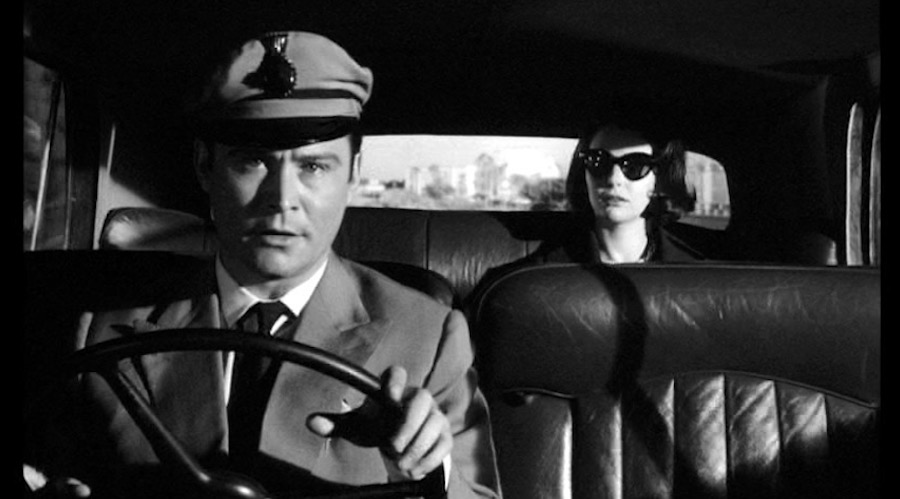
Director Yamatoya is best-remembered as the screenwriter of Seijun Suzuki's gangster masterpiece BRANDED TO KILL, and he made this film in tandem with another, the brazenly titled AMOROUS LIQUID aka LOVE'S MILKY DROPS (Tajo na nyueki, 1967). He was obviously very much under the spell of Godard's ALPHAVILLE when he made this; there are individual shots that could easily be shuffled into the earlier work without detection, and Sho is very much an Eastern Lemmy Caution, gumshoe in a cheap hat, wearing a wrinkled raincoat over a jacket and a necktie dickie. Yamamoto mixes his fictional narrative with documentary shots of his actors moving through documentary street scenes, which exert a quite different fascination of their own, and he reaches for some startling effects concerning the presentation of action and violence. At one point, a suitcase is flung so that it accidentally wings the camera, and the accident is left in; in another moment, a group of thugs bursting through our hero's barricades are shown in different feigned freeze-frame positions, incrementally advanced and adjusted as he sizes up his options for retaliation. The closer Sho comes to finding Mina, the more Yamatoya's technique adopts the technical recklessness of the home movies documenting her abuse. While I can't say the film's story is particularly memorable or even clear, it's a fascinating document and - for all its deliberate ugliness - appealing in the way it subverts its hardboiled drama into a kind of delirious poem about alienation and the need for human contact. Yosuke Yamashita's score adds a lot to the experience, heaping on some splashy, wailing, free jazz very much in the vein of John Coltrane's Quartet.


Aki Sasaki as the tragic heroine of GUSHING PRAYER.
The second feature, GUSHING PRAYER, is very much the other side of the coin. A more serious film, its protagonist Yasuko Aoyagi (Aki Sasaki) is not what we assume from the designation "15 Year Old Prostitute." First of all, she is not at all your typical 15 year old, as the non-stop conversations between her and her three best friends Koichi (Hiroshi Saito), Yoko (Makiko Kim), and Bill (Yuji Aoki) are intellectual, philosophical, and rigorous. In fact, their discourse is so relentless and mutually bullying, especially toward Yasuko (ironically the most sexually experienced of the group) that it attains a kind of abstraction separated from anything warm-blooded. They are also anti-sex, despite a shared sexual obsession induced by their young bodies and inherent friskiness, with the four of them determined to find ways within their rebellious fellowship of "beating" sex (which they perceive as a commercialized invention of predatory adults) and finding a way back in touch with their natural feelings. Yasuko would seem to have little chance of attaining this goal as, at 15, she finds herself pregnant from a covert relationship with one of her teachers (Shiganori Noda). The sometimes conflicting dogma of her fellows, not to mention her elders, makes it difficult for her to decide what her options are for the future.


Director Masao Adachi (still active as of 2016) was one of the more dedicated writers and directors of the pink cinema movement, having written the scripts for Koji Wakamatsu's reasonably well exported THE EMBRYO HUNTS IN SECRET (1966), VIOLATED ANGELS (1967), and GO, GO, SECOND TIME VIRGIN (1969), sometimes working under the alias "Izuru Deguchi." What he achieves with GUSHING PRAYER is anything but erotic; there is nudity and a few instances of animal rutting between people but we are only made to feel distanced from it and somewhat repelled and confused by it and what unsated greed or curiosity drives those involved.


Like its co-feature, GUSHING PRAYER takes advantage of some documentary locations where we see its characters passing among real people, and the silent spaces between forward jumps in the narrative are filled with quotations - tragic, despairing yet still inquisitive, and sometimes poetic - from the suicide notes of various teenagers, male and female. Filmed in black-and-white scope that occasionally jolts into bold color duotones (again, showing a debt to Godard) and a couple of shifts into full, if somewhat anemic, color, this is very much related to such grim teenage tragedies as Uli Edel's CHRISTIANE F. (1981) - and if its vomiting scenes are comparatively coy, at least one other instance of graphic body horror may serve you more than you're ready to see.

Both films are newly remastered and show just enough faint surface abrasion in places to remind us that these bizarre creations were actually shown to audiences in theaters, once upon a time. There is no commentary or essay material mentioned as part of this set, which would have provided some helpful context; however, Third Window has obtained the indispensable services of BEHIND THE PINK WINDOW author Jasper Sharp for their next round, which streets next week on May 25. VOLUME 3 + 4 will feature Masayuki Suo's ABNORMAL FAMILY (1984) and Kan Asai's BLUE FILM WOMAN - which I hope to write about soon. Here's a promotional image to tide you over, as well as this helpful link to more information.


(c) 2020 by Tim Lucas. All rights reserved.


Sunday, May 17, 2020

The Misery of Marie Roget

Found a somewhat blurry copy of Phil Rosen's Universal B-picture THE MYSTERY OF MARIE ROGET in my DVD-R collection and decided to give it a spin. I hadn't seen it since childhood and all I could remember of it were shots of a racing horse drawn carriage - which turns out to be because it's virtually the only thing in the film that's not talk. 

The movie opens with a discerning hand plucking a thick hardcover copy of Poe's short story from a piddling display of classic literature. The first thing the 60-minute film shows us is a Paris newspaper headline exclaiming the murder of Marie Roget - a simple perfume salesgirl in the story, but here an exotic music hall singer who is the toast of Paris! "Prefecture of Police BAFFLED!" we are informed. But Maria is soon revealed to be still alive, not the dead disfigured girl dredged up from the Seine. She and her sister's fiancée are plotting to murder her sister, a plan overheard by the grandmother who asks our hero Pierre Dupin to protect her. Dupin, the character Leon Ames (as Leon Waycoff) played in 1932's MURDERS IN THE RUE MORGUE, is played by the woefully bland Patric Knowles and he's continually being congratulated on solving that legendary case. The evil Maria's musicality is explained by the fact that Universal cast Maria Montez in the title role; but what is not so easily explained is that Maria is the granddaughter of Maria Ouspenskaya and the sister of Nell O'Day - so the three members of the Roget family living under the same roof have wildly different accents - and not one of them French! 


Nelly O'Day, Lloyd Corrigan, Patric Knowles, Maria Ouspenskaya and John Litel.
The other French roles are played by those beloved Gallic performers Lloyd Corrigan, John Litel, and (as a zoo keeper) Charles Middleton. Corrigan is the foolish Prefect ("Pre-fey") of Police, who has to be reminded more than once in his impulsive attempts to arrest people that it would help to have an airtight case against the suspects first. He gabs so relentlessly and pointlessly he must have been paid by the word; his fussy, comic, impatient window dressing crowds the film so badly that our hero-genius Dupin is reduced to standing around mixing chemicals and slyly testing theories he confides in neither the Prefect nor the audience, so his general lack of charisma is compounded by the no more than vague sketch we're given of this celebrated detective. The movie lifts whenever Madame Ouspenskaya puts him in his place. At a party, Maria makes everyone swoon by singing an interminable song in Spanish. When someone tries to poison her and Dupin (perhaps a music critic), it looks like Phil Rosen himself stepped up to tap the powder into their untended drinks. In a last act confession of creative bankruptcy, Dupin deduces that the cause of the shared facial disfigurementa of the female murder victims is a common hand garden rake - the very same prop used as the signature weapon of the killers in Universal's THE SCARLET CLAW and SHE-WOLF OF LONDON, made around the same time. The film's only persuasive whiff of France comes from a climactic rooftop chase as Dupin and the Prefect chase the skulking shadow figure from HORROR ISLAND over the rooftops of Paris. His defeat doesn't bring us much closure; we're told who this cloaked phantom is by name, but we're not given a shot of his face to confirm which of the cast members he was.

On the very narrow plus side is some occasionally striking photography by Elwood Bredell (THE MUMMY'S HAND, HELLZAPOPPIN!, PHANTOM LADY), which must be even better served by a proper presentation. Entertaining in its general ineptitude, and the inability of the actors to speak either believable English OR French, I'm sure the reason why my childhood memories of THE MYSTERY OF MARIE ROGET are so limited is that it must have driven me to raid the refrigerator.

Having fallen back on my old DVD-R out of mistaken desperation, I now see that it's been available from Universal since 2014 as part of their Vault Series. If my notes have intrigued you, you can find it here.

(c) 2020 by Tim Lucas. All rights reserved.

Monday, May 11, 2020

UNHEIMLICHE GESCHICHTEN, Sight and Sound

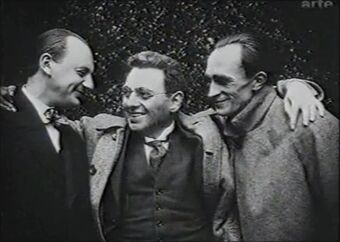
Rudolph Schündler, Richard Oswald, and Conrad Veidt.

I had never seen either version before, so I was delighted to find the 1919 silent and 1932 sound versions of Richard Oswald’s seminal horror anthology UNHEIMLICHEN GESCHICHTEN (EERIE TALES) on YouTube. The silent version contains five stories, the sound version three (or four, it's hard to tell), both incorporating Poe’s “The Black Cat” and Robert Louis Stevenson’s “The Suicide Club.” The 1919 version is quite impressive; I think 1919 feels longer ago in the past because it links us to period films more often than not, but EERIE TALES (while covering different time periods) is surprisingly contemporary in its filmmaking techniques, production design, and the close attention it pays to facial acting. Three archetypal figures - The Flirt, The Devil, and Death (respectively Anita Berber, Rudolph Schündler, and Conrad Veidt) - step out of their portraits, which adorn the walls of a used book store, frightening the owner and taking over the shop, availing themselves of stories in the books on display. 


Schündler, Berber, and Veidt as Literature's arcana of Evil. 

This unholy three appear in each of the stories, as different characters but sometimes within the same archetype, providing the actors with chances to flaunt their dramatic range. Veidt is predictably remarkable, but Schündler is a revelation. His Devil is a clear antecedent of the Lugosi vampire image, with his black cape, pasty face, and widow’s peak; his crazy husband character in the first story is the actual prototype of the aptly-named Cousin Eerie (!); and Peter Lorre clearly had his performance in mind when he essayed the same role on Roger Corman’s TALES OF TERROR almost 50 years later. The closing story, an original by Oswald told in verse, shows the chameleonic Veidt in a performance that serves as a dry run for his celebrated Gwynplaine/Lord Clancharlie in 1928's THE MAN WHO LAUGHS. In a surprising early gesture of auteurism, Oswald shares the screen briefly at the outset of the film in celebration of his partnership with the two principal actors. 


Domestic discord as mise en scène in the 1932 version.

The silent version is among the best of its kind, but the 1932 sound version (sometimes called THE LIVING DEAD) may be even better; I think there’s a good case to be made that it’s also the first feature-length surrealist work. Its stroke of genius is that the stories are presented as a single fluid entity; there is no framing device as in the previous version, so the stories flow one into the next like twists in an already delirious tale. It opens with Paul Wegener (THE GOLEM), truly a great and versatile horror star, starring in an adaptation of the subsequently oft-filmed “The Black Cat,” a touchy inventor who murders his wife, whose final scream is overheard by crusading on-the-spot reporter Frank Briggs (Harald Paulsen). Rather than submit to inescapable arrest as in the Poe story, Wegener (whose character is given no name other than Mörder, or Murderer) escapes the police and hides amid the figures in a waxworks. The film is said to consist of only three stories, but this waxworks segment has the feel of an uncredited fourth. Briggs trails Mörder to this shrine to dead criminals and their fistfight culminates in a switch being thrown that activates the figures' mechanical movements. Lots of creaky thrills before our villain wriggles his way out of yet another arrest and inevitable execution by arranging for his commitment to an insane asylum where, as it happens, the inmates have taken over in an adaptation of Poe’s “The System of Doctor Tarr and Professor Feather,” which may be the film’s highlight - it's the sort of thing we would now call Buñuelian. Wegener foils Briggs once again and disappears for six months, when he reappears as the mysterious ringleader of an ultra-sophisticated Suicide Club, in an adaptation of Stevenson’s classic story. The ultra-stylish design of this episode is almost alarming to discover in a 1932 film; its look  anticipates Edgar G. Ulmer’s 1934 feature version of THE BLACK CAT. The segment also includes a very Lugosi-like performance by Wegener, scenes in which he interacts with fellow GOLEM actor Ferdinand Hart (who would later essay the title role in Julien Duvivier's sound version of 1936), and an actual shot that would be repeated in Lew Landers' THE RAVEN from 1935. 
Paul Wegener - a great horror star. 

Director and co-scripter Oswald - whom I believe was the father of OUTER LIMITS director Gerd Oswald - is an under-appreciated craftsman and early horror specialist. These two films, though dealing to a fair extent with the same material, not only stand uniquely well on their own but they bear favorable comparison to most of the many horror anthologies that followed through the subsequent decades. They are both captivating entertainment, cleverly and stylishly served up, and feel more effectively organic than most of their imitators. We’re very much in need of definitive presentations of both films; they would make a marvelous double feature set.

UPDATE 05/14/2020:
Since posting the above, I have learned that YouTube also has a subtitled presentation of Richard Oswald's 1930 remake of ALRAUNE available for viewing here. Additionally, for those who haven't seen Henrik Galeen's 1927 silent original, that is also uploaded over there at this link. Both versions star Brigitte Helm, the Robotrix from METROPOLIS. The subtitles on the silent version (which also features Paul Wegener) are Russian, but if you go into Settings over there, you can reset them for Auto Translate into any language you wish.
    
Furthermore, from reader Volker Stieber:
"Hi, Tim - , I read your review of UNHEIMLICHE GESCHICHTEN and wanted to let you (and your readership) know that a restoration of the 1919 version was released on German DVD in 2013. It looks very nice and it is estimated to be missing only about 4 minutes. Cheers!" 

(c) 2020 by Tim Lucas. All rights reserved.

Friday, March 13, 2020

Friday the 13th Greetings

I apologize for my absence here of late. I've been working on more audio commentaries, and I'm knuckling down to a particularly ambitious one now. But I thought I really should pop in to let you know about some new work I've generated elsewhere online. 

I was recently interviewed by the online arts journal THE CHISLER. You can read our conversation here.

Apparently it was well received by their readership and I've been encouraged to contribute more regularly. Still not decided on whether to approach this challenge as a column or as a series of independent posts, but I did test the waters over there with a first contribution about director Al Adamson, whose entire surviving body of work is going to be released in a staggering box set from Severin Films next month. You can read it here.

I was recently invited by Shane Hazen and Ted Haycraft to be a guest on their podcast THE PHI PHENOMENON. We recording our conversation last night, talking for about 90 minutes; they may be breaking up the session into two episodes. I'll let you know when I know it's been uploaded.

In other news, this is shaping up to be a remarkable year. I've been pursuing my fiction career of late with more determination and, last week, I signed a contract with Lori Perkins' Riverdale Avenue Books, which will be publishing two of my novels - THE ONLY CRIMINAL and THE ART WORLD - later this year. Legendary BATMAN artist Kelley Jones has promised me a piece of original art for THE ONLY CRIMINAL. Additionally, I hope to have an announcement soon about the publication of my most recent novel, a novelization of the film script THE MAN WITH KALEIDOSCOPE EYES.  

You may also recall that my novella THE SECRET LIFE OF LOVE SONGS is due out from PS Publishing later this year, and work has been continuing on the musical soundtrack intended to accompany the book. There will be five songs I've co-written with Dorothy Moskowitz Falarski (formerly with Columbia recording artists, The United States of America) and the songs will not only be graced with vocals and piano by Dorothy herself, but also by legendary guitarist Gary Lucas (Jeff Buckley, Captain Beefheart's Magic Band) and the fabulous multi-instrumentalist Mike Fornatale (Murderer's Row and the reunited Left Banke and Moby Grape). Gary just turned in his tracks, and we're still waiting for one from Mike. It's been a long, slow process but it's exciting to see and hear it all coming together. We're just about at the mixing stage.

Other than that, I've been reading lately much more than watching films. I got through WAR AND PEACE finally, with great admiration for it, and I've been reading a good deal of French pulp and literature, some SHADOW, some DOC SAVAGE, and Edgar Wallace's THE DEVIL MAN - far and away, the best work I've yet read by him. Just finished DEATH PACKS A SUITCASE, the debut novel by his son Bryan Edgar Wallace, who I found to be a far more lucid and vibrant writer though the novel ultimately succumbs to a too hasty final couple of chapters. A great deal at stake is written off rather glibly, but I was still impressed by his skill at writing character - fairly dimensional women as well as men, even if they are prone to throwing tantrums and committing murder. I also recently got around to reading Black Coat Press' THE DAUGHTER OF FANTOMAS, which I should write about here soon at some point, as I've covered the previous ones in the series on this blog. By an absolute coincidence, I picked this book up on what this blog later reminded me was the second anniversary of finishing its predecessor, SLIPPERY AS SIN. 

(c) 2020 by Tim Lucas. All rights reserved.  


Wednesday, March 11, 2020

Return of THE WHITE SPIDER (1963)

Last night I decided to refresh my memory of THE WHITE SPIDER (Die Weisse Spinne, 1963), one of several adaptations of early pulp crime novelist Louis Weinert-Wilton (1875-1945) made in response to the success of Rialto’s popular Edgar Wallace franchise in West Germany. It may seem a flagrant intrusion given that the film's producers hired nearly all of Rialto’s star players (Joachim Fuchsberger, Karin Dor, Werner Peters, etc), had Rialto’s star composer Peter Thomas score the film, and handed its reins to director Harald Reinl, who had initiated the Wallace series with its first few films - but in fact the two franchises were not in literal competition, both being manufactured for distribution through the same company, Constantin Film. All four of the Weinert-Wilton adaptations are now available on Blu-ray in Germany (alas, without English audio or subtitles), but I was able to find the English dubbed version of THE WHITE SPIDER (prepared for Canadian television) over at YouTube, where at least one other of the Weinert-Wiltons (SECRET OF THE BLACK WIDOW) is available in its English dub.


Halfway through THE WHITE SPIDER, I realized I was grooving on the atmosphere rather than following its story, but it wasn’t hard to catch up. Dor plays a destitute widow trying to claim her rightful inheritance after the apparent death of her husband, a gambling addict whose good luck talisman was a decorative white spider on his keychain, likenesses of which are turning up as signatures at various murder scenes, causing Scotland Yard to doubt his demise. The murderings by lasso were subsequently adopted by Rialto for their two Wallace MÖNCH ("Monk") movies (known here as THE MYSTERIOUS MAGICIAN and THE COLLEGE GIRL MURDERS). The fine cast shines somewhat less here than elsewhere, but this outing also boasts Horst Frank and SLAUGHTER OF THE VAMPIRES’ Dieter Eppler, who steals the picture as the titular criminal master of makeup, modeling various disguises à la Fantômas. It’s not as well produced as the Rialto Wallaces but it's fairly eventful even at its more generous running time (about 103 minutes) and still worth seeing. At several points, one realizes that Dario Argento’s greater influence was from films like this, rather than the works of Bava or Freda.

(c) 2020 by Tim Lucas. All rights reserved.


Wednesday, February 19, 2020

RIP: José Mojica Marins (1936 - 2020)

Your Humble Blogger, with José Mojica Marins and Barbara Steele.
Chiller Theater Expo, New Jersey, October 1994. 
I've just heard that the great, impossible, absolutely individual Brazilian actor, writer, and filmmaker José Mojica Marins has passed away. He first made his mark in South American cinema with his Zē do Caixāo character in the early 1960s and some stray, bizarre photos from them drifted up North, but the films themselves remained lost to us until Mike Vraney's Something Weird Cinema came along and struck up a deal with him. As a perk of that deal, I got to meet him in 1994 at the Chiller Theater Expo, where Barbara Steele was also guesting. José extended me the gift of being allowed to gently shake his left hand, the one with the very long, highly brittle nails of which he made such chilling use onscreen - something he did not permit the eager general public. A bonafide original, a revolutionary, Hellfire incarnate, a master of narcissism and the darkest satire, we will not see his like again. He was 83.

You can search this blog for earlier postings about this important figure.  

(c) 2020 by Tim Lucas. All rights reserved.

Tuesday, December 31, 2019

Good Night, 2019!

Whereas last year felt to me like a time of great harvest, 2019 felt to me like a year of hard work and hard decisions. It was not without its accomplishments - I wrote, recorded, and edited more than 20 new audio commentaries, roughly 60 new blog entries, several new articles and essays for Quentin Tarantino's New Beverly Cinema blog (some actually written at Quentin's request), the Foreword to Tanya Constantine’s memoir OUT OF MY FATHER’S SHADOW, and also added a second Saturn Award and two new Rondo Awards to my mantel. In the midst of all this (with some days off for general sloth and other days dedicated to feeling either hopeless or uninspired), I also managed to complete my MAN WITH KALEIDOSCOPE EYES novel, finish the first draft of my 1960s Joe Sarno book (its polishing is already underway), and take an important step toward getting my long-neglected novel THE ONLY CRIMINAL finally into print. Last but certainly not least, I also managed to set up the groundwork to protect my musical collaborations with dear Dorothy Moskowitz Falarski and stream the first of them (“Merry Christmas Anyhow”), which has been a very special joy.

So as this busy year ends, the stage is somewhat set for a happy harvest next year. I did not leave myself much time to attend to physical maintenance or personal relationships, which I regret and hope to amend in the coming year. 

Other 2020 plans include seeing my Nick Cave-inspired novella and soundtrack into print through PS Publishing, finding a publisher for my Sarno book(s) and starting work on the second volume, and hopefully doing some work toward a new novel. In a sane world, all of this would constitute a full plate but bills must be paid, so my first priority will be the stack of exciting new audio commentary assignments already awaiting my attention. 

Thank you all for your interest, attention, and support of me and this blog these past twelve months. Wishing all of you and yours a safe, productive, and loving New Year! And as always, "responsibrate celebly" tonight!

(c) 2019 by Tim Lucas. All rights reserved.

Monday, December 23, 2019

My 13 Favorite Fantastic Blu-rays of 2019


1. ULTRA Q (Mill Creek Entertainment)
The forerunner of ULTRAMAN and its many spin-offs, this complete set of 28 half-hour episodes is not entirely what one might expect from its legacy. Some episodes are indeed about new Tsubaraya monsters (and some thinly disguised old ones) arising to crush cities underfoot, but its real basis is THE TWILIGHT ZONE; there are also unsettling stories about existential situations, haunted houses, science fiction, and childhood imagination - and its all shot in gorgeous 35mm black-and-white, giving this most satisfying package the flavor of a self-contained Japanese new wave fantastique festival. Mill Creek has also issued similar sets collecting the spin-off series ULTRAMAN, ULTRA SEVEN, ULTRAMAN GEED and ULTRAMAN ORB.


2. LAST YEAR AT MARIENBAD (Kino Lorber)
One of my favorite movies, given a breathtaking 4K Studio Canal presentation and couched in some of the year's best supplementary features, including a dazzling, enraptured, in-depth interview with assistant director Volker Schlöndorff, actual 8mm home movies documenting the behind-the-scenes reality of the production, a fascinating visual essay by James Quandt, and a booklet essay by K. Austin Collins. I must also mention that it contains a new audio commentary by me; I gave it my all, and it's one of the more than 100 I've done of which I'm most proud.


3. HAMMER VOLUME FOUR: FACES OF FEAR (Indicator)
Indicator's fourth box set of Columbia Hammer titles is, to put it plain, their best yet, collecting Terence Fisher's THE REVENGE OF FRANKENSTEIN and THE TWO FACES OF DR. JEKYLL, Seth Holt's suspense thriller TASTE OF FEAR (aka SCREAM OF FEAR), and Joseph Losey's masterful THE DAMNED (aka THESE ARE THE DAMNED), which may be my own favorite Hammer film of all and a science fiction film I consider equal to METROPOLIS at the very least. The films have not been equally upgraded; REVENGE is given a powerful 4K reading (if you know and love the film, and whether you saw it theatrically or just know it from lesser home video incarnations, the red lettering of the main titles will knock you back in your seat) and THE DAMNED's 2K upgrade is lovely; but this is not to say there's anything disappointing about how the other two look. I found TWO FACES (another Hammer favorite of mine) a revelation in its uncut form. As always, Indicator brings in a number of British Hammer authorities to provide opinion and context; especially appreciated is David Huckvale's talks on the musical scores of the various films, and the female perspectives brought to bear on the heroines of each picture. I've yet to delve into the audio commentaries, but we get Stephen Jones and Kim Newman on REVENGE, Josephine Botting and Jonathan Rigby on TWO FACES, Kevin Lyons on TASTE, and Kat Ellinger and Samm Deighan on DAMNED - the billing alone promises fascinating listens. This is a strictly limited edition of 6,000 numbered copies. Follow this link for a complete breakdown of the remarkably thorough contents.


4. UNIVERSAL HORROR COLLECTION VOLUME 1 (Scream Factory)
Collecting the remaining prime collaborations of Boris Karloff and Bela Lugosi - THE BLACK CAT (1934), THE RAVEN (1935), THE INVISIBLE RAY (1936) and BLACK FRIDAY (1940) - this box set brings together 2K scans of all but the first title (which is nevertheless beautifully detailed), along with an engrossing set of commentaries by Gregory William Mank, Tom Weaver, Gary D. Rhodes, Steve Haberman, Randall Larson, and Constantine Nasr. These are the foremost scholars on the subject and their talks take many different approaches to their subjects, ranging from great intensity, fannish veneration, scholarly distance, juicy gossip, even occasional irreverence - sometimes all in a single commentary! The set also includes a background documentary about the two stars that graduates from disc to disc like chapters from a fat, rollicking, illustrated book exploring their personas, their respective fortunes, and their much-speculated-upon rivalry. Scream Factory has since issued two more such collections of the studio's most macabre B-pictures (VOLUME 4 is coming in March), as well as a stand-alone release of Robert Florey's MURDERS IN THE RUE MORGUE (1932) with Lugosi, which stands as one of the finest film restorations of the year.


5. THE DEVIL RIDES OUT (Scream Factory)
This the first-ever Blu-ray release of this Hammer classic in its original form; an earlier UK release tinkered with the sadly unfinished climactic special effects footage in an unfortunate attempt to bring them up to date. Seeing it again confirmed a few things for me, but I can sum them up in a single line: this is arguably the best work Terence Fisher, Christopher Lee, and Richard Matheson ever did for the screen. Happily, the disc gives the film all the contextualizing it deserves, including the Christopher Lee/Sarah Lawson commentary from the previous DVD release, a new and invigorating commentary shared by Constantine Nasr and Steve Haberman, and featurette input from Kim Newman, Jonathan Rigby, Marcus Hearn and others.


6. ROBOCOP LIMITED EDITION (Arrow Video)
Ken Russell once famously said that Paul Verhoeven's ROBOCOP was the greatest science fiction film since METROPOLIS, praise that covered half a century. This 4K restoration lovingly preserves all the lustre it ever had and brings us into closer contact with some great performances. In addition to Peter Weller's deeply felt starring role, it's poignant to revisit the raw youthful ambition of Miguel Ferrar's performance. Priced at less than $30 at Amazon, this is much more than a two-disc set; it's also not merely three different versions of the film - just follow the link to look agog at the extras and bonus content. Get it before they're gone. PS: There are also three distinct soundtracks on offer. They're all good, but top marks go to the 4.0 theatrical mix.


7. ONCE UPON A TIME IN HOLLYWOOD (Sony Pictures Home Entertainment)
This is the only contemporary film on my list, which is at least partly due to my not seeing many new genre films this past year. Even so, each new viewing of this picture - written by Quentin Tarantino in a kind of celebration of the VIDEO WATCHDOG ethic - makes it more and more intoxicating; on the big screen, it's environmentally absorbing, and on Blu-ray it's Robert Richardson's master class in how to combine camera movement and historically recreated detail. Nearly every shot has something in it that's hypnotic, nostalgic, and loving. Some people will tell you this film doesn't have a plot, but it's there - just really spread out over an impressive territory, much like Los Angeles itself. Accompanied by 20 minutes of deleted scenes and five shorts to enhance one's appreciation of the cinematography, the clothes, the art direction, and the cars, this is an immensely satisfying disc but I wouldn't be surprised if a more deluxe package comes along later. In the meantime, I recommend Twilight Time's Blu-ray of Jaques Demy's THE MODEL SHOP for a terrific aperitif.


8. ALPHAVILLE (Kino Lorber)
Before ROBOCOP was made, novelist J.G. Ballard claimed Jean-Luc Godard's ALPHAVILLE as the greatest science fiction film ever made - and again, who am I to argue? This is another top shelf Studio Canal 4K restoration, but the black-and-white image retains a certain coarse quality that was apparently - as Anna Karina explains in a 4m interview segment - baked into the picture by Godard's use of a then-new film stock that could shoot in low light. Though ALPHAVILLE has enjoyed a past Criterion release, this is the first ever to include the film's English dubbing track, for which many of the film's American admirers have a special affection as it was how the film was initially shown here in the States. My audio commentary aspires to give equal time to Godard and star Eddie Constantine, and it includes input from Eddie's daughter Tanya (who was a visitor to the set) as well as from co-star Christa Lang Fuller.


9. DEAD OF NIGHT (Kino Lorber)
There were earlier horror anthology films, silent ones and maybe one or two sound ones made in Germany, but this is the acknowledged starting point of all those that would famously follow, from DR. TERROR'S HOUSE OF HORRORS to SCARY STORIES TO TELL IN THE DARK. More importantly, the film's various directors (particularly Basil Dearden and Alberto Cavalcanti, though Charles Crichton is also aboard) adeptly raise its shocks to a level stronger than what came before, much as THE EXORCIST would so again in the 1970s - watching it, it's very easy to understand how postwar audiences would have been jolted by it. The perfect fodder for a popcorn and gooseflesh night. There is a slight but persistent scratch on the print but it's worth it to see the film a grade closer to its original camera source; there is contrast and detail here never before seen in earlier renderings. There is a terrific feature-length supplement, "Remembering DEAD OF NIGHT" with on-camera reminiscences from Keith M. Johnston, Danny Leigh, Kim Newman, Matthew Sweet (not the musician), Jonathan Romney, Reece Shearsmith, and John Landis - and I provided an audio commentary, which SLANT Magazine's Chuck Bowen described as "characteristically detailed and erudite." 


10. FRITZ LANG'S INDIAN EPIC: THE TIGER OF ESCHNAPUR / THE INDIAN TOMB (Film Movement)
This lavish diptych was producer Artur Brauner's bid to tempt Fritz Lang back to postwar Germany to direct motion pictures. For confounding reasons - possibly political, but more probably rooted in American International's decision to whittle this opulent masterpiece down to a combined single-feature length - it has never enjoyed the respect here that it fully warrants. The story itself is pure pulp, but the rest is eye candy of the highest caliber - never moreso than when American actress Debra Paget performs two of the most erotic, downright tantric dances in film history. Not available on disc since Fantoma's 2003 DVD set, both films have been treated to 4K restorations but here include only a subtitled German sound option - so hold onto the Fantoma disc if you want to reserve the English dub option never otherwise heard in this country in its entirety. David Kalat provides two remarkably thorough audio commentaries, incorporating a wealth of research. Other supplements include a 21m making-of documentary, a 36m Mark Rappaport visual essay on La Paget, and an illustrated booklet including a Tom Gunning essay.
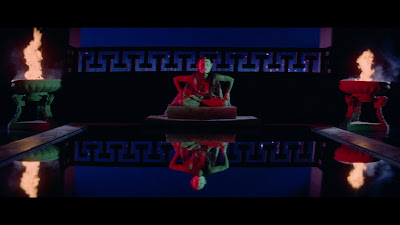


11. HERCULES IN THE HAUNTED WORLD (Kino Lorber)
The directorial filmography of the great Mario Bava takes another long stride toward completion with HERCULES IN THE HAUNTED WORLD - his second feature as director, his first in robust Technicolor, and an early return to the sword-and-sandal genre. Like PLANET OF THE VAMPIRES, the film is an exercise in how to pull the most rewarding rabbits out of a cheap hat, giving us not only Bava the director but Bava the maestro of special effects magic, all produced using charmingly antiquated yet convincing in-camera techniques. Reg Park makes a splendid Hercules, and the story - though it doesn't quite makes sense and evinces a lot of rewriting during production - never stops moving, whether it's forward or sideways. This double-disc set includes no less than three different cuts of the film (Italian, British, and the extensively tinkered-with American version, never before officially released), along with a lengthy if sparse interview with co-star Giorgio Ardisson (then struggling with throat cancer) and my audio commentary, first released on a 2018 Koch Media BD in Germany. That release included a bonus feature as an extra, Mario Soldati's THE TAMING OF DOROTHY (1950), which Bava photographed.


12. DER GAUNER VON BAGDAD aka THE THIEF OF BAGHDAD (Colosseo Film)
Arthur Lubin's THE THIEF OF BAGHDAD was made around the same time and I've been waiting literally decades for it to make the leap to disc; it's been missing in action since its 1980s release on Embassy Beta and VHS. Though the special effects of this glorious Steve Reeves fantasy are credited to the British technician Tom Howard, and its miniature scale models attributed to Joseph Natanson, the film also features glass matte paintings and second unit direction by Mario Bava - who chose not to be credited to protect his then-new advent into the director's chair. This German import disc marks the first time the film has been available in full widescreen and its colors, art direction, wardrobe, choreography and battlefield spectacles (one involving a magic army of Reeves lookalikes) are a constant treat for the eye, while Carlo Rustichelli's score blends ethereal exotica and darkly suspenseful cues reminiscent of his work on BLOOD AND BLACK LACE. I've heard complaints about not all the shots looking so great, but the brief shots of slightly coarser quality were all mildly compromised by optical dissolves and have always looked this way.


13. BLOOD HUNGER: THE FILMS OF JOSÉ LARRAZ (Arrow Video)
A box set collecting three of the most representative works of the late Spanish specialist in erotic horror and suspense: the debut feature WHIRLPOOL, not available for viewing for almost 50 years; his most famous feature VAMPYRES; and a powerful and ambitious art feature about the potency of myth, THE COMING OF SIN. Audio commentaries by Samm Deighan, Kat Ellinger, and myself help to fill in the blanks of what's missing and to contextualize what's here; also among the extras providers are Kim Newman, Marc Morris, various cast members, and archival interviews and video of Larraz himself, who was quite a character. The 2K restorations of all three features are superb and one sincerely hopes another such set will follow to prolong the conversation.

13 HONORABLE MENTIONS:

1. THE QUEEN OF SPADES (Kino Lorber)
Thorold Dickinson's enthralling British production from 1949, based on an Alexander Pushkin story, is really an historical melodrama and only tangentially fantastic - Dame Edith Evans stars as an aged Countess who is rumored to have sold her soul for the secret of winning at cards, a mystic secret hungrily coveted by a penniless young officer, played by an intense Anton Walbrook. It's as gripping and dreamy as any Technicolor Powell and Pressburger epic.  Graced with a thoroughly informative commentary by Nick Pinkerton, two archival interviews with Dickinson, and an elegant video essay by author-critic Philip Thorne.

2. BLACKMAIL (Kino Lorber)
Includes both the celebrated sound and overlooked silent versions, as well as my audio commentary. According to DVD Beaver, it's at my "usual proficient level and adds significant value and appreciation."

3, SCARS OF DRACULA (Scream Factory)
The extras, notably the new commentary by Constantine Nasr and Randall Larson, and a new 18m documentary, goes a long way toward explaining the shortcomings of a beloved but compromised film.

4. VIY (Severin)
The most celebrated of Russian horror features, distinguished by wonderful special effects sequences by the great Aleksandr Ptushko, makes its Blu-ray debut. Includes "The Portrait," a silent-era short by Ladislas Starewitch, which anticipates THE RING by nearly a century.

5. FANTOMAS THREE FILM COLLECTION (Kino Lorber)
A sterling presentation of Andre Hunebelle's comic crime fantasies, including two sequels that never before had a US release. My audio commentary accompanies the first.

6. THE MAN WHO LAUGHS (Flicker Alley)
One of the year's most impressive 4K restorations, this Blu-ray makes Paul Leni's silent masterpiece almost contemporary in its presence. It also offers a choice of musical accompaniments and a wealth of enriching bonus content, including a Kevin Brownlow essay in the accompanying booklet.

7. QUATERMASS II (Scream Factory)
8. QUATERMASS AND THE PIT (Scream Factory)
Having these two films on Blu-ray is absolutely essential, but under the direction of producer Constantine Nasr, these discs represent important new blocks of research. Three (count 'em), three new commentaries on QUATERMASS II (Ted Newsom, Constantine Nasr and Steve Haberman, and the classic Val Guest and Nigel Kneale track), while PIT includes two commentaries (Bruce G. Hallenbeck, Nasr and Haberman) and more than an hour of new on-camera interviews with various cast and crew members and Kneale's widow Judith Kerr (who has since passed away).

9. THE LOST SKELETON RETURNS AGAIN and TRAIL OF THE SCREAMING FOREHEAD (Hydraulic Entertainment)
Both funded by Kickstarter campaigns, these two fully-loaded discs bring two of Larry Blamire's surreal genre comedies into high definition, with the latter including two different cuts of the film, one being the US debut of his long-withheld director's cut. The extras include audio commentaries, behind-the-scenes documentation, and some brand-new comedy shots that are absolutely hilarious in their inspired weirdness. I'm counting these two as one, so less call this a tie!

10. TOYS ARE NOT FOR CHILDREN (Arrow Video)
11. AMERICAN HORROR PROJECT VOLUME 2 (Arrow Video)
12. ALICE, SWEET ALICE (Arrow Video)
These three Arrow releases feel related, with TOYS and ALICE both belonging (and, to some extent, crowning) the territory defined by Stephen Thrower's book NIGHTMARE USA and the AMERICAN HORROR PROJECT series. The three titles included in the second AHP box set (DREAM NO EVIL, DARK AUGUST, and THE CHILD) are minor disappointments but the way the set contextualizes and analyzes them is essentially faultless and where the real value of the set resides. TOYS is an inspired and unsettling descent into the sick underbelly of 1970s America, and ALICE - a film that may have somewhat worn out its welcome due to its inclusion in various PD DVD sets - is completely revitalized, not only with a much warmer looking restoration but an ace audio commentary by Richard Harland Smith.

13. LET THE CORPSES TAN (Kino Lorber)
Released early in the year, this is the third feature by the exciting team of Hélène Cattet and Bruno Forzani (THE STRANGE COLOR OF YOUR BODY'S TEARS) and, as with Tarantino, it proposes a new post-VIDEO WATCHDOG meta-language of storytelling. The genre here is crime with western elements - imagine BREAKING BAD co-directed by Alejandro Jodorowsky and Sergio Corbucci. The filmmaking is consistently dazzling.


RESTORATION OF THE YEAR:


HOUSE OF SEVEN BELLES (ByNWR)
The sole work print of Andy Milligan's not-only-long-lost but never-completed antebellum, anti-everything epic has been treated to a deluxe restoration by Nicolas Winding Refn's streaming-only channel and is also due to screen on MUBI. Say what you will about it, HOUSE is unmistakably the work of its wonderfully deranged director/photographer/editor/costume designer and this is an important chapter of his story - the last of his Staten Island productions before he relocated to the west coast. The sort of major recovery one simply cannot stop gawking at in disbelief, this never could have happened without Andy's friend, biographer, and archivist Jimmy McDonough, whose completely redesigned and updated book THE GHASTLY ONE is due in March from FAB Press.

I am acutely aware that my list omits most everything of a contemporary nature and heavily favors the classic titles. I have only included titles I have seen. I'm sure there are many titles not on my list that probably belong there - to name just a few: Criterion's GODZILLA: THE SHOWA ERA FILMS; Arrow's deluxe box sets on NIGHTBREED, the RINGU series, and Akio Jissôji's BUDDHIST TRILOGY; and Kino Lorber's LA PRISONNIÈRE and so many, many others.

All in all, this was quite a bountiful year!  

(c) 2019 by Tim Lucas. All rights reserved.