Friday, September 15, 2017

RIP Basil Gogos (1929-2017)


I swear to you, one of my first thoughts upon awakening yesterday morning was of the first time I met Basil Gogos. It was October 1994 and I was at the Chiller Theater convention in Secaucus, NJ, helping Barbara Steele with her table when I heard that Basil Gogos was down the hall, setting up his own table. I hightailed it right over there, found him setting things out on his table and speaking with an attractive younger woman seated behind it (I later learned this was his partner, artist Linda Touby); I grabbed him by the hand and told him that I had to rush over and tell him how very much his work had enriched my life. Out of the corner of my eye, I saw Linda smile and look down; I still don't know if she was smiling because she was pleased to see him so appreciated or amused because she heard this from everyone meeting him for the first time.

And now I've just heard that Basil has passed away the day before yesterday, September 13, at age 88 (though some Internet sources list him some 20 years younger), in time for him to have sent me that waking thought. No cause has been reported.

Though he was not the first artist to paint a cover for FAMOUS MONSTERS OF FILMLAND, Basil (then a veteran illustrator for men's adventure magazines) literally blazed the trail for horror and monster portraiture, single-handedly defining the glory of the painted monster magazine cover, turning images coined for exploitation into the finest of fine art - feral poses and bestial, skeletal faces splashed with all the colors of fright and passion. He began with the image of Vincent Price's Roderick Usher on the cover of FAMOUS MONSTERS OF FILMLAND #9, and - incredibly - though his artwork (sometimes recycled) appeared on fewer than 45 covers in the magazine's 25-year, 191-issue run, his work arguably defined the flavor and the potential of the magazine in ways its photo-heavy, juvenile interior could only hint at. He also provided covers for other Warren Publications, including SCREEN THRILLS ILLUSTRATED and SPACEMEN, but Warren seemed to tap him to launch new ventures rather than to sustain them.  Remarkably, he had provided only 15 covers for FAMOUS MONSTERS before there was an unexplained parting of the ways that led to his being replaced by the likes of Ron Cobb, Vic Prezio, Ken Kelly and various photo covers, and even some reprises of his covers (Claude Rains' PHANTOM OF THE OPERA, GORGO) on later issues. (Discovering how rarely his work actually appeared on FM's covers, in contrast to the seismic cultural impact they had, is like realizing that Christopher Lee appears for only eight minutes in HORROR OF DRACULA.)

Upon the death of Boris Karloff in February 1969, Warren Publications wisely arranged for Gogos' return, and his elegiac portrait of Boris Karloff as the Frankenstein Monster for the cover of FM's Karloff Memorial issue (# 56) proved an instant classic. Looking back, in some ways, this cover and issue were my introduction to the mourning process and something in me, now, wants to relight its beautifully rendered candle for Basil.

The return of Gogos to the covers of FAMOUS MONSTERS was the beginning of a second and even longer streak of classic cover paintings: Jonathan Frid as DARK SHADOWS' Barnabas Collins; Fredric March as Mr. Hyde; Hurd Hatfield as Dorian Gray; Vincent Price in HOUSE OF WAX. But within the year, the magazine resorted to another recycling, this time of Lon Chaney's razor-toothed vampire from LONDON AFTER MIDNIGHT, FM's cover for #20 reformatted for #69. As fans, we patiently awaited the next Gogos cover. His last for the magazine came with an extraordinary portrait of Prudence Hyman as Hammer's THE GORGON for the cover of FM 179, in 1981. In a terrible lapse of judgement, a photograph of Arnold Schwarzeneggar from CONAN THE BARBARIAN was allowed to intrude upon and share the composition.

At the time I met Basil, he was doing covers for Steven Smith's fine new magazine MONSTERSCENE. I presented him with some copies of VIDEO WATCHDOG, and though he was later very complimentary about the content, we both had a chuckle when the first words out of his mouth were a disappointed "Oh, you do photo covers..." I have no idea what he was paid for his cover art, but - till the very last issue of VW - I always found the hardest job to be working out adequate compensation for our cover artists, because Gogos had instilled in me so much respect for that work. He was a soft-spoken, cheerful, and humble man and I wasn't prepared to insult him by making him an offer I considered to be far beneath him. His brushes had conjured so many of the contours of my young imagination; he articulated with greater skill than my young self could muster a real passion for the monsters I loved, and therefore taught me something of love and passion. His mastery of color prepared me to love Mario Bava. My favorite of all his works is his portrait of Ingrid Pitt, done for the cover of MONSTERSCENE; Ingrid was at that Chiller show too, and I know that she was deeply pleased and flattered by it. (How could she have felt otherwise, beholding the difference between a performance and a piece of iconography?) I was fortunate enough to have been standing there as she voiced her appreciation and he returned it by saying it was his great honor to work with such a beautiful subject.

Since his passing was announced on Facebook last night, I have seen countless postings on my news feed by artists who have said, in their own ways, much the same thing - and I realized from this outpouring of gratitude that Basil Gogos was not just a seminal cultural figure but a germinal one; he presented to us largely untapped territory that was there for everyone's future mining. And the most wonderful thing about this influence of Gogos is that everyone he inspired paints differently; no one really paints like him. Basil remains unique. What his students derive from his example is permission to paint monsters with love and empathy and joy and absolute freedom. 

Valé to the great Gogos, who taught so many of us how to see in the dark.

(c) 2017 by Tim Lucas. All rights reserved.

Monday, September 04, 2017

One For the Grandkids: TWIN PEAKS: THE RETURN


"I should follow YOU?"
- Miles Davis, to a fan expressing his wish that he go back to playing ballads

At the end of Episode 16 of Showtime's TWIN PEAKS: THE RETURN, we saw Audrey Horne (Sherilyn Fenn) briefly rescued from mid-life marriage to a man who was something less than the man to whom she once aspired by an invitation to dance. She then returned to her husband's side and a reality-shattering crash through that illusion into what appeared to be a confrontational collision with her own makeup mirror. I spent the past week wondering where this scene would take us. In a way, it took us nowhere, because we don't see Audrey again in the miniseries' last two episodes; then again, this scene tells us exactly where we are headed.

The last two episodes, or hours (if we accept - as I think we should - David Lynch's description of this latest collaboration with Mark Frost as "an eighteen-hour film" rather than a miniseries) of this story suggest to me a one-hour or 90-minute story with a 15-16 hour prologue and a one-hour epilogue. It does not accommodate traditional narrative structure, and therefore is doomed to disappoint most audience expectations geared to that experience. Many times as the weekly chapters rolled out, I found myself responding to them not as narrative, not even as cinema, but as digital painting - making use of live actors selected much like emotional colors. As some others have observed, the quality of the digital effects suggested an unusual transparency that might look bad or cheap to those whose standard of measure was reality; but I always felt the point was never to suggest reality but different graphic ideas put into motion. A noble attempt to reclaim the viewer's right to suspend disbelief with their own senses, rather than have the technology rob them of that privilege. As the entire arc of the program is revealed, this level of artifice has a point to make.

As with the original series finale, the general response I've been seeing has been disappointment, even anger, sometimes followed by a slowly blooming acceptance and enthusiasm. The disappointment, I believe, comes from a thwarted authorial impulse: it didn't go where we wanted it to go. But as characters in the story have been saying, "The past dictates the future." Therefore, any attempt to return to the past is a sentimental urge, a romanticism doomed to failure or, if indeed such contact is made, we run the risk of monkeying with our present vantage point in the future. Which is exactly the trajectory of the final chapter. In the last moments, when Dale Cooper (Kyle MacLachlan) asks "What year is this?" I don't think he's asking which year he's inhabiting. Rather, he's questioning our expectations of the narrative, our demands for clarity and a happy ending - even a satisfying reunion. Why did we want to go back to a murder scene? What did we want to undo? Or do? Were these characters not supposed to change - though we, their creator, indeed television itself, have?

And finally, Cooper is also asking the wrong question, which points to a suggestion of his condemnation to another long detour through mystic circles - his penance for his ego in assuming superhuman responsibilities and a god-like role in setting everything right. When Cooper and Diane (Laura Dern) risk "changing everything" by riding the electrical coordinates to new identities, they soon lose each other and Dale finds himself alone in the American west, in the city of Odessa. It's not only the name of a Ukrainian city, but the feminine form of Odysseus or Ulysses, the hero of Homer's THE ODYSSEY, and finally a Greek word meaning "full of wrath." (The ODYSSEY connection to Cooper is quite interesting, particularly if we consider the interpretation that it took Odysseus so many years of wandering to return home because he didn't want to go home.) The Cooper whom we see cruising the streets of this melting pot American city is neither the all-good Cooper of the original series, nor the Bad Cooper, whose negative energies have been conquered by this point, or at least redistributed. As earlier events have shown us, Cooper's efforts came very close to saving Laura retroactively - indeed, he does seem to prevent her murder, at least on one plane of existence - but in doing so, he interfered with her own karmic destiny and sent that compulsory drama elsewhere to find its fulfillment.

But he has not yet learned this lesson, and when he sees the fateful name Judy on a restaurant sign in Odessa, he follows the sign to a breakfast interrupted by the modern-day equivalent of an Old West shootout, as he butts in to save a stranger's honor. The melting pot signs (Odessa, Maersk, etc), the open carry laws, people living in accordance with romantic ideas of freedom in a conspicuously unfree world...  Lynch's purpose here is plain - this is the America we now I habit, viewed through a pair of THEY LIVE eyeglasses, as it were. Cooper continues to take lawful responsibility for Laura Palmer's metaphysical fate by tracing Judy to her lookalike counterpart - an apparent kook and murderess whose name is not Judy but rather Carrie Page (Sheryl Lee) - and hoping to discharge the evil energies riding her existence by introducing her to her mother (Grace Zabriskie), who is dealing with demons of her own. But it's no longer her house... for the rather obvious reason that "You can't go home anymore." What Cooper may suddenly be inhabiting outside the Palmer house is not a different year, but a different tense - namely, reality. (This reading of the ending would appear to be supported by the casting of Mary Reber, the real-life owner of the Palmer House property, as its present owner Alice Tremond.)


In short, David Lynch and Mark Frost have addressed themselves to the fact that art is a thing of process and progress that does not move in reverse; only the longing of the human heart does that. In so doing, it may well motivate the creation of art, but such art is usually wrenching in its torment, bringing us to terms with more innocent times that were never really so innocent, the nostalgic songs that closer scrutiny reveal to come from places of real pain, the high school sweetheart who got away and fired a bullet through the brain of the fellow lucky enough to catch her. Because what such investigations usually signify is that the present, our present, is in some way unsatisfactory - but if we dare to move back, we risk changing or losing connection with where we were. 

The original TWIN PEAKS series still exists, and that experience can be repeated to the heart's content, leaving THE RETURN to warn us of the myriad dangers awaiting anyone careless enough to rifle backwards through the spent pages of a life we've been blessed with. 

(c) 2017 by Tim Lucas. All rights reserved. 

Thursday, August 24, 2017

The Bava Book at 10


Free Pass through August 31!
Now with more extras! Click book to access.
It's hard to believe, but today marks the 10th Anniversary of the arrival of printed copies of MARIO BAVA ALL THE COLORS OF THE DARK at our doorstep.

It was a traumatic arrival, midwived by two large delivery trucks, whose drivers proceeded to fill our dining room and foyer with towers of heavy boxes, each containing three shrink-wrapped copies and weighing 39 pounds. Somehow the wooden floors of our old house, built in 1907, stood up to the crushing punishment and we lived that way for weeks, moving from here to there through tight passages between the boxes. Postmen who showed up to take the outgoing cursed under their breaths, but the patrons who pre-ordered blessed us and sent us photos of their children being crushed by the almighty monster. It all balanced out, and now (as those lucky enough to secure a copy know) it is What It Is. There's not a deluxe imprint out there that hasn't tried to make something even bigger and unwieldy in response.

Donna and I were wondering what we could possibly do to commemorate this important date. Unfortunately, the stars are not yet in alignment for us to undertake a revised edition. I am presently swamped with audio commentary work and there was no time or opportunity for me to produce something new for it. So what we've decided to do is to update the Digital Edition with more archival bells and whistles pertaining to its research and release.

Here is a list of the new audio-visual contents added to the Digital Edition today: 

  • My original interviews with Vincent Price (1975 - the first interview conducted for the book) and Cameron Mitchell (1989) - Audio, both released complete for the first time!
  • A webcam promotional interview with Tim & Donna Lucas, conducted by research associate Lorenzo Codelli, with a guest panel consisting of Lamberto Bava, Joe Dante, Kim Newman and Alan Jones, recorded in Trieste on November 16, 2007. (I was later told that Daria Nicolodi was in the audience for this event!)
  • The Bava Book Behind-the-Scenes, including our First Peek at a preview copy, the arduous and precarious Delivery (uncut - because, as Donna says, "Why shouldn't they share our anguish?"), and the packing and shipping process out of our home!
  • Tim & Donna at the Saturn Awards in Los Angeles, 2008 - introduced by actor John Saxon and including our acceptance of the Award for Special Achievement!
  • Select examples of stills and posters BEFORE and AFTER the meticulous restoration work!
  • All this, PLUS an IMPROVED Table of Contents spread, with films and multimedia now listed ALPHABETICALLY for your greater convenience!

It's also now available in HTML-5, so it can be viewed on all web browsers without the addition of Flash.

So, what are all these new bells and whistles going to cost you? Well, you know us: NOT A CENT!

If you've already bought and downloaded the book, download it again and your copy will be automatically upgraded.

If you still haven't bought the Bava book, we are offering everyone a Free Pass to sample the new HTML format online, browse it, read it, live with it ABSOLUTELY FREE through August 31. No log-in required.

If you already know this is something you need and can't live without, you can buy it here and have it forever for the regular sale price. We appreciate your continued support.

Donna has been doing all the work on this upgrade, so I asked to summarize it in her own words. This is what she said:

"Now the digital Bava Book is the way I always imagined it could be! Not only does it look like the original, it's more functional and entertaining! The addition of trailers and interviews, home movies, and the "before" shots of the stills and posters we worked with will give readers a more complete picture of Bava's life and times, and the work and skill involved in creating a book of this size! I want to add more... and the great thing is, I can! I will! And updates are free!"

So, what are you waiting for? Go get yours NOW.

(c) 2017 by Tim Lucas. All rights reserved.

SaveSave

Tuesday, August 15, 2017

Sarno's RED ROSES OF PASSION An Overlooked Gem

Patricia McNair is up to some suburban witchcraft in Joe Sarno's RED ROSES OF PASSION.

You may have had the same feeling, but sometimes I see a film that so impresses me I'm reluctant to go back and watch it again. I once put Eric Rohmer's PERCIVAL in my Top Ten on the basis of a single viewing, and - even as a long-standing Rohmer champion - was nowhere near so impressed on the second pass. Such has also been the case since my first viewing of Joe Sarno's RED ROSES OF PASSION (1966) about 15 years ago, which I reviewed with great favor back in VIDEO WATCHDOG #85. I love Sarno's work - I'm even writing a book about it now - but could this really be the knock-out I remembered?

I hate to say it (because I would have much preferred it to come out as part of Film Movement's Joseph W. Sarno Retrospect Series, and had the chance to do a proper commentary for it), but I was - if anything - even more impressed by my second viewing of RED ROSES OF PASSION last night. Vinegar Syndrome has now released it in a DVD/BD dual pack and the camera neg-sourced transfer is gorgeous. Not really about sex so much as sensuality, it's one of Sarno's best realized pictures, and possibly his most strikingly original story; it's a kind of horror fable (in that regard, rather like Jess Franco's LORNA THE EXORCIST) that looks at erotic inhibition and licentiousness through an occult lens. If you can imagine what Herk Harvey, for example, might have done with a remake of Romero's HUNGRY WIVES - that'll point you somewhere near the right direction. It's astonishing to me that a film this potent and original could still be so little-known.

The VS set is a limited edition of 2000 copies and apparently prone to the odd bad pressing; I had to return mine to Amazon today because the soundtrack on the Blu-ray disc was badly distorted. (Knowing how cheaply Sarno was sometimes obliged to work, it took me about 15 minutes to question the sound quality by putting on the other disc.) The DVD looked almost as sharp as the BD and sounded fine.

The only extra is a 20m monologue by Sarno authority Michael Bowen. He's a genial talker and knows his stuff. I smiled a lot because I've been covering much of the same tricky ground and coming up against the same questions in my own research.

(c) 2017 by Tim Lucas. All rights reserved.


Monday, August 07, 2017

First Look: Kino Lorber's THE GOOD, THE BAD AND THE UGLY

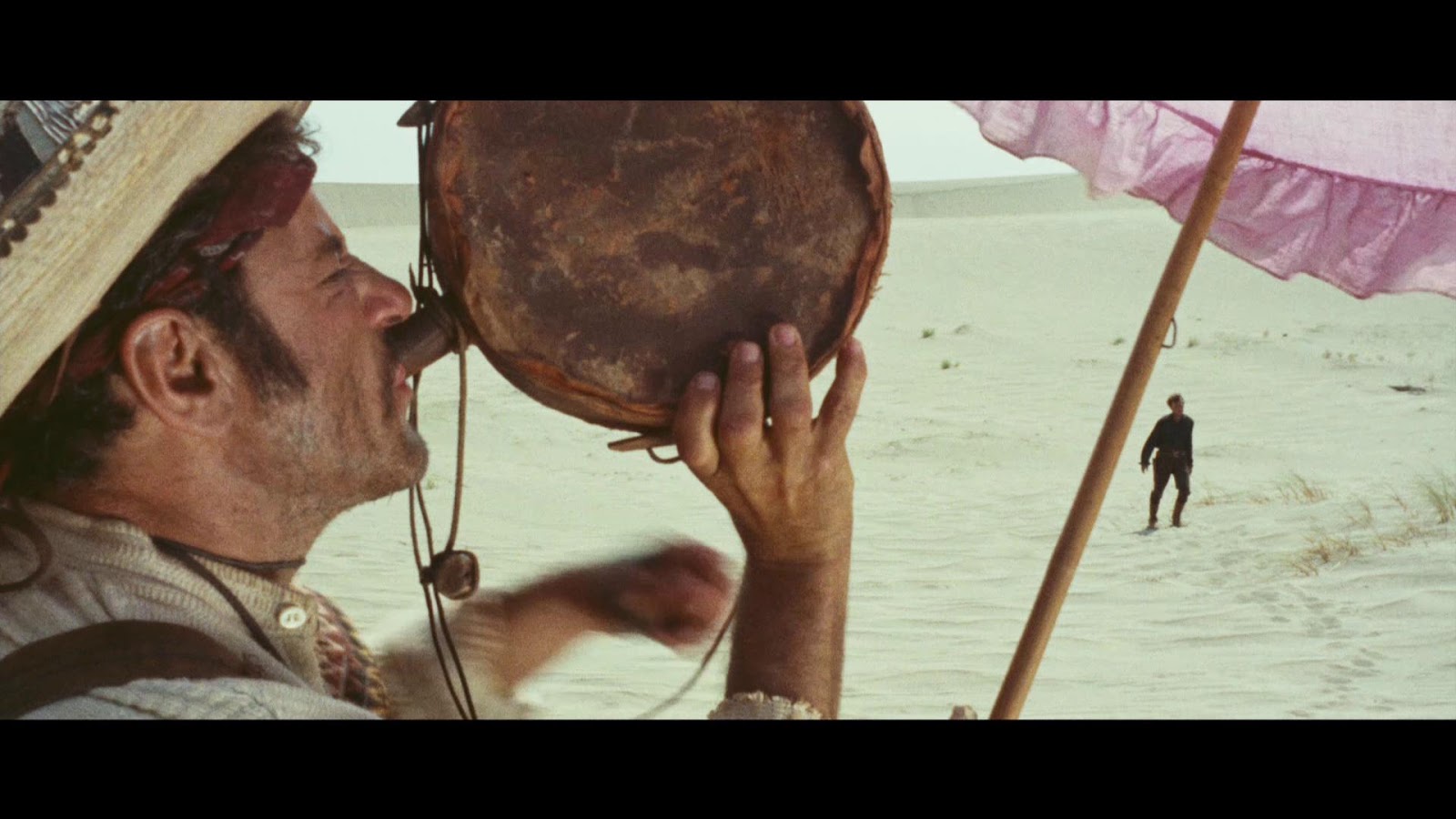
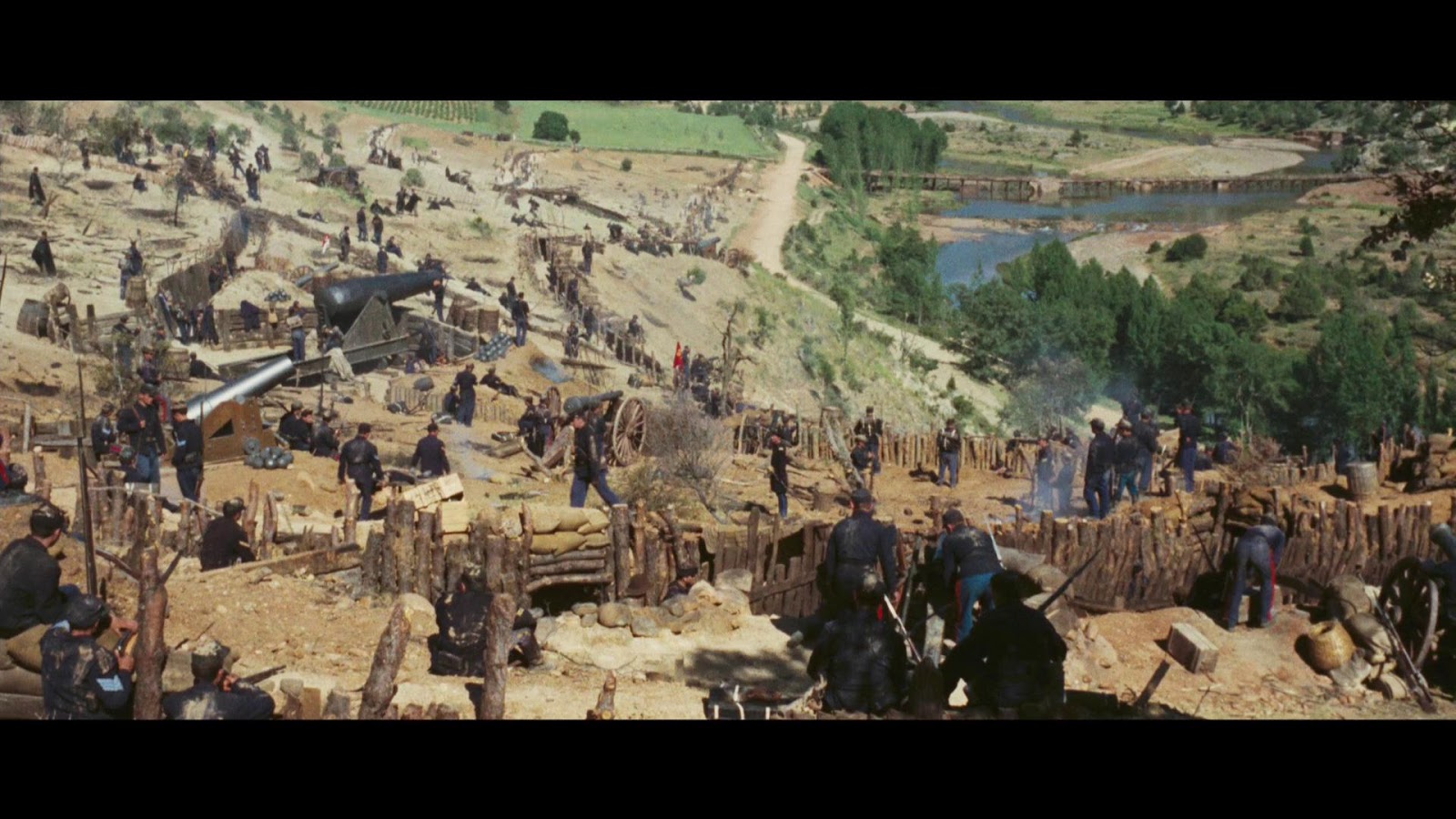
Kino Lorber Studio Classics is set to release their 50th Anniversary Blu-ray edition of Sergio Leone's THE GOOD, THE BAD AND THE UGLY (1967) one week from tomorrow, on August 15. I had the good fortune of being invited to provide the audio commentary for the US theatrical cut of the film, which most fans seem to feel is the definitive version and is making its Blu-ray debut in this release. It's a two-disc set and both the theatrical cut (162 minutes) and the extended cut (179 minutes) are included, both versions treated to 4K restorations. The extended cut is offered in this same set with optional audio commentaries by Sir Christopher Frayling and Richard Schickel.

As a contributor to the set, I received an advance copy of the set today, so I thought I might whet my readers' appetites with an advance peek. (Click on images to enlarge.) There has been some concern among the film's most ardent devotées about how this release is going to look, since MGM's previous Blu-ray release had a pervasive golden tint that was never part of the film's cinematography. As you see, that aspect has been eradicated. The blues in this new transfer are handsomely reasserted, and the depth of some compositions is actually dizzying. This film was shot in Technicolor and Techniscope, the latter being a two-perforation scope process that led to it being termed "the poor man's CinemaScope" back in the day. When I was a kid, and seeing a lot of sword-and-sandal pictures at my local theater, I could pick a Techniscope film out of a line-up because they were prey to excessive grain and a coarseness of detail, especially in depth. So I am sometimes astounded today by how much detail and depth it is now possible to digitally exhume from old Techniscope film - and Leone and Tonino Delli Colli choose their shots in this film as though they could see the technology coming that would someday unlock all of its power. Love seeing the original UA logo card back, too.


Pre-order now and get yours... for a few dollars less.

Text (c) 2017 by Tim Lucas. All rights reserved.


Thursday, August 03, 2017

Catching Up With Your Friendly Neighborhood Blogger

It has been awhile since I've posted anything like an autobiographical blog entry, and many of you have kindly encouraged me to keep you posted on my current activities since we don't have the Kennel listings to guide you anymore. As it happens, I've been extremely productive and fortunate this year, and here's a sampler of just some of the things I can tell you about (or at least a little about):

I'm over 100 pages into a new book about a maverick filmmaker, but I'm not quite ready to announce that project.

I've also agreed to write two books for Neil Snowdon's Midnight Movies Monograph series (Electric Dreamhouse/PS Publishing) - one about Georges Franju's JUDEX (which will probably happen second) and another that hasn't yet been announced.

Speaking of PS Publishing, and Neil, my lengthy chapter on Nigel Kneale's literary works is part of their new book WE ARE THE MARTIANS: THE LEGACY OF NIGEL KNEALE, edited by Neil Snowdon.

And in what I personally consider my most exciting news, a very well-respected publishing house overseas recently accepted the first piece of lengthy fiction I've sold in twelve years. It will likely be published sometime late next year or early the following. It seems something happens with my fiction every twelve years; there were a dozen years between THROAT SPROCKETS and THE BOOK OF RENFIELD, and now a dozen years between RENFIELD and this one. It's not for lack of writing, just for lack of energy in showing that work around.

I'm also pleased to report that my work in audio commentary is continuing to pile up. My commentaries for the 50th Anniversary edition of Sergio Leone's THE GOOD, THE BAD AND THE UGLY (Kino Studio Classics), Mario Bava's ERIK THE CONQUEROR (Arrow Films), and no less than three already-recorded Joe Sarno titles are presently awaiting release, as well as a few other as-yet-unannounced titles. I am presently working on two commentaries simultaneously, and they will be followed later this month my continuation on the Sergio Leone series with A FISTFUL OF DOLLARS.

So there is a lot of me to look forward to! If you would care to know more in the meantime, I am the guest on the current episode (#27) of Bill Ackerman's excellent podcast Supporting Characters. In my day-to-day life, I actually speak very little, but somehow Bill managed to keep me talking for more than four hours! Fortunately he tightened the recording up a bit by extracting some hemming and hawing, and I am pleased to direct you to the final result here.

Friday, July 28, 2017

THE FABULOUS BARON MUNCHAUSEN (BARON PRÁŠIL) reviewed

THE FABULOUS BARON MUNCHAUSEN
(BARON PRÁŠIL)
1961, Second Run (UK), 1.37:1, BD-ABC, 85m (163m of supplements)

To watch a Karel Zeman film is to feel that all other filmmakers are impeded, that they were short-changed on the day the Angels distributed the tools of filmmaking. Pick a random Zeman film and you will see his mastery of black-and-white and color; live-action and animation; collage and sculpture; sobriety and humor; science and imagination. His creativity is like a fountain; it never stops flowing, never stops its own endless reinvention. A simple shot of a rose in the moonlight is enough to bring us to our knees.

Zeman, a Czech filmmaker who lived from 1910 to 1989 and made films from 1946 to 1980 (his first feature, CESTA DO PRAVEKU / JOURNEY TO THE BEGINNING OF TIME, in 1955), belongs in the ranks of animators who became directors: Georges Méliès, Ladislas Starewicz, George Pal, Frank Tashlin, and even Mario Bava - but he is particularly well-placed among Pal and Starewicz, and a third filmmaker who never graduated to stage direction: Lotte Reiniger (best-known for her animated cut-out feature THE ADVENTURES OF PRINCE ACHMED, 1926). As a child, Zeman fell in love with the stories of Jules Verne and the illustrations of Gustave Doré and became a confirmed fantasist. His aforementioned debut begins realistically, with live action, but then almost imperceptibly melds into fantasy as a group of boys on a nature trip find themselves face-to-face with creatures that never existed in their own time. His second feature, VYNÁLEZ ZKÁZY / A DEADLY INVENTION (1958; released in English territories as THE FABULOUS ADVENTURES OF JULES VERNE), was a far more radical and delightful creation, a melding of different Verne scenarios into an original story, told in a conglomeration of live-action, trick shots, and animation that brought Verne's original book illustrations uncannily to life. After more than half a century, it remains the most commercially successful Czech film of all time - and the primary reason why there now exists a Karel Zeman Museum in Prague. This same museum has made it their mission to see Zeman's groundbreaking work better known and more fully appreciated; some years ago, they began releasing DVDs of his work, with VYNÁLEZ ZKÁZY released as a solo (and English-friendly) Blu-ray disc, while Zeman's first three films have also been released by them as a single-disc Blu-ray. Now the British label Second Run, which has long specialized in Eastern European cinema and previously released Zeman's BLÁZNOVA KRONICA / A JESTER'S TALE on DVD, has entered the picture with a glorious 4K restoration of what is arguably the filmmaker's greatest film, one that is tempting to interpret as a testamental work thought it perversely arrived well before the midpoint of his career: BARON PRÁŠIL / THE FABULOUS BARON MUNCHAUSEN (1961).

The tall tales collected in THE ADVENTURES OF BARON MUNCHAUSEN - based on the public exaggerations of a nobleman so named, written and published by Rudolf Erich Raspe in 1785 - were well-plundered by other filmmakers from Méliès to Josef von Baky by the time Zeman got around to filming them, so he took a unique approach. He saw Munchausen not as a figure to mock or ridicule, but to revere; he saw him as the avatar of all imagination and human invention, invention that would someday take us to the Moon. His film opens by taking us from our species' lowly origins beyond what was then the summit of our achievements, to the footprints of man on the Moon - footage now astonishing for how exactly it visualizes our documentation of scientific miracles now well in our past. There, the first lunar lander - identified only as Moonman or Tony (Rudolf Jelinek) - is surprised to be welcomed by the three protagonists of Verne's FROM THE EARTH TO THE MOON, by Cyrano de Bergerac, and Baron Munchausen himself (Miloš Kopeckÿ). These fantastical figures, romantics all, offer the Moonman the temptations of silver lunar wine and what appears to be a broom-riding space siren (and another, more beholden to science, held aloft by two balloons), but find him too pragmatic and earthly to believe in them. Therefore, they determine that it is on Earth where this adventurer truly belongs. The Baron escorts him back him personally aboard a great ship carried through space by a team of winged horses. Landing in Turkey, the Baron meets with the Sultan (THE CREMATOR's Rudolf Hrušinskÿ) for assistance, and in his great palace they discover that the beautiful - and remarkably passive - Princess Bianca (Jana Brejchová) is being held prisoner. (The almost three-dimensional shot entering the palace is probably one of my 10 favorite shots in all of cinema.) Both men are instantly enamored, but it is the Baron - for whom no feat is impossible - who asserts that she must be rescued and a kidnapping in the only manly means of doing so.
 
The balance of the film finds the three principal characters besting one outrageous jam by even more outrageous means, including being swallowed by a gigantic sea monster. But the actual drama of the piece is the urbane Baron's bafflement over the fact that the Princess prefers the unimaginative Tony to him as a suitor, in which one recognizes a philosophical contest between cold scientific logic and brave-hearted imaginative abandon. (The film also allows for a third reality, "the language of high democracy," which is spoken to and by rulers and politicians as so much meaningless blowing and slurring into a harmonica.) Without revealing too much, suffice to say that the pragmatist finds his way to dreaming through love and dreams up something that the good Baron can use to help them live happily ever after. The Baron, meanwhile, learns that romance may belong to the moon and the stars, but love itself is by nature an earthly thing.

I am tempted to say that no film has ever benefited quite so much from 4K restoration as this one. The Czech Blu-rays were lovely, but this disc is razor-sharp with sometimes astonishing illusions of depth. The purity of the colors is awe-inducing, and I suspect that if the film was not so wittily grounded in humor, the work as a whole might be alienating in the sheer aggression and accumulation of its beauty. There are instances when the live-action components of individual shots look a trifle soft, but this has to do with how the shots were filmed and processed and layered. Second Run and the Zeman Museum have asserted the film's Czech nationality by presenting the film only with a Czech language track. In the 1990s, around the time Terry Gilliam (inspired in large part by this film) made his own ADVENTURES OF BARON MUNCHAUSEN, Image Entertainment released the Zeman picture on LaserDisc as THE ORIGINAL ADVENTURES OF BARON MUNCHAUSEN with an English-dubbed soundtrack, so completists may want to acquire this as well.

Second Run's optionally subtitled Blu-ray disc runs welcomely riot with nearly three hours of supplementary extras, the most important being Tomáš Hodan's 2015 documentary FILM ADVENTURER KAREL ZEMAN (102m), which includes interviews with the likes of Terry Gilliam and Tim Burton and many who knew Zeman personally. It is remarkable for the sheer plentitude of its behind the scenes footage - as one witness observes, Zeman had no fear of visitors peering into his techniques because there was nothing to steal but the intangibles of vision and hard work. It is a superb introduction to the subject, and exactly what you will want to see after the intoxicant of the main feature. It also documents a group of contemporary film students working together to recreate on film one of MUNCHAUSEN's most memorable illusions. Additionally, there are various essential documentary briefs ported over from the Zeman Museum releases, a nearly-half-hour spoken and illustrated essay by Michael Brooke about the real and fictional Munchausen and much about this film in particular (including a marvelous appreciation of Zdenēk Liška's endlessly inventive score), a trailer and a 16-page booklet featuring an informative and contextualizing essay by Graham Williamson.

Perhaps it goes without saying in light of all I've just said, but this is one of the most important HD releases of 2017 and warmly recommended. The region-free disc can be obtained directly from Second Run or from retailers such as Amazon.co.uk.

(c) 2017 by Tim Lucas. All rights reserved.             

Thursday, July 27, 2017

BEYOND THE DOOR reviewed

BEYOND THE DOOR
Chi sei? / "Who Goes There?"
1974, Code Red, 1.85:1, BD-A, 108m

I had the unforgettable good fortune to see Ovidio Assonitis' BEYOND THE DOOR in its first release, in a multiplex that was also showing (unbelievably) FLESH GORDON, MANDINGO and LINDA LOVELACE FOR PRESIDENT. (As Lou Reed sang, those were different times.) While I had a sneaking suspicion of what was probably coming, the lights went down on an audience whose like I had never seen before in attendance at run-of-the-mill horror pictures; they were clearly anticipating another experience on the level of William Friedkin's THE EXORCIST, not quite realizing that such things come only once in a lifetime. Seven minutes later, and I am probably being generous in my estimation of the time, the walk-outs began.

I couldn't call BEYOND THE DOOR a "guilty pleasure" because I don't really feel any guilt for my film-related pleasures, but it is a film I've come to treasure for how riotously wrong it is, on so many counts - but, as time has gone on, I've also acquired a deeper appreciation for what, against all odds, is good about it. The story, in brief, is about a record producer whose wife, formerly involved with a man named Dmitri, begins acting strangely as a result of a pact that Dmitri has made with the Devil - while poised mid-fall through a suicidal car dive off a coastal cliff. She becomes both pregnant and possessed and Dmitri is offered a chance at escape from his pending ever-lasting torment if he can abort the child. To make matters still more preposterous, the woman - Jessica Barrett (Juliet Mills) - has already given birth to two children, Gail (Barbara Fiorini) and Ken (David Colin, Jr.), who are as much like Hellspawn as you'd care to imagine. They're both potty-mouthed poster children for OCD, with Gail a compulsive reader and collector of LOVE STORY paperbacks (hence her vocabulary) and Ken forever suckling at cans of Campbell's Green Pea soup. The kids are, in some ways, the best reason to see it, and their dialogue - attributed to no less than eight screenwriters on the IMDb - is enough to make you doubt your own sanity. (Like this from Gail, when her little brother wakes up crying: "Ken. What's the matter? You're gonna blow my mind. Man, if you don't quit crying, you're gonna have a real bad trip.") They also pass, in the context of this film, as acceptable - possibly because the family pediatrician and friend, Dr. George Staton (Nino Segurini), looks like Chevy Chase doing a vintage SNL skit.
 
Produced for $350,000 and shot on location in San Francisco with interiors filmed at De Paolis Studios in Rome, BEYOND THE DOOR actually contains some good material. Much like Elke Sommer in THE HOUSE OF EXORCISM, Juliet Mills commits to giving the best performance possible as the possessed Jessica, and her portrayal is potent and occasionally extremely eerie. She is assisted by some uncredited effects work by Wally Gentleman (2001, THE SHAPE OF THINGS TO COME, ONE FROM THE HEART) and Donn Davison (who shot inserts for the ASYLUM OF THE INSANE variant of David Friedman's SHE-FREAK) that, all these years later, still beg to viewer to pause and deconstruct them. Richard Johnson, formerly of THE HAUNTING and THE WITCH IN LOVE and barrelling toward the Lucio Fulci end of his career, also brings great authority to the part of Dmitri. And then we have Gabriele Lavia as Jessica's husband Robert Barrett (which happens to be the name of one of the film's screenwriters - R. Barrett), who is introduced in a recording studio, producing a new reggae track by a mostly black band, bobbing his head wildly out of time, and then cutting them off in the midst of a respectable take, complaining that "it's got about as much balls as a castrrated jellyfish." You know you're in good hands with that line, but I don't remember hearing it in the theater. The English dubbing, by the way, includes Mills and Johnson's own voices, with Ted Rusoff voicing Gabriele Lavia and his wife Carolyn de Fonseca voicing Carla Mancini, who plays the creepily Alida Valli-like woman on the boat.


This new dual-layered Blu-ray from Code Red - available from Diabolik DVD - is not quite the BEYOND THE DOOR we remember from its theatrical playdates. Carrying the title THE DEVIL WITHIN HER (which was already taken by an AIP release starring Joan Collins, the US retitling of a British picture called I DON'T WANT TO BE BORN!), this is the original English export version which contains approximately 10 minutes of footage that was cut from the picture by Edward L. Montoro's company Film Ventures International. Not only does the additional footage include some of Mills' and Johnson's best work in this picture, but there is some additional humor (like the opening recording studio sequence) and an overall more languid pace that makes sense of some of the spaced-out tone of the piece. Best of all, by going back to the original cut, this release avails itself of a razor-sharp, richly colorful picture quality that was never on view in US theaters, where the film looked fuzzy and grainy with watery colors in its multiplex incarnation.

While this Code Red disc would need that alternate theatrical cut to qualify as definitive, this is an impressive presentation nevertheless. The HD master is identified as brand new and there are quite a few extras, including VW's Nathaniel Thompson interviewing Ovidio Assonitis in the first commentary, and VW's Darren Gross moderating a third audio track with Juliet Mills and Scott Spiegel. There is also a "BEYOND THE DOOR: 35 Years Later" featurette that interviews Assonitis, Mills, Johnson and script contributor Alex Rebar (who remembers Johnson rewriting his dialogue), and a separate interview with Gabriele Lavia. The packaging features reversible cover art, allowing a choice of original art or the original Film Ventures campaign. 

(c) 2017 by Tim Lucas. All rights reserved.