Thursday, July 23, 2020

Going Ape With Scream Factory, Part 3

Acquanetta is examined by new mad doctor J. Carrol Naish in JUNGLE WOMAN.
The second film in the Paula the Ape Woman series is JUNGLE WOMAN (1944), directed by Reginald LeBorg. LeBorg is best remembered for a handful of later horror films, including THE BLACK SLEEP and DIARY OF A MADMAN. JUNGLE WOMAN has the reputation of being one of Universal's most disposable chillers because it's almost entirely told in flashbacks as Dr. Carl Fletcher (J. Carrol Naish) is tried for Paula's murder in a judge's (Samuel S. Hinds) private chambers, with the now-married principals of CAPTIVE WILD WOMAN (Milburn Stone, Evelyn Ankers) occasionally chipping in their recollections, prompting more stock footage from CWW and THE BIG CAGE than seems quite decent. As noted in my last installment, there are no transformation scenes; in fact, the only view given of Paula in her half-ape form is withheld for a single shot at the end of the picture. Laid out in synopsis form, it doesn't sound very promising - and yet I personally find JUNGLE WOMAN to be the most interesting of the three films in terms of its approach to generating horror scenes. LeBorg wasn't a first rank horror director, but you can see him turning the disadvantages of this production to their best advantage with a series of interesting and sometimes very effective set pieces - the opening attack (staged with doubles in silhouette), the attempted development of Acquanetta's Paula - now with actual lines to speak - into a kind of B-movie version of Simone Simon's Irena in Jacques Tourneur's CAT PEOPLE (1941), and especially a sequence in which a swimming Paula sets out to avenge her hair-trigger jealousy against this film's romantic couple (Lois Collier, Richard Davis) as they enjoy a moonlit boat row. The single shot of the submarine Paula's arrow-like wake closing in on the rear of the rowboat is one of Universal's most effective frissons of the 1940s, looking ahead to a special form of aqueous horror that would not come fully about until CREATURE FROM THE BLACK LAGOON (1954) or JAWS (1975).


Vicky Lane in Paula makeup by Universal's resident genius, Jack Pierce.
THE JUNGLE CAPTIVE followed its troubled predecessor by a full year, and its release was muted by placing it in many theaters as the co-feature on double bills with Universal's latest Inner Sanctum picture THE FROZEN GHOST, both films directed by Harold Young (THE MUMMY'S TOMB). At least it had display ads in newspapers - a prowl through newspaper archives indicates that Universal hadn't wished to draw undue attention to JUNGLE WOMAN. The script takes a horror pulp premise, a standard romantic back story (Amelita Ward, Phil Brown) and wedges Paula's rocky legacy into it. She is now played by 18 year old Vicky Lane, born to an American mother in Dublin, who - in a disclosure that must have mortified Universal's publicity department - described herself to reporters as "Black Irish." She was also, already at her young age, the wife of actor Tom Neal, the star of Edgar Ulmer's DETOUR. She does not in the least resemble Acquanetta, looking like an all-American sweater girl than and exotic import, but the makeup and hair department did their best to emulate her predecessrors' distinctive coiffure. Lane had actually appeared uncredited in a few earlier films (including Douglas Sirk's HITLER'S MADMAN), but this was her first credited film role - and her last.


Brooklyn Daily Eagle, July 29, 1945.
Lane's inheritance of Acquanetta's duties is lacking in a convincing feral nature in either of her personas, and Universal seems to have deliberately deprived Paula of central attention by casting their "monster without makeup" star Rondo Hatton as Moloch, the henchman of the film's mad scientist, who is always firmly addressed as Mr. Stendhal (DRACULA'S DAUGHTER's Otto Kruger). Usually cast in silent roles, Hatton gets a surprising amount of dialogue and an even more surprising amount of lip from Stendhal, who lambastes the poor man's moonstruck reactions to heroine Ann Forrester (Ward) with unbelievable lines like "you're not exactly a Casanova, you know," and adding with a glance at the nearby Ape Woman, "that's more in your line." Harold Young, whose specialty seems to have been movies like BACHELOR DADDY and JUKEBOX JENNY, doesn't come near the atmosphere his cameraman George Robinson gave to THE MUMMY'S GHOST; his cameraman here was Maury Gertsman, a longtime Universal DP who was dealt this as his first horror picture. The studio was pleased enough with his Rondo Hatton scenes to place him in charge of the visuals on the rest of the films Hatton would make for the studio: HOUSE OF HORRORS and THE BRUTE MAN (both scripted by this film's author, Dwight V. Babcock), as well as the relatively woebegone one-shot, SHE WOLF OF LONDON.


In many ways, it's the audio commentaries that raise UNIVERSAL HORROR COLLECTION VOLUME 5 to the level of a reference necessity, especially for anyone who doesn't already own Tom Weaver's UNIVERSAL HORRORS or Greg Mank's WOMEN IN HORROR FILMS two-volume set. As always, Weaver's THE MONSTER AND THE GIRL and CAPTIVE WILD WOMAN (he's assisted by Steve Kronenberg on the former) are smart, feisty, often amusing talks that succeed as entertainment as much as production studies. He imports vocal performances by Larry Blamire and Lucy Chase Williams to fill in for Edward Dmytryk and Acquanetta, and pokes his nose into all sorts of production trivia and data - including a TMI explanation for John Carradine's aversion to white pants. Mank's JUNGLE WOMAN commentary is impeccably snappy, detailed, and expressive, its every shift and silence perfectly timed to the onscreen action; it's about as perfectly and tightly (yet smoothly) executed a commentary as I've heard. Scott Gallinghouse's JUNGLE CAPTIVE commentary is a bit dry by comparison, with some unannounced gaps, but there is no faulting his documentation, an exhaustive report on the making of the picture with special attention reserved for Rondo Hatton.

(c) 2020 by Tim Lucas. All rights reserved.

If you enjoy Video WatchBlog, your kind support will help to ensure its continued frequency and broader reach of coverage.


Wednesday, July 22, 2020

Going Ape With Scream Factory, Part 2

John Carradine unveils Acquanetta in Edward Dmytryk's CAPTIVE WILD WOMAN.
In the 1930s, Universal produced a series of ambitious sequels to their horror hits, ranging from DRACULA'S DAUGHTER to 1939's epic SON OF FRANKENSTEIN; but in the 1940s, their approach to sequels became more influenced by serials than any attempt to improve on what had been done before. As several horror scholars have noted, their approach to their Mummy series was fecund enough but also swollen with stock footage and a complete disregard for the characters, geography, and chronology established by previous entries. These films have already been released on Blu-ray, as has their highly varied Invisible Man series (which even includes an INVISIBLE WOMAN); however, it has not been until recently - with the release of Scream Factory's UNIVERSAL HORROR COLLECTION VOLUME 5 - that Universal's entire trilogy of "Paula, the Ape Woman" movies has been made available on disc. The entire series was issued on VHS and through Universal's MOD DVD-R "Vault Series," but only CAPTIVE WILD WOMAN had a general DVD release as part of the 2009 set UNIVERSAL HORROR: CLASSIC MOVIE ARCHIVE, where it was paired with THE BLACK CAT, MAN MADE MONSTER, HORROR ISLAND, and NIGHT MONSTER.  

The Scream Factory release presents beautifully restored copies of CAPTIVE WILD WOMAN, JUNGLE WOMAN, and THE JUNGLE CAPTIVE, along with Paramount's THE MONSTER AND THE GIRL (reviewed yesterday). The four films (each barely over - or under - an hour) are spread over four discs with audio commentaries, still galleries and trailers. There's also a full-color booklet but its content is almost entirely photographic, without an accompanying essay. The set is priced at a notch below $70, which rounds off to just under $18 per movie. Some reviewers have complained that the set is over-priced, given the length of the movies (and the extent of the stock footage contained within a couple of them), but it should be noted that the audio commentaries by Universal historians Tom Weaver (UNIVERSAL HORRORS), Greg Mank ( KARLOFF AND LUGOSI and Scott Gallinghouse (SCRIPTS FROM THE CRYPT: THE BRUTE MAN) are valuable additions to the set. Admittedly, these are hardly essential titles for the average horror fan, but they are of fair significance to genre buffs with a specific interest in Universal horror or 1940s mad science horror of any stripe.


CAPTIVE WILD WOMAN is of somewhat greater general interest than the others as it was one of the later B-pictures made during the early phase of his career by director Edward Dmytryk. Before he became established as the director of such films as MURDER, MY SWEET and THE CAINE MUTINY, Dmytryk honed his skills on pictures like THE DEVIL COMMANDS, CONFESSIONS OF BOSTON BLACKIE, THE FALCON STRIKES BACK, and this mad science caper, which is as lean and taut a 1940s thriller as you're likely to find. It not only incorporates a fair amount of stock footage from an earlier Universal adventure picture, 1933's THE BIG CAGE, which was built around documentation of famous animal tamer Clyde Beatty at work, but took a chunk of its actual storyline itself, which was about a circus on the verge of bankruptcy gambling on a comeback by having Beatty tame lions and tigers in a cage at the same time. In CAPTIVE WILD WOMAN, this is the scheme of animal tamer Fred Mason (GUNSMOKE's Milburn Stone), who's counting on its success so that he can marry pretty Beth Colman (Evelyn Ankers). While on his latest expedition to Africa, Mason found and brought back a gorilla he named Cheela (Ray "Crash" Corrigan), whose responses to him are almost human. In a bit of handy exposition that changes the story just enough to not be identical to the Beatty film it's swiping from, Beth is given a depressed sister with a glandular problem, which brings her into the orbit of debonair scientist Dr. Sigmund Walters (John Carradine), who is fascinated by the circus and takes her up on an invitation for a behind-the-scenes visit. It is during this visit that Walters observes Cheela's human streak, and since he's completely unbalanced, he decides to have the primate abducted and taken to his secret laboratory. His glandular research enables him to extract Cheela's most human essence in the form of an attractive girl, whom he names Paula Dupree. When Walters visits the circus with her in tow, everyone is astounded at her innate ability to control the animals, even a battling lion and tiger. To make a long story short and a short movie shorter, horror ensues.

CAPTIVE WILD WOMAN (1943) isn't great but it is admirably efficient of its kind. It does a splendid fluid job of matching up with the BIG CAGE footage, and Stone (who is a great help in selling those illusions) and Ankers have more chemistry than most Universal romantic couples. Naturally, Corrigan is not nearly so convincing a gorilla as Charlie Gemora in THE MONSTER AND THE GIRL, but the real show here is Carradine at his most icily menacing. There is a great moment when he engineers the death of the man he's hired to abduct Cheela, once the job's been done. We don't see any of the violence; Dmytryk trains our attention to Carradine's face, which doesn't blink once as the man is being torn apart in front of him. And then there is Acquanetta's portrayal of Paula, as close to Germany's Alraune as American cinema had ever come to creating a daughter of mad science. Like Alraune, she's both monster and glamour girl, and Aquanetta's mute (and to an extent, blank) performance lends Paula an impenetrable mystery. Of course, she is essentially unknown even to herself until those occasions when her sexual jealousy of Beth causes her simian glands to reassert themselves, darkening her in color, sprouting hair, and reverting Paula to her true nature.

There was something about Paula's transformations into the Ape Woman that was troubling to the critic with the US communist newspaper THE DAILY WORKER. He complained that CAPTIVE WILD WOMAN was promoting Hitler's racist conception of black people being subhuman and ape-like. There had apparently always been some distrust of how Acquanetta - whose full name she claimed to be Burnu Acquanetta - represented herself. A full year before CAPTIVE WILD WOMAN, the Salt Lake Tribune (28 July 1942) carried this caption to one of her early Universal promotional shots: 


Here's a sidebar of Acquanetta's full account of her personal history, as published in the Tallahassee Democrat (Tallahassee, FL) , 30 July 1942:


The DAILY WORKER rants enflamed curiosity, curiosity led to rumor, rumor led to former acquaintances coming forth and speaking out, and Universal bowed to pressure during the filming of the sequel JUNGLE WOMAN - not only by omitting any and all transformation scenes from the picture but by postponing any view of the Ape Woman at all until the last 50 seconds of the movie! By the time the filming was completed, Universal had undertaken their own private investigation of Acquanetta's personal history and learned the truth: "Burnu Acquanetta" was in fact the former Mildred Davenport of Pennsylvania, an 18 year old African-American woman. By this time the word was out, JUNGLE WOMAN (1944) was already in the can. Even as Universal was quietly tearing up her contract, they still had a picture to promote, so they ballyhooed her as "the exotic, dark-skinned, dark-haired American beauty who hoodwinked the entertainment world into thinking she was South American," while praising her latest performance as "even more intriguing and effective" than her work in CAPTIVE WILD WOMAN. The truth was out, and it would come out even more loudly in 1950, as Acquanetta sought an enriching divorce from millionaire Luciano Baschuk, who claimed that - despite the son they shared - they had never been properly married. Acquanetta would be replaced by Vicky Lane in the final Paula the Ape Woman film. When Universal first issued their horror films to television as the famous "Shock Theater" package, CAPTIVE WILD WOMAN and THE JUNGLE CAPTIVE were included, but the controversial JUNGLE WOMAN was mysteriously withheld. My own newspaper archives research shows that the film wasn't shown on television in North America until June 1972 - an absence from circulation of 28 years.

Though well-intentioned, the DAILY WORKER's righteous outrage against the film was misplaced; a time-lapsed transformation of any human actor into Ape Creature would have had to transition to a darker phase to get from Stage 1 to Stage 3. All that was ultimately achieved for making an issue out of this non-story was the public embarrassment of a black woman and the willful destruction of her career - the career of the first African-American actress to achieve name-above-the-title stardom in movies that were not advertised with the words "All Colored Cast." Some might see her downfall (some downfall, she always married and remarried well!) as Acquanetta's rightful comeuppance for denying her race, but was what she did really all that different from what separated Archie Leach from Cary Grant, or Ruby Stevens from Barbara Stanwyck, or the lies that Hollywood studios regularly concocted about their stars to fuel the gossip columns?

I'll delve into JUNGLE WOMAN and THE JUNGLE CAPTIVE tomorrow. 

(c) 2020 by Tim Lucas. All rights reserved.

If you enjoy Video WatchBlog, your kind support will help to ensure its continued frequency and broader reach of coverage.


Tuesday, July 21, 2020

Going Ape With Scream Factory, Part I

Philip Terry as Scot, Charles Gemora as his simian alter ego in THE MONSTER AND THE GIRL. 
Scream Factory's UNIVERSAL HORROR COLLECTION VOLUME 5 focuses on Universal's Paula the Ape Woman series (CAPTIVE WILD WOMAN, JUNGLE WOMAN, and JUNGLE CAPTIVE, 1943-1945) and appends a well-chosen, earlier ape-meets-mad-science B-title from Paramount, THE MONSTER AND THE GIRL (1941). 

An early directorial achievement by former editor Stuart Heisler (PETER IBBETSON), THE MONSTER AND THE GIRL is a remarkably sensitive potboiler about Scot Webster (Philip Terry), a young man from small town America, who moves to "the Big City" with his sister Susan (Ellen Drew), where he is quickly framed for murder by gangsters (spearheaded by Paul Lukas) who have dragged his innocent sibling into prostitution. Scot is tried, found guilty, and sent to Death Row, where he is approached by the hat-in-hand Dr. Parry (George Zucco, in the first of many demented doctor portrayals), who persuades him to bequeath his brain to science. Scot is too depressed to be anything but amenable, and when the big day comes, he dies only to reawaken inside the body of a powerful gorilla - inter-species transplantations being Dr. Parry's pet project. The soulful-eyed primate then embarks on a spine-crushing spree, eliminating the crooks who played him for a patsy and are making his sister's life a living hell.
George Zucco and Gemora in another portrait pose.

Working from a script by Stuart Anthony, who had previously written Heisler's breakthrough film THE BISCUIT EATER (1940) as well as Charlie Chan's forays into London and Paris, the early scenes of Heisler's film are surprisingly Lewtonesque - muted, soulful, introspective, noir-like - which is odd because this film was released in February 1941, while Lewton's first horror picture CAT PEOPLE didn't come out until December of the following year. It wouldn't surprise me if Lewton had chosen Ellen Drew to star in ISLE OF THE DEAD (1945) on the basis of her work and general look in this film. It's a similarity that Tom Weaver tags in his commentary as Drew makes her first appearance stepping forth from an abstract plane of mist, over dubbing her opening words with "I walked with a zombie...", though he takes the comparison no further. But the film's early scenes, establishing a flashback structure interweaving the sibling's small town life, their gentle mutually supportive relationship, and the subsequent trial, share much of the way Lewton had his characters portrayed in CAT PEOPLE, THE LEOPARD MAN (1943), and particularly THE SEVENTH VICTIM (also 1943), where another sheltered small town girl follows a sibling to a dark metropolis, only to be confronted with the myriad dark dangers of Gotham. Photographed by Victor Milner (LOVE ME TONIGHT, DARK CITY), the film never forfeits its noir atmosphere even as its story shifts gears into a horror pulp "body count" saga. 


What holds the film's schisms together is the performance of Charles Gemora as the ape, in an ape suit of his own design. Gemora had previously played apes in Tarzan films, in Universal's MURDERS IN THE RUE MORGUE, and BLONDE VENUS with Marlene Dietrich, but he created his most ambitious ape suit for this film. Some 80 years later, this film's gorilla illusions remain among the most convincing ever filmed, and its not only due to the impeccable costume but to Gemora's soulful performance. Only Rick Baker has exceeded Gemora's work in this area, adding contact lenses to his masterworks, but Gemora is here portraying a gorilla with a man's brain, so the appreciably human gaze behind his bestial features is what finally sells the whole picture. But Heisler doesn't stop there, peppering the cast with numerous names we happily exclaim when these familiars of ours loom into view: Joseph Calleia, Gerald Mohr, and Marc Lawrence as Lukas' supremely slimy cohorts, plus Edward van Sloan, Robert Paige, Cliff Edwards, and Dave Willock, to name a few. There's also a little dog, Skipper, who has a heart-tugging relationship with Scot that picks up where it left off when he crosses paths with the ape.

To paraphrase what UNIVERSAL HORRORS author Tom Weaver (intending to shock) says in his commentary: pound for pound, Paramount might actually have been THE top horror studio of the 1930s and '40s, given the consistently high quality of such pictures as ISLAND OF LOST SOULS, Rouben Mamoulian's DR. JEKYLL AND MR. HYDE, MURDERS IN THE ZOO, SUPERNATURAL (now available from Kino Lorber with my audio commentary), THE CAT AND THE CANARY, AMONG THE LIVING, and particularly THE MONSTER AND THE GIRL. Despite its bland title and relatively short running time, it is an indisputable gem of the period and well worth discovering. 

Tomorrow I'll begin dealing with the Paula the Ape Woman films as a set.

(c) 2020 by Tim Lucas. All rights reserved.

If you enjoy Video WatchBlog, your kind support will help to ensure its continued frequency and broader reach of coverage.


Monday, July 20, 2020

Mondo Karloffo

Tiny rocker Franz Drago performs with Les Amants in MONDO BALARDO.

MONDO BALORDO (1964, 86m 45s; Severin Films/Something Weird): The title means "Crazy World" - and who am I to argue? The director of this Italian pseudo-documentary, Roberto Bianchi Montero, was a prolific filmmaker who seized upon the mondo craze launched by MONDO CANE with the jaws of a pit bull, cranking out ORIENT BY NIGHT, SUPERSPETTACOLI NEL MONDO, SEXY FOLLIE, AFRICA SEXY, MONDO INFAME, SEXY NUDO, SEXY NEL MONDO, UNIVERSO PROIBITO and this film within the two years following the Cavara-Jacopetti hit. What has caused this film to stand out in overviews of this genre is the fact that the American version - supervised by Albert T. Viola and released by Crown International Pictures - somehow obtained the dulcet narration services of Mr. Boris Karloff.

What I would love to know is whether or not Karloff recorded his track in Italy, as this would have coincided with his work on Mario Bava's BLACK SABBATH, or if he did the work for Viola stateside. There is no indication anywhere of who wrote Karloff's material, but it is so consistent with what one knows of his personal wit that one can easily imagine him rewriting (or even writing!) his lines at his leisure - though the mind boggles at his laboring this way over footage of diminutive rocker Franz Drago, witch doctors who cure others with a dancing frenzy culminating in the devouring of a live chicken (not graphic), white hunters who chase down manacled natives ("after all, it's the only form of hunting permitted by law"), and native women whose hair is dyed blonde with the miracle ingredient of camel urine fresh from the spigot. (It's so fake you'll want to share this clip with all your friends.)


Other, milder topics are also covered such as prostitution, opium dens, the sword-and-sandal film phenomenon (with glimpses of Brad Harris and Kirk Morris), the Asian S&M magazine business, lesbian parties, a montage of how some people resemble members of the animal kingdom, a blindfolded guess-the-kisser game, the Italian pastime of derrière-watching, and the third world appetite for cocaine ("a much dreaded word in decent society, but the staff of life to the people of Ecuador"). Karloff's guidance through this garden of the strange and uncivilized is actually quite literate and elegant, and even after seeing it one can't quite accept that it exists. The film's score adds to its disorientation value, veering from Bert Kaempfert-like brass ballads to recurrences of a manic Lou Monti-like theme song.

Bearing in mind that the film was compiled from loose material gathered from all over the world, the presentation - scanned in 4K from the original internegative - is as attractive as the content can be ugly, pointless, and even repulsive. Animal-concerned viewers should be forewarned of an elephant shooting and a brief sidebar on assembling the ingredients for turtle soup. PS: If you go looking for this film on the IMDb, try the title A FOOL'S WORLD.


Aside from a trailer, the film's only supplement is a bonus feature, THE ORIENTALS (MONDO ORIENTALE, 92m 44s), a cropped 16mm TV print bearing the Thunderbird Films logo. Directed by Romolo Marcellini in 1960, this title actually precedes the mondo craze, and it shows in a stronger fictional narrative bent. It's much closer to the Italian caroselli or portmanteau films that were in favor around this time, consisting of a half-dozen stories about young women in Egypt, Malaysia, Nepal, Thailand, Hong Kong and Japan. The film is something of a snoozer, best watched in an alienated mood, with the kind of bad dubbing that you know is lousy but feels strangely comforting when viewed in the wee hours. Surprisingly, THE ORIENTALS has a far greater pedigree than the main feature, being a Galatea production (the production house that brought you BLACK SUNDAY) -scored by Carlo Rustichelli, photographed by Aldo Giordani (ATOM AGE VAMPIRE, THE MONGOLS, and AMUCK), and narrated by Richard McNamara (you'll know his voice from countless peplum films)! Also in the film's favor is that the longest segment, set in Japan and lasting some 20m, is constructed around an early star turn by the beautiful Akiko Wakabayashi, best-remembered for her mysterious roles in Toho's DAGORA THE SPACE MONSTER, KING KONG VS. GODZILLA, and GHIDRAH THE THREE-HEADED MONSTER. The presentation is not definitive, given the compromised screen ratio, but the print is otherwise nice and colorful.

MONDO BALARDO streets on July 28.
(c) 2020 by Tim Lucas. All rights reserved.

If you enjoy Video WatchBlog, your kind support will help to ensure its continued frequency and broader reach of coverage.


Thursday, July 16, 2020

THE WAR OF THE WORLDS Reviewed


THE WAR OF THE WORLDS (1953, 85m 21s; Criterion): My apologies to Warner Archive's highly worthy MYSTERY OF THE WAX MUSEUM, but this 4K restoration of George Pal's classic production - with an optional 5.1 soundtrack remix by sound designer Ben Burtt - is the Blu-ray restoration of the year, thus far. 

Circa 1974-75, I had the privilege of seeing one of Paramount’s surviving Technicolor and Stereophonic prints when it was shown at a local repertory theater, and I have always remembered it as one of the most exciting theatrical experiences of my life. Contrary to common criticism, the wires supporting the Martian war machines could scarcely be seen on the big screen given the specific color timing and light levels of those first-generation prints, so the griping being heard from some quarters ("How dare they go back and erase the wires?") is uneducated, working from a knowledge limited to the brighter prints generated for television and early home video, which brought some of the film's secrets into open view.


As vivid an experience as theater goers got back in the day, this Blu-ray presentation is far sharper and more colorful without any distortion even when incendiary reds prevail. The Technicolor is Bava-level intense, and the 5.1 audio makes the paranoid terror of the proposed invasion all the more palpable and frightening. The original monaural track is also here, restored beyond anything we've heard before, after the immersive, heart-pounding experience of the 5.1 track, I don’t think I’ll ever go back to it. Funnily enough, the textural improvement of all its eye and ear candy also serves to heighten every other department rather than draw inordinate attention to itself - Byron Haskin's beautifully modulated direction, the velvety lighting of George Barnes' cinematography, the tight editing of Everett Douglas, and not least of all the performances; never before, not even in a theatrical setting, have I so appreciated the affecting dramatic detail that Gene Barry, Ann Robinson, Les Tremayne,  Russ Conway, Paul Birch and Jack Kruschen bring to this picture. More than half a century further on, this is a movie that's never lost its moxie; it remains the definitive dramatic adaptation of H.G. Wells' novel.


Some extras have been ported over from the previous 2005 Paramount DVD release, the audio commentary (featuring Joe Dante, Bob Burns, and the late film historian Bill Warren) and the making-of documentary short, "The Sky Is Falling." Fascinating new featurettes specific to the restoration are also included, as is the famous 1938 Orson Welles radio broadcast and a 1940 radio program interviewing Welles and the author of the original novel, H.G. Wells.

(c) 2020 by Tim Lucas. All rights reserved.

If you enjoy Video WatchBlog, your kind support will help to ensure its continued frequency and broader reach of coverage.


Wednesday, July 15, 2020

Dipping Into GUNSMOKE: Lucky Season 13

Ken Curtis and James Arness estimate the damages in "Vengeance." 
Donna and I have been immersing ourselves in a gift copy of GUNSMOKE Season 13, which is so far anything but unlucky. It starts out with Robert Totten/Hal Sitowitz's "The Wreckers" with Warren Oates headlining as a gunman heading a group of desperadoes who overturn stagecoaches for plunder and end up taking Matt and Kitty captive. This is one of Amanda Blake's finest showcases in my experience and Oates is already at his Peckinpah level - an outstanding episode... but don't watch the preview, which goes crazy with spoilers!
Directed by Gunnar Hellstrom and written by Clyde Ware, "Cattle Barons" is a tense showdown between landowners Forrest Tucker and Robert J. Wilke; it's first-rate until it builds to an overlong fist-fight involving just about every character in the show in the middle of Dodge's main street.

Bernard McEveety/Calvin Clements' "The Prodigal" features an excellent Lew Ayres as the doddering grandfather of a young gunman determined to learn the identity of the man who shot his father in the back, which is a secret guarded under law. Also written by Calvin Clements, Richard C. Safarian's two-parter "Vengeance" stars James Stacy at his peak as a former carnival trick-shooter out to avenge himself against steely-eyed landowner John Ireland, whose men killed his father and brother for relieving the pain of one of his wounded calves. This superb episode also features a truly fine, touching early supporting appearance by Kim Darby, an authoritative minor part for Paul Fix, and rural menace from Royal Dano and Victor French. Then Robert Totten returns to the director's chair for Ron Bishop's script "A Hat," with an amazing, over the edge performance by Chill Wills as an aging gunman whose son is killed in self-defense by a mountain man who finds the protection of Matt Dillon, thus putting all of Dodge into imminent danger. 

It's remarkable how often the same story elements and situations come into play, but there is never any sense of redundancy in the storylines. The only trouble with these early color episodes is that CBS really wanted to sell color television sets, so the color is BATMAN-lurid and sometimes hard to look past. I never imagined that Marshall Dillon's one and only shirt was lavender all these years! There's even some lavender lighting in the exteriors, and the green felt tabletops in the Long Branch Saloon look like enormous lime lollipops.

And then there's episode 12: "Death Train," written by Ken Trevey and directed by Gunnar Hellström. When a train passes through Dodge City carrying the luxury train car "Nimrod," one of its passengers (Dana Wynter), sneaks away from her millionaire husband (Morgan Woodward, an arrogant man who believes his position makes him invulnerable and above the law) and his hired hand (Norman Alden, looking a lot like Dennis Hopper in EASY RIDER, made two years later) to covertly notify Doc (Milburn Stone) that their butler is deathly ill. Doc follows her to the train and quickly confirms the mottled passenger as having spotted fever, a form of plague, and declares a quarantine. At Marshall Matt Dillon's order, the "Nimrod" is uncoupled from the main train, allowing the other cars to continue on unencumbered. Doc and Matt do their best to keep the word stifled, but it spreads through town anyway, given additional fearsome fervor by an evangelist determined to put the fear of God into the locals. Soon enough, frightened locals circle the train and when their attempts to build a barrier around it fail, they decide to try burning it down to purify the contagion.

The more GUNSMOKE episodes I see, the more Dodge City itself - beyond the main characters - seems rife with bad seeds and dangerous drifters who have to be regularly taught lessons about racism, violence, lust, alcoholism, and so forth. It carries a regular message (or reminder) that there are certain things that civilized people just won't, or shouldn't, stand for. As such, it's a very socially constructive program. We don't really have much of this now, and it's showing in the way we interact with each other in public. Watching this particular episode was a lot like holding up a mirror to the world we find ourselves in today, and it showed me that this is nothing new, that people have always been like this, at their most dangerous when they are scared; but what they had then that we don't have today is a genuine leader to stand up our worst instincts and show people the folly of their own fears, which are as endangering to them as they are to others. The mob in this episode initially wants to send the train on, which would carry its contagion to other states; then they want to burn it down, which would remove the barrier of the train itself from deadly contagion - these are not carefully considered solutions. They have no logic, no science to back them up; the prevailing thought is "get this away from me, and to hell with anyone else." The point made here, and in so many other episodes, is that guns, torches, mob violence, and ignoring or disavowing medical knowledge are not acceptable solutions to any problem. I makes me think we need to bring a stronger educational, precautionary bent back into our entertainment, and take heroism away from costumed freaks and return it to the exceptional common man. It may seem a backward step, but this country's in tatters and TV is where most people learn things.

(c) 2020 by Tim Lucas. All rights reserved.

Tuesday, July 14, 2020

THE EVIL OF FRANKENSTEIN Reviewed


THE EVIL OF FRANKENSTEIN (1964, 86m 36s; Scream Factory): Of the Hammer's half-dozen Frankenstein films starring Peter Cushing, this one has always been the bone of contention among its devotées. It is the only one not directed by Terence Fisher, and Freddie Francis' brief assumption of that chair (as Fisher was making THE HORROR OF IT ALL and THE EARTH DIES SCREAMING for Lippert) is a fascinating look at contrasting techniques in action.


Fisher worked his way up to director as an editor, Francis as an Academy Award-winning cameraman, and here there is a far greater assertion on the power of visuals, so much so that Francis indulges in a memorable six-minute flashback played entirely without dialogue. In contrast to Fisher's wry but never humorous work, which maintained a conservative presentation to all the better make the subversive subject matter pop, the visuals here sometimes err on the vulgar (see any scene involving David Hutcheson's burgomaster and his busty wife, Caron Gardner) and Francis' interests stray too far from Cushing's Baron to Peter Woodthorpe's barnstorming portrayal of the hypnotist Zoltan, whom the Baron recruits to make controlling contact with the damaged brain of the Monster (New Zealand wrestler Kiwi Kingston). While there are disappointing aspects, time has treated the film well; it's attractively produced, the ragged and poorly-designed Monster has become iconic despite itself, and the dynamic score by Don Banks is a refreshing "en garde" change of pace from James Bernard onomatopoeic scoring.


The extras are more than entertaining; the packaging literally cannot list them all. They amount to a multi-authored audio-book monograph on the film and are thus necessary to any serious Hammer enthusiast. Once again, Constantine Nasr's audio commentary provides a wonderfully detailed overview of the film as well as an enlightening production account that helps to explain (and sometimes forgive) its various flaws. Some of the other extras are ported over from a 2003 release, including a "making of" featuring Hammer authority Wayne Kinsey, while the new material includes a warm 30m reminiscence of Francis by his co-biographer Tony Walton and illuminating visits with assistant director Bill Cartlidge and actress Katy Wild, who plays the deaf-mute beggar girl. Cartlidge remembers Francis as being still a bit insecure at the time of filming, and Wild recalls him and producer Anthony Hinds confessing to her on the last day of filming that they had made her character deaf-mute to save themselves the trouble of developing an actual character! It shows just how much an actor stands to bring to a "nothing" role on their own watch; at the same time, the absence of an obviously missing account of the girl's sympathetic relationship with the Monster shows that Francis was frankly unaware of the elements most important to this material - the centrality of Cushing's Baron, and its subtle metaphor of his audience's attraction to monster movies.

As an extra, the similar TALES OF FRANKENSTEIN TV pilot (1960) is included, as is the padded 97m NBC-TV version (which premiered on January 1980), regrettably source from a "best available" 16mm print, which has turned all red and yellow. Had I known they needed it, I could have provided correct color copies of all the scenes exclusive to the TV version, which I recorded from a local station on Betamax in the early 1980s.


(c) 2020 by Tim Lucas. All rights reserved.


Monday, July 13, 2020

Groton and Grazbo Go Boating

From Bob Labar's terrific main titles sequence for DRACULA VS. FRANKENSTEIN.
DRACULA VS. FRANKENSTEIN (1971, 90m 47s) is the film for which Al Adamson will always be best-known, which is a shame; as the original cuts of his films in Severin Films' AL ADAMSON MASTERPIECE COLLECTION show, he was capable of doing much better when working in the genres that most engaged him. Horror, alas, was not one of them - and DRACULA VS. FRANKENSTEIN is yet another film that sprang out of initial detritus. It was originally filmed as THE BLOOD SEEKERS, initiated as SATAN'S BLOODY DEVILS, which followed upon the success of SATAN'S SADISTS as another biker picture with Charles Manson-like associations starring Russ Tamblyn. When this version (no longer extant) was screened, it was decided it didn't work, so Adamson and producer Samuel M. Sherman embarked on a two-year schedule of reparations.


Lon Chaney Jr. as Groton, before and after his injection.

What ultimately prevailed was a typically schizophrenic film with biker elements and hatchet murder elements struggling to incorporate biker elements. The new storyline posits the former Dr. Frankenstein (J. Carrol Naish) as hiding behind a carnival haunted house of illusions, with his pet moron Groton (Lon Chaney Jr.), whom he periodically injects with a formula that transforms the puppy-petting simpleton into an axe-swinging killer (dubbed with the heavy breathing of Brother Theodore from his MAD DOCTOR OF BLOOD ISLAND trailer session) along the Venice beachfront. The wheelchair-bound doctor then drains the victims of their terror-heightened blood to reshoot into Groton. If it sounds like Dr. Frankenstein is slumming, "Lord of the Manor of Carpathia" Count Dracula ("Zandor Vorkov" aka Roger Engel) materializes and blackmails the doctor, forcing him to resurrect the inert body of his monster (John Bloom) and thus ramp up the terror factor to yield some truly trippy blood for Dracula to drink. The doctor also uses the Monster as an agent of vengeance against his old colleague (actually considerably younger) Dr. Beaumont, quickly crushed to death and played by FAMOUS MONSTERS OF FILMLAND editor Forrest J Ackerman. 


Angelo Rossitto, whose film career dated back to FREAKS and earlier.
The carnival boardwalk is patrolled by the dwarf Grazbo (Angelo Rossitto), who has lines like "You see? You must open your eyes to see things!" while taunting a young hippie couple who, for some unexplained reason, have to walk through the haunted house "ride." 


Judith Fountain (Regina Carrol) and her Vegas stage act.
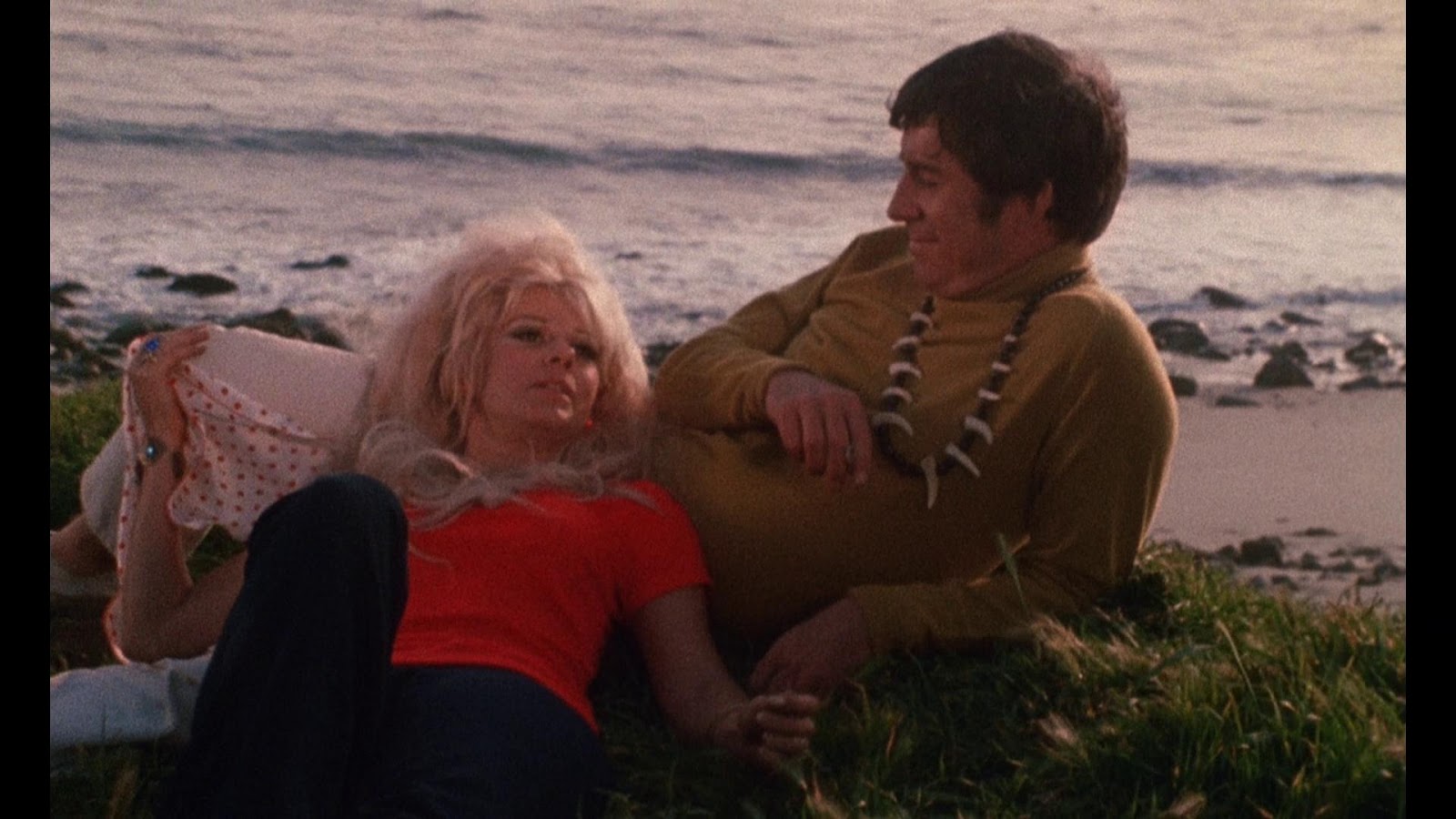
Tacked onto all this mayhem is a subplot carried over from THE BLOOD SEEKERS, in which Las Vegas performer Judith Fontain (Adamson's wife Regina Carrol, we see her singing to a thin crowd about overpacking her bags for a trip to the Hilton Mau Mau) comes to Venice in search of her missing sister Joanie (Joe Sarno veteran Maria Lease), who has actually been decapitated and then nonsensically recapitated before becoming repurposed as a blood donor for Groton. Crusty police detective Sgt. Martin (Jim Davis) isn't much help (though he does get the terrific line "Nobody but nobody understands the subconscious, not even ourselves"), and after Tamblyn's biker gang doses Judith with LSD, she gets the help she needs from Mike (Anthony Eisley), the straightest looking hippie you ever saw. (We know he's a hippie because he wears a turtleneck, a toothed necklace, and has a "pad.") As with the romance between John Gabriel and Erin O'Donnell in THE FAKERS, Mike and Judith's fall into limerence plays a lot like a Salem cigarettes commercial of the period. For a love story that takes so long to set up, it's over hilariously fast due to some laughable circumstances. 


"Let's not get involved": Regina Carrol and Anthony Eisley.
Apparently the climax of the original cut - titled THE BLOOD OF FRANKENSTEIN (not preserved) - didn't play too well, so Sherman conceived the new title and had Adamson shoot a hastily concocted battle royale between the two living dead icons in a dilapidated church location. Apparently the crew arrived under ideal Dracula conditions (they were "losing the light") because Zandor Vorkov's makeup had to be brightened to Kabuki white-faced proportions to show up onscreen. Under the heavily blue-tinted murkiness you can barely see what's going on - and believe me, you see more of the battle on Blu-ray than you ever could in the pre-digital days of drive-ins, early television broadcasts, VHS and even laserdiscs.

Dracula (Zandor Vorkov) revives the Frankenstein Monster (John Bloom).


Photographed by three different cameramen (Paul Glickman, Gary Graver, and an uncredited Sam Sherman), the patchwork film is not without interest but it's never as rewarding as one hopes. Adamson really knew nothing about creating or sustaining a horror atmosphere; he's all about cute, ironic cutting; when Jim Davis ends a scene by saying "It's a dark, dark world," we cut to him turning off an overhead light that wasn't turned on earlier in the scene, and when Beaumont is fastidiously crushed in the arms of the Monster, he takes the cue to cut to the slogan on the back of a 1969 bottle of Mountain Dew ("It'll Tickle Your Innards!"). Tony Tierney's makeup for the Frankenstein monster is actually one of the better post-Universal designs and John Bloom embodies the role acceptably well. Likewise, Naish, Chaney, and Rossitto all strike macabre characterizations and the film is also given a nostalgic charge with the library music of William Lava, which extends to some CREATURE FROM THE BLACK LAGOON cues later in the picture, and the use of Kenneth Strickfaden's mad laboratory equipment used in the original FRANKENSTEIN (1931). I also must admit that the promised confrontation between the two monsters gives us somewhat more than Universal did when Frankenstein met the Wolf Man, or when HOUSE OF FRANKENSTEIN and HOUSE OF DRACULA pulled all the great monsters into one story and then disappointingly kept them largely apart - but even so, more amounts to less. The major disappointment is "Zandor Vorkov" as Dracula, a role that requires innate authority - which is not the same as treating all of his dialogue with reverb. Not only is Vorkov more Doctor Strange than Dracula (firing animated beams from his magic ring, no less), he's basically too young and lacking in presence. Giving credit where credit is due, his disintegration scene is not bad, though Roger Engel's explanation in the featurette of how hastily and crudely it was accomplished is hilarious. 


J. Carrol Naish as the enfeebled Dr. Frankenstein. Oops, spoiler!
The disc includes a Samuel M. Sherman commentary - Sam is very well-spoken and is a highly responsible film historian who shares his experiences with clarity and a bit of humor - as well as a featurette of interviews with cast and crew members. Most engaging, however, is a visual essay called "Feed Your Head! Lose Your Head!" by the Flying Maciste Brothers (Howard S. Berger and Kevin Marr), narrated by smooth talker Berger. It is their view that DRACULA VS. FRANKENSTEIN is something of a misunderstood masterpiece, that beneath its misbegotten surface resides a multi-tiered investigation into the schism of illusion and reality, especially as manifest in the pleasure we take in our darker forms of entertainment.


Judith's uncredited stage show partners in the "Travelin' Light" number.


Berger's narration identifies the film as being made in the spirit of the 1940s "monster rallies" like Erle C. Kenton's HOUSE OF FRANKENSTEIN (1944), in which both Naish and Chaney were prominently featured, which is of course readily evident - and so it goes. Though the points he and Marr make help to underscore some aspects of the patchwork narrative that Adamson's direction (and the film's disjoined origins) left muddled, there's a fundamental difference between pointing out connections and bringing them together in actual chords of enlarged comprehension. Rather than arriving at answers or a bigger picture, the narration is more inclined to pursue the duo's notes to a series of ironic, self-reflective, zen-like questions. For example: it's true there is a similarity between Dr. Frankenstein's self-proclaimed status as one who lives "beyond fear" in a threadbare palace of illusions and the subplot about Judith (herself a stage performer) and her quest to find her lost sister, which takes her through a kind of looking glass into psychedelics and a different kind of life/lifestyle than she has been exposed to before. These details are certainly there but I would argue that what the essay savors as subtext is most often text; these elements are up front and don't exactly galvanize one another so much as merely coincide. The essay also credits Adamson and Sherman with providing all of these subterranean connections with knowing, masterful deliberation, while never mentioning or questioning screenwriter William Pugsley's role in all this, nor that of the cameramen or art director when pointing out revelatory details in composition and backgrounds. Though certainly diverting in its own right as entertainment, what this literate if not entirely persuasive essay ultimately proves is that some folks like this movie a lot more than others, and some - God bless 'em - have worked really hard at it.

(c) 2020 by Tim Lucas. All rights reserved.