Friday, June 19, 2020

GUNSMOKE: An Overdue Reckoning


In the early part of my life, I had very little time for Westerns - and even less for television Westerns. When I saw Sergio Leone's ONCE UPON A TIME IN THE WEST about 50 years ago, in 1970 second run, I was enormously impressed; it was a turning point for me, but it did not make other Westerns more available to me. I actually made a point of not seeking out Leone's other work until another ten years had passed, just using that time to absorb OUATITW again and again, whenever an opportunity arose - sadly, mostly on television until the 1990s, with that climactic zoom into Charles Bronson's eyes had to make a pan & scan choice between one eye or the other. That said, once I got into my 30s and 40s, Westerns began making more sense to me as a genre, and directors like John Ford, Budd Boetticher, Sam Fuller, Sam Peckinpah, Joseph H. Lewis, Monte Hellmann, and particularly Anthony Mann began showing me the way to classic Westerns and also those special examples that Kevin Grant and Clay Hodgkiss call the "renegade" Westerns.

My interest in television Westerns has deepened from the time I realized they were a place to find some great performances by actors and character actors  hiding in plain sight. THE RIFLEMAN had always been something of an exception to my general lack of interest because it had a young character I could identify with, but as the years passed I developed additional interest in WANTED: DEAD OR ALIVE, THE REBEL, LAWMAN, HAVE GUN WILL TRAVEL and that wonderfully baroque example, YANCY DERRINGER. 

In the back of my mind, as this education proceeded, were the imposing figures of the two biggest TV Westerns, BONANZA and GUNSMOKE, for which I had never felt any particular interest. I've seen my share of BONANZA episodes and, while I'm sure there must be fine performances along the very long way, the formula of that show just doesn't work for me - it may have something to do with the lead characters' casting and it may also have something to do with it all being in color. Black-and-white seems so essential to my appreciation of this world in which so much is said about a character by whether they wear a white hat or a black hat.

John Dehner in "Ash."
Then, not too long ago, over on Facebook, my friend (and VW "Star Turn" columnist) Larry Blamire caught my attention with a posting about his acquisition of CBS Video's massive new GUNSMOKE - THE COMPLETE SERIES box set. He wrote a memorable posting about his initial plunge into this accumulation of riches by revisiting an episode entitled "Ash," from GUNSMOKE's first hour-long season. Here's what Larry posted, reproduced with his permission: 


Decided to jump into the complete GUNSMOKE set with an 8th season episode called "Ash" that I'd seen on the Westerns Channel several years back. John Dehner is one of my favorite actors and I had been blown away by his performance.
I was this time too. For all the times I've seen him--heroic, villainous, comedic--I don't recall ever seeing him quite like this.
Dehner plays a rowdy rough-edged buffalo hunter with a lot of heart who decides to open a freight business with an equally rough and tumble trapper (Anthony Caruso). A blow on the head for Dehner's character puts the skids on things and when he wakes he's a different person--surly, cold, grim. Thanks to Dehner and director Harry Harris it's a fascinating study of a Jekyll-Hyde sort where something buried within the man's psyche has come to the surface.
If I were still writing my "Star Turn" column for Video Watchdog I may well have covered this performance. Dehner is very much in control of the subtle shades on display and there's an unpredictability to his work that keeps us on edge. He makes some unusual choices and by doing so commands our attention. Dehner manages such amazing subtlety it's like a camera-acting master class.

I was captivated by what Larry had written and happened to mention to him in my reply that I had always sort of missed the boat with GUNSMOKE. Learning this, Larry made me a spontaneous gift of an introductory assortment of no-longer-needed DVD-Rs he had recorded from Encore's Western Channel, along with a now-spare set of Volumes 1 and 2 of Season 11. I promptly dipped in and recognized that these were indeed a profound gift.

I've been watching at least an episode each evening since that time. I haven't written about everything I've watched, and nothing really at the depth these programs deserve, but I thought my readers here might like to have a peek at my process of discovery. Here are some of my early notes on GUNSMOKE, which I may have treated here and there to some additional polish. Perhaps they will stoke your interest in exploring this filmed legacy as well:    

* * *
Virginia Gregg and James Arness in "Phoebe Strunk."

Since learning that my knowledge of GUNSMOKE was nearly nil, Larry Blamire has been providing me with some essential episodes - and I must say I'm impressed. My problem with GUNSMOKE was always a persistent conviction that James Arness, Amanda Blake, and Dennis Weaver were just not very interesting in their roles. Someone like John Russell in LAWMAN or Chuck Connors in THE RIFLEMAN - now those were and are top drawer Western heroes! Arness's Marshall Dillon never did it for me... but thanks to Larry's gift, I am learning that Arness, Blake, and Weaver were the binding, the framing device for episodes that told stories often involving the people who live or ride through Dodge City. I've watched a few of these, with great appreciation for guest performers like John Dehner and Strother Martin and their respective episodes, but last night's viewing - "Phoebe Strunk" (Season 8, Episode 9) - was especially powerful stuff. Virginia Gregg starred as a completely deglamorized, pipe-smoking, face-slapping, mother of a murderous brood of overgrown boys (including Don McGowan and COMBAT!'s Dick Peabody) who rob a farmhouse, leaving a couple murdered and their only daughter (Joan Freeman) orphaned. She is taken in by a kindly couple (IN COLD BLOOD's John McLiam and a very welcome Phyllis Coates) who want to adopt her, but history repeats itself when the Strunk boys can't get that pretty little girl out of their heads and they abduct her. Director Andrew V. McLaglan keeps a violent story presentable without pulling any punches, and Marshall Dillon has some welcome help in pursuing justice with half-Indian companion Quint (Burt Reynolds). Full marks to writer John Meston (the show's creator) for a taut script and the cast are uniformly at their best. You can find it streaming.

* * *
John Drew Barrymore (right) and gang in "Seven Hours To Dawn."

The best of last night’s GUNSMOKE viewing was the 11th season opener, “Seven Hours To Dawn.” A nattily-dressed, still-contemporary-looking John Drew Barrymore heads a professional army bandits who effectively isolate and take over Dodge City, milking it of all its citizens’ cash and valuables. In an attempt to ride out to get help, Matt Dillon is shot four times and presumed dead. It’s up to Festus and Doc to turn around a grim and seemingly hopeless situation. I’ve never seen Barrymore give a better performance than here, and the baleful situation ratchets its intensity steadily right up to the finish, giving all the principals a chance to shine more than usual dramatically. In the background there’s an early screen credit for Al Lettieri (THE GODFATHER), credited as “Al Lettier.”

* * *

Argumentative aces in the deck: Ken Curtis as Festus Haggen, Milburn Stone as Doc Adams.
Didn’t want to go to bed sad last night, so I stayed up to watch an extra GUNSMOKE episode. So yesterday I saw two episodes focusing on Ken Curtis as Festus. The first, “Killer At Large” (Season 11, Episode 20), was a remarkable drama in which Festus is goaded into shooting a man dead and flees the consequences, finding his way to a widow’s homestead where he is pushed once again to the point of finding his bravery. There is a scene of Festus getting covered in flour and mollasses by a group of sadistic gunmen that is an extraordinary piece of acting by Curtis.

Slim Pickens and Brooke Bundy in "Sweet Billy."
The other, “Sweet Billy, Singer of Songs” (Season 11, Episode 17), was more of a comic piece about Festus’ relatives urging him to help his nephew Billy to find a girl from Dodge to marry up with. The relatives include Royal Dano, Shug Fisher (from Curtis’ THE GIANT GILA MONSTER), and Robert Random (THE OTHER SIDE OF THE WIND) as Sweet Billy, who - after being turned down by Diane Ladd - has the unbelievable luck to find a much more willing Brooke Bundy, who is just unbelievably gorgeous. Add Slim Pickens as Brooke’s scheming widdered pa and you’ve got yourself purdy darn near perfick slice o’ silliness.


* * *
Anne Helm and John Drew Barrymore.

When I saw that “One Killer On Ice” (Season 10, Episode 18) was directed by Joseph H. Lewis (GUN CRAZY), I had an inkling this would be something special. This was another guest star spot for John Drew Barrymore, who seems to be still wearing his WAR OF THE ZOMBIES beard while playing a charming Southern gentleman who has retired his sheriff’s badget to set out on the more lucrative life of a bounty hunter. He rides into Dodge, charms everyone but Matt (who has learned not to accept people on first impressions), and engages the Marshal to accompany him to where he’s secured a wanted desperado as his first bounty. (It would be too dangerous to bring him into Dodge and risk attack by the outlaw’s still-marauding kid brother and other gang members.) The brother is played by Dennis Hopper, already near the height of his powers, and it’s truly a shame that he and Barrymore have no proper scenes together. Hopper’s farmgirl flame is played by Anne Helm (THE MAGIC SWORD, THE COUCH), a complex sullen girl made amoral by a restrictive upbringing whose isolation and fantasies of escape are sorely disappointed. I still prefer Barrymore’s more overtly villainous, yet still charismatic, clean-shaven performance in “Seven Hours To Dawn” but this one may well be the richer and more dimensional; he turns out to be a villain here too, but due to a very delicate shading of immorality rather than something more operatically egregious. He doesn’t become fully-fledged as such till his last moments in the episode. It’s kind of a remarkable dramatic achievement for a show juggling so many interesting characters in less than an hour.

* * *
Festus susses out what Warren Oates, Zalman King and Bruce Dern might be up to.

Another great Season 11 GUNSMOKE: “Ten Little Indians” (Episode 10). Outside of town, Matt is forced ot a threatening young gunman (Manuel Padilla, Jr.) and returns to Dodge to find the Long Branch Saloon playing host to three other notorious gunmen (get this: Bruce Dern, Warren Oates, and... Zalman King???), just biding their time and getting on each other’s nerves. The episode has already delivered everything it needs to, but the plot thickens. It seems they have all been lured to Dodge by a $25,000 price on the Marshal’s head. Unfortunately, these big names were all young ‘uns at the time, already brilliant and the sparks between Dern and Oates are incredible... but they are not the stars of the episode, which boils down to a bigger conflict between Nehemiah Persoff and John Marley. In looking at the packaging, guest stars were listed for the other shows on this disc: John Drew Barrymore, Forrest Tucker... but this one mentioned NO special points of interest, not even for the previous okay episode “Clayton Thaddeus Greenwood,” which featured Jack Elam as the spearhead of a cattle rustling gang and Paul Fix. Go figure.

(c) 2020 by Tim Lucas. All rights reserved.


Thursday, June 18, 2020

YouTube Eurekas: Robert Siodmak, Richard Oswald and more

Hans Stühe in the title role of Richard Oswald's CAGLIOSTRO (1929).
This continues to be a tremendously healthy period for new and remastered films on Blu-ray and DVD, however there comes a time in almost every budget when our appetite for new discovery is held in check by fiscal limitations. With such cold reality in mind, it's heartening to realize there are means out there of placing some rare, arcane treasures within our reach, not so well known because it has no proper publicist - one of which is YouTube, no longer the comfortable dumpster of public domain eyesores. I've been noticing that YouTube has been undergoing a rather quiet redefinition of itself, especially if your voracious appetite for film exceeds the mainstream into more international waters.

The problem with YouTube, of course, is that your discoveries there are often limited to what you type into its Search engine, or what is recommended to you on the basis of your most recent search and past algorithms. With this in mind, I thought I would point out some of the treasures I've discovered over there, hiding as it were in plain sight, which can now even be transferred from your computer or iPad to your largest television screen given technologies like Apple TV's mirroring option. Be that as it may, some of the copies they've made available are less than ideal so a certain amount of visual compression might not be a bad thing. Beggars can't be choosers, you know. 


Fernand Grave and Louis Jouvet in Robert Siodmak's MISTER FLOW (1936).
You must know about the films of noir specialist Robert Siodmak, whether you do or don't. A number of his better-known films are readily available on Blu-ray and DVD here in the US, such as PHANTOM LADY, THE SUSPECT, THE SPIRAL STAIRCASE, THE DARK MIRROR, THE KILLERS, THE STRANGE AFFAIR OF UNCLE HARRY, THE CRIMSON PIRATE, as well as very early work such as PEOPLE ON SUNDAY and his latter day Cinerama epic CUSTER OF THE WEST. I recommend them all - but, happily, YouTube is a valuable source for some of his harder-to-see titles, including LOOKING FOR HIS MURDERER (Der Mann, der seine Mörder sucht, 1931), a contemporary retelling of Jules Verne's THE TRIBULATIONS OF A CHINESE GENTLEMAN written by Billy Wilder and Curt Siodmak, in German with French subtitles); his first French film Tumultes ("Tumult," 1932) with Charles Boyer and Florelle, in French with English subtitles (yes!); Le sexe faible ("The Weaker Sex," 1933) with Pierre Brasseur, in French with Spanish subtitles; MISTER FLOW (1936) with Louis Jouvet, Fernand Gravey and Edwige Feuillière, in French without subtitles - a light suspense thriller based on Gaston Leroux's two-part novel THE MAN OF A HUNDRED FACES and LADY HELENA, OR THE MYSTERIOUS LADY - which was in fact Leroux's thinly disguised sequel to the long-running series of FANTÔMAS novels abandoned by Marcel Allain after the death of his collaborator Pierre Souvestre. 


Deanna Durbin and Gene Kelly in Siodmak's startlingly subversive CHRISTMAS HOLIDAY (1944).
I understand that the lack of "English friendly" options can seem an insurmountable hostility to some people, but the films made in the 1930s were not so distant from the silent era and every film I've listed here is a master class in visual technique, even if you can't follow the narrative as closely as you'd like. However, if you're looking for an obscure Siodmak title that's as English friendly as you could hope, find the right night for CHRISTMAS HOLIDAY (1944) starring a pre-MGM musicals Gene Kelly, Deanna Durbin and Gale Sondergaard. Ignore the highly subversive title of this W. Somerset Maugham adaptation and be astonished by this story of a young wife who discovers that her devil-may-care husband may be a serial killer. This deeply troubling masterpiece, made at a time when women were welcoming their homecoming husbands and boyfriends at the end of the war, not knowing how many lives they might have taken, deserves to be much better-known than it is.


Conrad Veidt and Reinhold Schünzel in Richard Oswald's EERIE TALES (1919). 
Another maestro from the cusp of sound whose work I've been exploring in recent weeks is Richard Oswald, the father of OUTER LIMITS director Gerd Oswald. Oswald père was responsible for making the first horror anthology film, EERIE TALES (Unheimliche geschicten, 1919), which is rarely seen in America but is available on YouTube with an engaging musical accompaniment English subtitles. It contains five stories, the sound version three, both incorporating Poe’s “The Black Cat” and Robert Louis Stevenson’s “The Suicide Club.” For a film now more than a century old, it feels remarkably contemporary in its filmmaking techniques, production design, and the close attention it pays to facial acting. Three archetypal figures - The Flirt, The Devil, and Death (respectively Anita Berber, Reinhold Schünzel, and Conrad Veidt) - step out of their portraits, which adorn the walls of a used book store, scaring the owner and availing themselves of stories in the books on display. The three of them appear in each of the stories, playing different characters roughly within the same archetype, providing the actors with chances to flaunt their dramatic range. Veidt is predictably outstanding, but Schünzel is a revelation. His Devil is a clear antecedent of the Lugosi vampire image, with his black cape, pasty face, and widow’s peak; his crazy husband character in the first story is the prototype of Cousin Eerie (!); and Peter Lorre clearly had his performance in mind when he essayed the same role on Roger Corman’s TALES OF TERROR almost 50 years later. There are two different uploads of this film on YouTube, but only one has English subtitles; I have linked to the preferable one.


Maria Kopenhofer as "The Black Cat"'s murdered wife in the sound remake.
When the sound era commenced, Oswald remade his groundbreaking film (under the same title, Unheimliche geschichten) with the Paul Wegener (THE GOLEM) in the lead as a crazed character who connects the stories in his mad meanderings. The silent version is excellent, but this - the first sound horror anthology - may be even better; I think there’s a good case to be made that it’s also the first feature-length surrealist work. Its stroke of genius is that there is no framing device; the stories flow one into the next like twists in an already delirious tale. It opens Paul Wegener, truly a great and versatile horror star, starring in an adaptation of the subsequently oft-filmed “The Black Cat,” who makes his escape from the police and hides in a waxworks. Lots of creaky thrills in that before he wriggles his way out of an arrest by being committed to an asylum where the inmates have taken over in an adaptation of Poe’s “Dr. Tarr and Professor Feather,” which may be the film’s highlight - what we would now call Buñuelian. Wegener foils a dedicated newspaper reporter pursuant and disappears for six months, when he is discovered as the ringleader of an ultra-sophisticated suicide club, in an adaptation of RL Stevenson’s classic story whose look anticipates Edgar Ulmer’s feature of THE BLACK CAT in 1934. This segment also includes a very Lugosi-like performance by Wegener and an actual shot that would be repeated in 1935’s THE RAVEN. Also known as THE LIVING DEAD, the version on YouTube also carries English subtitles.


Conrad Veidt and Fritz Schultz in Oswald's groundbreaking DIFFERENT FROM THE OTHERS (1919).
Also by Oswald and available on YouTube are DIFFERENT FROM THE OTHERS (1919) with Conrad Veidt and Anita Berber, surviving now only as a 50 minute fragment but said to be the first film ever made about LGBT lives and adversities (it's with English inter titles though sometimes overprinted with unremovable Russian titles); LUCREZIA BORGIA (1922) with Liane Haid, Wegener, Veidt, THE GOLEM's Lothar Müthel, and future director William Dieterle (with English inter titles); and CAGLIOSTRO (1929), Oswald's last silent and an impressive achievement fusing German Expressionism and the 18th century costume romantic heroism mastered during this same period by Abel Gance. It's got French inter titles and Spanish subtitles, but an easy adjustment under Settings allows the user to "auto-translate" the subtitles into many other languages - including English. 


In closing, I'll add one more link to a film I only discovered while rooting around for links for this blog entry. Here's your ticket to the 1919 Thomas Ince silent FALSE FACES, starring Henry B. Walthall as Louis Joseph Vance's heroic spy/detective/master of disguise Michael Lanyard, aka The Lone Wolf! It's apparently a sequel to an earlier film, but this one has special historical interest in that the second male lead is the silent screen's master of false faces, none other than Lon Chaney!


(c) 2020 by Tim Lucas. All rights reserved.  


Monday, June 15, 2020

VIDEO WATCHDOG At 30

It was on this date thirty years ago - June 15, 1990 - that the first issue of VIDEO WATCHDOG was delivered to our home to be shipped out to points all over the globe. It's a bit sobering to realize that our debut's anniversary is already half as distant from us today as tomorrow's 60th Anniversary of the World Premiere of Alfred Hitchcock's PSYCHO (1960); I was around at that time, if not fully conscious, and wouldn't actually see PSYCHO till later in the 1960s when it first made its way to television.

My aptitude for missing dates by a day and years by a year, at least thinking off the top of my head, led me to announce this anniversary yesterday on Facebook, where it was met with a very warm reception from satisfied readers going all the way back to this humble but signal beginning:

"You helped create a whole culture and the canon of that culture. Bravo!" - critic Adrian Martin

"I bought this off the stands on my first date with my wife and told her how important this stuff was to me! Your mag was sharp and smart and she thought well of me because it elevated this type of stuff to literary consideration. Thanks, Tim - for this, the best of its kind mag in my life!" - comics legend Kelley Jones

"I started reading VW with the FIRE WALK WITH ME issue, and then quickly bought all the back issues, as this was the genre magazine I'd been waiting for my entire life. The moment I started writing for film magazines, I realized that I was unconsciously employing VW's house style. Getting invited to be a regular contributor was seriously one of the highlights of my life." - VW's own John-Paul Checkett, now writing regularly for SCREEM

"[I have] every single issue in binders... a magazine that completely changed how we view fantastic cinema." - Dave Kosanke

"It's the gold standard of magazine quality, the magazine all other magazines wish they could be. Still have all mine. Invaluable!" - Wayne Shellabarger Fox

"It would be impossible to overstate how much I've learned and how many films, directors, actors, genres, etc. I've discovered via this amazing magazine. Thanks for the long run, it was a pleasure with every new issue."- Tim Spears

There were dozens more along similar lines, but these are happily representative of the great feeling that still endures for VIDEO WATCHDOG out there, for which Donna and I remain eternally grateful and appreciative.

Of course, we're no longer publishing but most of our back issues remain available. If you are missing back issues, if you've lost some to flood or fire or covetous "borrowing" friends, or if you happen to be one of those unfortunate millennials who came along too late and missed the boat, Donna and I would like to make it easier for you to experience our legacy of publishing the best available writing and thought about international genre cinema. In commemoration of this 30th Anniversary, we're making all extant print back issues - and all digital back issues, with their additional bells and whistles - available at half the usual cost. 

That's right, 50% Off!

Just check the Back Issue details on our webpage and use the special coupon code 50MINT at checkout. It's easy as that.

I have made this claim before, but I was so energized and inspired by yesterday's outpouring of affection and respect that I want to devote more time to keeping this blog more active. I do a lot of writing on my Facebook wall that never gets shared here, which is frankly bass-ackward. It should appear here first and linked over there. And I should be more attentive to sharing notes here on the new and old discoveries I'm making - not just in video but in the ancillary areas of books and music. I am also going to invite some former VW contributors to make guest appearances here in the near future. So bookmark this page, subscribe, or just check back with some frequency. 

As ever, we aim to engage your interests and to please.


Leonard Maltin as "The Movie Police" in GREMLINS 2: THE NEW BATCH.
PS: Happy 30th Anniversary to Joe Dante's GREMLINS 2: THE NEW BATCH, also born on this day back in 1990 - as apt a spiritual "twin brother" as I can think of!

(c) 2020 by Tim Lucas. All rights reserved.


Sunday, June 14, 2020

COUNT YORGA, VAMPIRE At 50

I was there!

It was fifty years ago this week that Bob Kelljan's game-changing  COUNT YORGA, VAMPIRE first went into theatrical release. I was there, half a century ago, in a car with my mother and sister at Cincinnati's Twin Drive-In and wasn't really aware of how totally invested the three of us were in the movie until Robert Quarry's elegant, eponymous bloodsucker got staked in the climax, which caused every car horn assembled there to honk on earnest approval. It remains the only "standing ovation" I ever witnessed in a drive-in - a sudden, joyous realization that everybody out there under the stars had been caught up in its spell as much as we had - and we enthusiastically joined in.

I tend to remember it as a bigger, more mainstream film than it actually was - probably because it carried the AIP imprimatur; on renewed acquaintance, I see it's really a very early example of the kind of 1970s film Stephen Thrower herds together in his magisterial volume NIGHTMARE U.S.A.; that is, a DIY independent horror picture with rough edges and moments of dated silliness, but also some startling moments of grace, that uses the known clichés of the horror genre against its knowing audience, resulting in new kinds of tensions and shocks. When Yorga responds to a handmade crucifix being wielded in his direction with mocking laughter, I remember the bottom of my 15 year old stomach dropping out and a new feeling of terrible exposure to monstrous evil. It was what the atheism subplot of DRACULA HAS RISEN FROM THE GRAVE hinted at, but didn't have the courage to enact.


"May I?" asks Robert Quarry.
Robert Quarry justifiably gets most of the attention the film does, but I think it’s Roger Perry as the doctor who carries the picture. Particularly impressive is the moment when Yorga disarms him by casually asking “May I?,” thereby taking physical possession of the busted chair leg he’s brought to stake him; it's a remarkable show of Evil effortlessly trumping Good by abusing Good’s tendency to civility, especially when he then returns the weapon to him in an elegant gesture perfectly timed to his remark that the intelligence of vampires is such that they can make the most intelligent mortal look a fool.

Producer Michael Macready’s humorless, hunch-over-and-stare acting remains one of the film's few demerits; it’s a shame when he outlives the more capable actors, presumably for financial reasons - another reason why Perry’s contribution is so important. What surprised me most unfavorably on renewed acquaintance is how shaky (and frankly, overlit) so much of Arch Archambault's hand-held photography is, but there are just as many impressively observed shots - like the one of Yorga's hand softly lifting the edge of a drawn window shade to see what's happening on his grounds. (Archambault subsequently shot ANGELS DIE HARD and THE JEKYLL AND HYDE PORTFOLIO.)

I felt certain that Bob Kelljan would go on to become a major new horror director, but despite fairly strong follow-up efforts THE RETURN OF COUNT YORGA (1972) and SCREAM, BLACULA, SCREAM (1973), this didn't happen. He subsequently moved into series television, racking up eight episodes of STARSKY AND HUTCH, five CHARLIE'S ANGELS, and numerous one-shots before his premature death at age 52 in 1982. I'd like to see FLESH OF MY FLESH, the erotic film made by Kelljan and Macready prior to YORGA in 1969, to see if it holds any indications of the promise found here. Of course, as the story goes, YORGA (or IORGA, as Michael Murphy can sometimes be heard pronouncing it) was initially undertaken as an adult film until Robert Quarry persuaded the filmmakers that horror films could be commercial as well. 


Roger Perry, Michael Murphy and Donna Anders.
As I recall, COUNT YORGA VAMPIRE was restored to its original title (THE LOVES OF COUNT IORGA... VAMPIRE) and length sometime around the turn of the new century. The AIP cut was a few minutes shorter, reducing its raw sensuality and violence to a GP level - which certainly worked to the film's commercial benefit. It was the #1 box office champion of its opening week and, according to Quarry, the film went on to become the third highest grossing film in AIP's history. To watch THE LOVES OF... shows us that restoration can sometimes be a mixed blessing; it’s great to have the more graphic horror material intact (the discovery of Erica feeding on a kitten remains a shocker - and further empowers the transfusion scene, which nicely mirrors and updates Mina's "Unclean! Unclean!" scene in Stoker's novel), however the inclusion of some lame content that I remember as absent from the theatrical cut - like the stupid redhead in Perry’s bed, and the stupid but “efficient” blonde working as his receptionist - make me wonder if the AIP cut didn’t do the film some favors that should be preserved as a variant for historical reference. I believe the now-uncirculated AIP cut last appeared on home video on laserdisc.

(c) 2020 by Tim Lucas. All rights reserved. 

Saturday, May 30, 2020

Birthday With the Big G

It's my 64th birthday today, May 30th. After Donna went to bed this evening and left me to celebrate alone, I felt a sudden strong urge to revisit the film that was once known as GODZILLA VS. THE THING. I watched a bit of the English version but then switched to the Japanese, MOSURA TAI GOJIRA. Watching it again, I realized that it was one of my favorite childhood memories - I actually saw it four times in one weekend back in 1964. (I guess I was revisiting 1964 From the new vantage of 64.) The Japanese version is not just the best story of all the Toho films, with arguably the best monster effects of the bunch, it is a reprimand addressed to all politicians, businessmen, and military leaders (not least of all their own) whose decisions betray the common good with selfish, divisive dreams of avarice and conquest. Godzilla here is the incarnation or result of misguided power, while Mothra epitomizes green peace, Mother Nature. I found it not just nostalgic but profoundly moving, due in no small part to the purity of Eiji Tsubaraya’s special effects, Akira Ifukube’s heart-wrenching score, and the sweet duets of the Peanuts.

(c) 2020 by Tim Lucas. All rights reserved.


Thursday, May 21, 2020

The Big Pink From Third Window

British Blu-ray label Third Window Films has initiated a new series of "pink" double features to bring some of the more interesting examples of Japanese erotic cinema to a broader audience in the west. For those in need of further background, "pink" films were introduced in Japan in the mid 1950s and were so called because they aspired to compete with Scandanavian cinema of the time by featuring incidental nudity. They didn't really flourish until the early 1960s, when they became rougher as well as a Trojan Horse of sorts for exposing radical stylistics and political content to their unsuspecting public.

Third Window's PINK FILMS VOL. 1 + 2 (Region Free) provides inescapable evidence that the "pink" movement was not just about arousing its audience but also challenging them, not only in terms of what it was possible to depict onscreen but also in terms of genre-hopping, wild (even mad) filmic experimentation, and conveying bold political messages. Included in this first set are Atsushi Yamatoya's memorably titled INFLATABLE SEX DOLL OF THE WASTELANDS (Kôya no Dacchi waifu, 1967; listed on the IMDb as DUTCH WIFE IN THE DESERT) and Masao Adachi's GUSHING PRAYER (Funshutsu kigan - 15-sai no baishunfu, 1971 - to which the IMDb adds the subtitle "A 15-YEAR-OLD PROSTITUTE"). Approached simply as films, without predominantly carnal expectations, both films show a noticeable affiliation with the French nouvelle vague, where nudity was also intermittently found; while they both have their moments, they are not sexually arousing so much as wildly inventive and intellectually invigorating.


Yuichi Minato is weaned away from his gun by the amorous Noriko Tatsumi.
Yamatoya's INFLATABLE SEX DOLL OF THE WASTELANDS would make an interesting companion piece to Riccardo Freda's DOUBLE FACE. It's essentially film noir, filmed in B&W scope, and tells the story of Sho (Yuichi Minato), a private detective and expert marksman, who is hired by businessman Naka (Masayoshi Nogami) to rescue his kidnapped fiancée Mina (Miki Watari) from her abductor, gangster Ko - also known as "The Flying Dagger" (Shohei Yamamoto). Ko has been periodically torturing Naka and Mina's aging, gibbering father by sending them 16mm films that show her being manhandled and raped by hooded men. The father has been driven so far around the bend by filial remorse and inadvertent lust that he's become neurotically attached to (not-so-inflatable) department store mannequin he uses as an adult pacifier, or sex doll. Sho's path to Mina - which comes with a next-day deadline of 3:00pm - is barred with danger, obstructed by the seductive ploys of Ko's moll Sae (Noriko Tatsumi), and fraught with increasing delirium leading to erotic fantasies concerning his bond with his possibly-dead quarry.


Director Yamatoya is best-remembered as the screenwriter of Seijun Suzuki's gangster masterpiece BRANDED TO KILL, and he made this film in tandem with another, the brazenly titled AMOROUS LIQUID aka LOVE'S MILKY DROPS (Tajo na nyueki, 1967). He was obviously very much under the spell of Godard's ALPHAVILLE when he made this; there are individual shots that could easily be shuffled into the earlier work without detection, and Sho is very much an Eastern Lemmy Caution, gumshoe in a cheap hat, wearing a wrinkled raincoat over a jacket and a necktie dickie. Yamamoto mixes his fictional narrative with documentary shots of his actors moving through documentary street scenes, which exert a quite different fascination of their own, and he reaches for some startling effects concerning the presentation of action and violence. At one point, a suitcase is flung so that it accidentally wings the camera, and the accident is left in; in another moment, a group of thugs bursting through our hero's barricades are shown in different feigned freeze-frame positions, incrementally advanced and adjusted as he sizes up his options for retaliation. The closer Sho comes to finding Mina, the more Yamatoya's technique adopts the technical recklessness of the home movies documenting her abuse. While I can't say the film's story is particularly memorable or even clear, it's a fascinating document and - for all its deliberate ugliness - appealing in the way it subverts its hardboiled drama into a kind of delirious poem about alienation and the need for human contact. Yosuke Yamashita's score adds a lot to the experience, heaping on some splashy, wailing, free jazz very much in the vein of John Coltrane's Quartet.


Aki Sasaki as the tragic heroine of GUSHING PRAYER.
The second feature, GUSHING PRAYER, is very much the other side of the coin. A more serious film, its protagonist Yasuko Aoyagi (Aki Sasaki) is not what we assume from the designation "15 Year Old Prostitute." First of all, she is not at all your typical 15 year old, as the non-stop conversations between her and her three best friends Koichi (Hiroshi Saito), Yoko (Makiko Kim), and Bill (Yuji Aoki) are intellectual, philosophical, and rigorous. In fact, their discourse is so relentless and mutually bullying, especially toward Yasuko (ironically the most sexually experienced of the group) that it attains a kind of abstraction separated from anything warm-blooded. They are also anti-sex, despite a shared sexual obsession induced by their young bodies and inherent friskiness, with the four of them determined to find ways within their rebellious fellowship of "beating" sex (which they perceive as a commercialized invention of predatory adults) and finding a way back in touch with their natural feelings. Yasuko would seem to have little chance of attaining this goal as, at 15, she finds herself pregnant from a covert relationship with one of her teachers (Shiganori Noda). The sometimes conflicting dogma of her fellows, not to mention her elders, makes it difficult for her to decide what her options are for the future.


Director Masao Adachi (still active as of 2016) was one of the more dedicated writers and directors of the pink cinema movement, having written the scripts for Koji Wakamatsu's reasonably well exported THE EMBRYO HUNTS IN SECRET (1966), VIOLATED ANGELS (1967), and GO, GO, SECOND TIME VIRGIN (1969), sometimes working under the alias "Izuru Deguchi." What he achieves with GUSHING PRAYER is anything but erotic; there is nudity and a few instances of animal rutting between people but we are only made to feel distanced from it and somewhat repelled and confused by it and what unsated greed or curiosity drives those involved.


Like its co-feature, GUSHING PRAYER takes advantage of some documentary locations where we see its characters passing among real people, and the silent spaces between forward jumps in the narrative are filled with quotations - tragic, despairing yet still inquisitive, and sometimes poetic - from the suicide notes of various teenagers, male and female. Filmed in black-and-white scope that occasionally jolts into bold color duotones (again, showing a debt to Godard) and a couple of shifts into full, if somewhat anemic, color, this is very much related to such grim teenage tragedies as Uli Edel's CHRISTIANE F. (1981) - and if its vomiting scenes are comparatively coy, at least one other instance of graphic body horror may serve you more than you're ready to see.

Both films are newly remastered and show just enough faint surface abrasion in places to remind us that these bizarre creations were actually shown to audiences in theaters, once upon a time. There is no commentary or essay material mentioned as part of this set, which would have provided some helpful context; however, Third Window has obtained the indispensable services of BEHIND THE PINK WINDOW author Jasper Sharp for their next round, which streets next week on May 25. VOLUME 3 + 4 will feature Masayuki Suo's ABNORMAL FAMILY (1984) and Kan Asai's BLUE FILM WOMAN - which I hope to write about soon. Here's a promotional image to tide you over, as well as this helpful link to more information.


(c) 2020 by Tim Lucas. All rights reserved.


Sunday, May 17, 2020

The Misery of Marie Roget

Found a somewhat blurry copy of Phil Rosen's Universal B-picture THE MYSTERY OF MARIE ROGET in my DVD-R collection and decided to give it a spin. I hadn't seen it since childhood and all I could remember of it were shots of a racing horse drawn carriage - which turns out to be because it's virtually the only thing in the film that's not talk. 

The movie opens with a discerning hand plucking a thick hardcover copy of Poe's short story from a piddling display of classic literature. The first thing the 60-minute film shows us is a Paris newspaper headline exclaiming the murder of Marie Roget - a simple perfume salesgirl in the story, but here an exotic music hall singer who is the toast of Paris! "Prefecture of Police BAFFLED!" we are informed. But Maria is soon revealed to be still alive, not the dead disfigured girl dredged up from the Seine. She and her sister's fiancée are plotting to murder her sister, a plan overheard by the grandmother who asks our hero Pierre Dupin to protect her. Dupin, the character Leon Ames (as Leon Waycoff) played in 1932's MURDERS IN THE RUE MORGUE, is played by the woefully bland Patric Knowles and he's continually being congratulated on solving that legendary case. The evil Maria's musicality is explained by the fact that Universal cast Maria Montez in the title role; but what is not so easily explained is that Maria is the granddaughter of Maria Ouspenskaya and the sister of Nell O'Day - so the three members of the Roget family living under the same roof have wildly different accents - and not one of them French! 


Nelly O'Day, Lloyd Corrigan, Patric Knowles, Maria Ouspenskaya and John Litel.
The other French roles are played by those beloved Gallic performers Lloyd Corrigan, John Litel, and (as a zoo keeper) Charles Middleton. Corrigan is the foolish Prefect ("Pre-fey") of Police, who has to be reminded more than once in his impulsive attempts to arrest people that it would help to have an airtight case against the suspects first. He gabs so relentlessly and pointlessly he must have been paid by the word; his fussy, comic, impatient window dressing crowds the film so badly that our hero-genius Dupin is reduced to standing around mixing chemicals and slyly testing theories he confides in neither the Prefect nor the audience, so his general lack of charisma is compounded by the no more than vague sketch we're given of this celebrated detective. The movie lifts whenever Madame Ouspenskaya puts him in his place. At a party, Maria makes everyone swoon by singing an interminable song in Spanish. When someone tries to poison her and Dupin (perhaps a music critic), it looks like Phil Rosen himself stepped up to tap the powder into their untended drinks. In a last act confession of creative bankruptcy, Dupin deduces that the cause of the shared facial disfigurementa of the female murder victims is a common hand garden rake - the very same prop used as the signature weapon of the killers in Universal's THE SCARLET CLAW and SHE-WOLF OF LONDON, made around the same time. The film's only persuasive whiff of France comes from a climactic rooftop chase as Dupin and the Prefect chase the skulking shadow figure from HORROR ISLAND over the rooftops of Paris. His defeat doesn't bring us much closure; we're told who this cloaked phantom is by name, but we're not given a shot of his face to confirm which of the cast members he was.

On the very narrow plus side is some occasionally striking photography by Elwood Bredell (THE MUMMY'S HAND, HELLZAPOPPIN!, PHANTOM LADY), which must be even better served by a proper presentation. Entertaining in its general ineptitude, and the inability of the actors to speak either believable English OR French, I'm sure the reason why my childhood memories of THE MYSTERY OF MARIE ROGET are so limited is that it must have driven me to raid the refrigerator.

Having fallen back on my old DVD-R out of mistaken desperation, I now see that it's been available from Universal since 2014 as part of their Vault Series. If my notes have intrigued you, you can find it here.

(c) 2020 by Tim Lucas. All rights reserved.

Monday, May 11, 2020

UNHEIMLICHE GESCHICHTEN, Sight and Sound

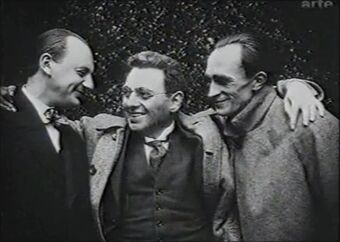
Rudolph Schündler, Richard Oswald, and Conrad Veidt.

I had never seen either version before, so I was delighted to find the 1919 silent and 1932 sound versions of Richard Oswald’s seminal horror anthology UNHEIMLICHEN GESCHICHTEN (EERIE TALES) on YouTube. The silent version contains five stories, the sound version three (or four, it's hard to tell), both incorporating Poe’s “The Black Cat” and Robert Louis Stevenson’s “The Suicide Club.” The 1919 version is quite impressive; I think 1919 feels longer ago in the past because it links us to period films more often than not, but EERIE TALES (while covering different time periods) is surprisingly contemporary in its filmmaking techniques, production design, and the close attention it pays to facial acting. Three archetypal figures - The Flirt, The Devil, and Death (respectively Anita Berber, Rudolph Schündler, and Conrad Veidt) - step out of their portraits, which adorn the walls of a used book store, frightening the owner and taking over the shop, availing themselves of stories in the books on display. 


Schündler, Berber, and Veidt as Literature's arcana of Evil. 

This unholy three appear in each of the stories, as different characters but sometimes within the same archetype, providing the actors with chances to flaunt their dramatic range. Veidt is predictably remarkable, but Schündler is a revelation. His Devil is a clear antecedent of the Lugosi vampire image, with his black cape, pasty face, and widow’s peak; his crazy husband character in the first story is the actual prototype of the aptly-named Cousin Eerie (!); and Peter Lorre clearly had his performance in mind when he essayed the same role on Roger Corman’s TALES OF TERROR almost 50 years later. The closing story, an original by Oswald told in verse, shows the chameleonic Veidt in a performance that serves as a dry run for his celebrated Gwynplaine/Lord Clancharlie in 1928's THE MAN WHO LAUGHS. In a surprising early gesture of auteurism, Oswald shares the screen briefly at the outset of the film in celebration of his partnership with the two principal actors. 


Domestic discord as mise en scène in the 1932 version.

The silent version is among the best of its kind, but the 1932 sound version (sometimes called THE LIVING DEAD) may be even better; I think there’s a good case to be made that it’s also the first feature-length surrealist work. Its stroke of genius is that the stories are presented as a single fluid entity; there is no framing device as in the previous version, so the stories flow one into the next like twists in an already delirious tale. It opens with Paul Wegener (THE GOLEM), truly a great and versatile horror star, starring in an adaptation of the subsequently oft-filmed “The Black Cat,” a touchy inventor who murders his wife, whose final scream is overheard by crusading on-the-spot reporter Frank Briggs (Harald Paulsen). Rather than submit to inescapable arrest as in the Poe story, Wegener (whose character is given no name other than Mörder, or Murderer) escapes the police and hides amid the figures in a waxworks. The film is said to consist of only three stories, but this waxworks segment has the feel of an uncredited fourth. Briggs trails Mörder to this shrine to dead criminals and their fistfight culminates in a switch being thrown that activates the figures' mechanical movements. Lots of creaky thrills before our villain wriggles his way out of yet another arrest and inevitable execution by arranging for his commitment to an insane asylum where, as it happens, the inmates have taken over in an adaptation of Poe’s “The System of Doctor Tarr and Professor Feather,” which may be the film’s highlight - it's the sort of thing we would now call Buñuelian. Wegener foils Briggs once again and disappears for six months, when he reappears as the mysterious ringleader of an ultra-sophisticated Suicide Club, in an adaptation of Stevenson’s classic story. The ultra-stylish design of this episode is almost alarming to discover in a 1932 film; its look  anticipates Edgar G. Ulmer’s 1934 feature version of THE BLACK CAT. The segment also includes a very Lugosi-like performance by Wegener, scenes in which he interacts with fellow GOLEM actor Ferdinand Hart (who would later essay the title role in Julien Duvivier's sound version of 1936), and an actual shot that would be repeated in Lew Landers' THE RAVEN from 1935. 
Paul Wegener - a great horror star. 

Director and co-scripter Oswald - whom I believe was the father of OUTER LIMITS director Gerd Oswald - is an under-appreciated craftsman and early horror specialist. These two films, though dealing to a fair extent with the same material, not only stand uniquely well on their own but they bear favorable comparison to most of the many horror anthologies that followed through the subsequent decades. They are both captivating entertainment, cleverly and stylishly served up, and feel more effectively organic than most of their imitators. We’re very much in need of definitive presentations of both films; they would make a marvelous double feature set.

UPDATE 05/14/2020:
Since posting the above, I have learned that YouTube also has a subtitled presentation of Richard Oswald's 1930 remake of ALRAUNE available for viewing here. Additionally, for those who haven't seen Henrik Galeen's 1927 silent original, that is also uploaded over there at this link. Both versions star Brigitte Helm, the Robotrix from METROPOLIS. The subtitles on the silent version (which also features Paul Wegener) are Russian, but if you go into Settings over there, you can reset them for Auto Translate into any language you wish.
    
Furthermore, from reader Volker Stieber:
"Hi, Tim - , I read your review of UNHEIMLICHE GESCHICHTEN and wanted to let you (and your readership) know that a restoration of the 1919 version was released on German DVD in 2013. It looks very nice and it is estimated to be missing only about 4 minutes. Cheers!" 

(c) 2020 by Tim Lucas. All rights reserved.