Monday, September 05, 2016

Revealing the Secrets of THE HORRIBLE DR. HICHCOCK

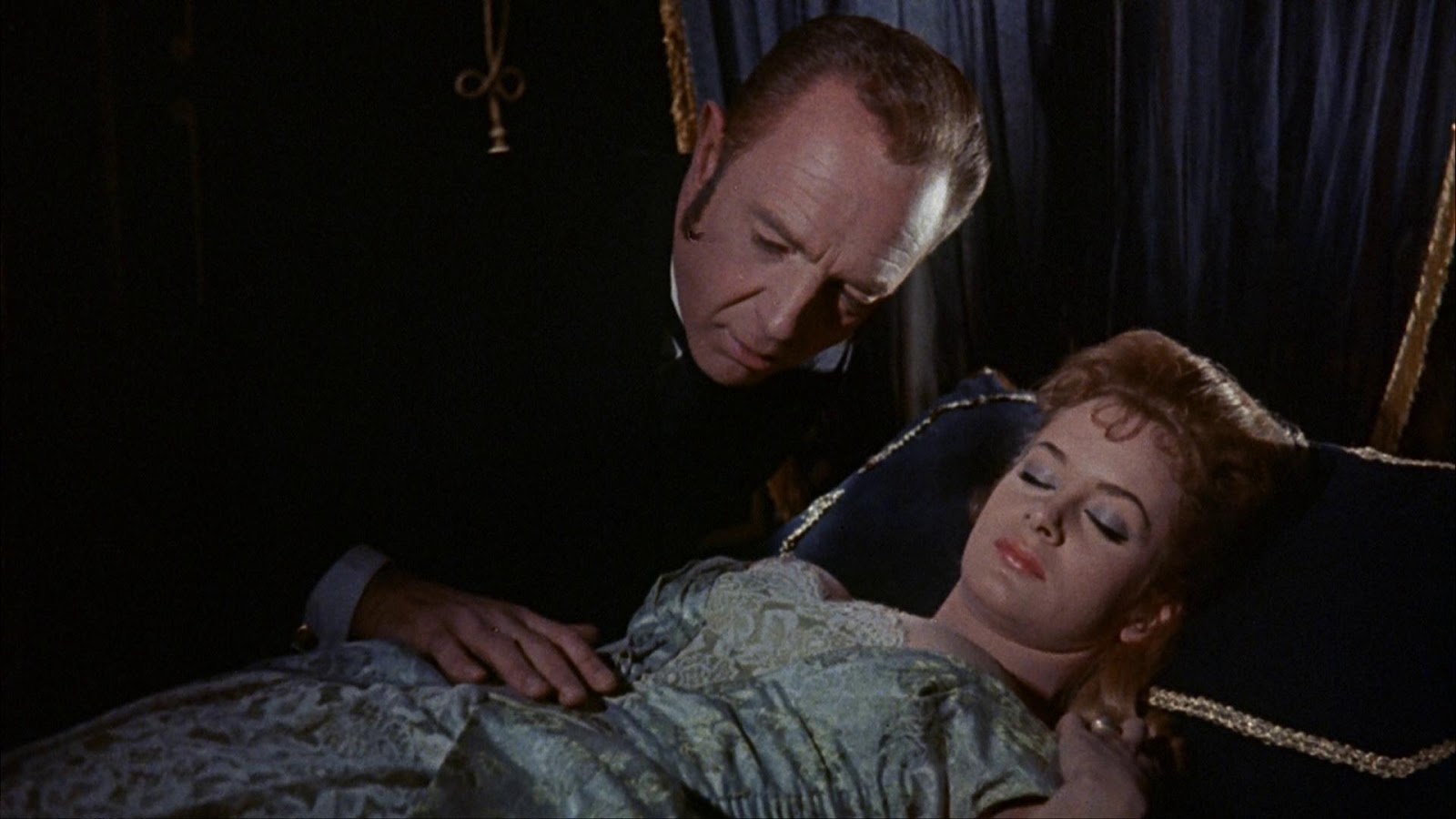
Robert Flemyng sets the mood in Riccardo Freda's THE HORRIBLE DR. HICHCOCK.
Before there was HITCHCOCK/TRUFFAUT, there was HICHCOCK/HAMPTON - better known under its theatrical release title:

http://amzn.to/2bRYGiU

THE HORRIBLE DR. HICHCOCK was the US release title only, given to a film released in the UK in its uncut English-dubbed export version, THE TERROR OF DR. HICHCOCK. The US version, which shared a set-in-cement double bill with Jess Franco's THE AWFUL DR. ORLOF, was cut down to 76m 48s from its original 88m length. I was only being slightly glib with my opening line because, years before François Truffaut's extraordinary interview book presented its ground-breaking analyses of Alfred Hitchcock's visual tropes and techniques, Italian director Riccardo Freda (under his Anglocentric pseudonym of "Robert Hampton") used this opportunity to gather some of his own favorites together and play with them toward new ends.

To illustrate a few examples... There is a funeral scene that pays homage to the assassination scene in Hitchcock's FOREIGN CORRESPONDENT (1940):


There is a poisoned glass of milk that recalls one in SUSPICION (1941):


There is a scene in which a young woman discovers a skull secreted in her bed, à la UNDER CAPRICORN (1949):


And, most significantly, HICHCOCK also contains allusions to VERTIGO (1958):

But where THE HORRIBLE DR. HICHCOCK transcends its namesake, and VERTIGO, is in its remarkably frank incorporation of necrophilia as its protagonist's primary peccadillo.

In the film itself, the third of those preceding images is seen first. I have known and loved this crazy film for decades, but it wasn't until I saw the film in high definition for the first time this past weekend - thanks to Olive Films' new Blu-ray disc - that I noticed that the corpse about to be buried in the pre-credits sequence is the same young woman's corpse he is irresistibly drawn to at the hospital where Dr. Hichcock presides as a distinguished surgeon, about halfway through the picture. This revelation alone showed me that the story must have been reordered somewhat in the editing room. If the pre-credits sequence was meant to depict the fulfillment of Hichcock's thwarted hospital fondlings, this means that his succumbing to actual necrophilia wasn't written to be his "thing" all along, but rather came about years of whistling around his tendencies with his kinky sex games with willing wife Margareta (Maria Teresa Vianello aka "Teresa Fitzgerald") - whom we see allowing herself to be injected with her husband's experimental anesthetic to the point of complete physical passivity. It is only twelve years after her death following an apparent overdose that Hichcock's kink is fully formed, a circumstance wherein he can relive the memory of Margareta's complete physical passivity and come to deal with the cold fact of her death.

Robert Flemyng's performance in this scene - and in the film, generally - is nothing short of operatic and magnificent. Like many actors in his place, he accepted the film as an opportunity to spend time in Rome, and yet history has proven it the role for which he'll likely be remembered. Though fans tend to think of HICHCOCK as a Barbara Steele film, it doesn't offer one of her better performances. It doesn't help that the role itself is underwritten, but she upstages herself throughout with bizarre, compulsive flexings of her hands, distracting the eye from her face. She does figure in some memorable scenes, however, particularly the scene in which she finds herself drugged and occupying the altar-like bed in her husband's supposed "laboratory," where her predecessor formerly yielded her will to that of her husband. It's one of the great delirious scenes in Italian horror, and one that makes fairly early use of special makeup effects involving inflatable bladders.

Note also in that sequence the presence of incandescent red lighting, which at this time was the signature expression of Freda's former cinematographer Mario Bava. When I interviewed Freda many years ago for my Bava book, he confirmed for me that his collaborations with Bava continued past the point when published filmographies claimed they stopped. There was a reason for the secrecy surrounding such involvements, namely that Bava was, by this point, a director in his own right and it would have proven detrimental to that career to be seen accepting side-jobs on the projects of other directors. A director didn't "shine other people's shoes." Actor Brett Halsey also confirmed for me that he first met Bava on the set of another 1962 Freda film, THE SEVENTH SWORD (La sette spade del vendicatore), where he was shooting an atmospheric scene in a torture chamber with lots of incandescent red lighting - which is what caused me to ask Brett about the scene in the first place. Mind you, if Bava did have a hand in filming this sequence, it doesn't mean that he worked with Barbara Steele a second time; Flemyng's half of the scene, the half affected, was obviously shot separately. I didn't specifically ask Freda about Bava's possible involvement on THE HORRIBLE DR. HICHCOCK because the state of available video copies at that time gave no hint that such was likely. However, seeing this scene with its scarlet hues now red to bursting, I am tempted to revise my thinking... but not only for this. There is also the matter of a certain transitional shot that, now that I've finally seen it in high definition, made my suspicions that much more certain.

The first shot you see in the following sequence is the actual exterior of the villa where the film was shot. The following grabs are exteriors of the villa shown with an illuminated upstairs window, and also during storms - which, while utterly convincing on an old VHS tape, are exposed in high definition as trick shots involving a painting of the exterior with foregrounded foliage (including a potted plant!), tree trunks seemingly fashioned from black rubber tubing, and foregrounded rain from a watering can with a flickering light for lightning! Everything that went into this trick shot was consistent with techniques Bava brought to his own films, making HICHCOCK now highly suspect as a film that employed Bava as an independent unit. This trick shot is the kind of thing he could have created at home or on a weekend. 

     
Something else about THE HORRIBLE DR. HICHCOCK that I never quite realized until this latest viewing: When Ernesto Gastaldi was hired by this film's producer Luciano Martino to write his script, it was always part of his mandate to emulate the latest British and American models of gothic horror. Certainly there is something in this film, which tells the story of Hichcock's return - with a new wife in tow - to his brooding villa a dozen years after his first wife's death, only to find it haunted by her spectre, which alludes to the Poe films of Roger Corman as well as the works of Alfred Hitchcock. But what I have never really noticed before about HICHCOCK is that it contains all the pieces that Robert Towne needed to write Roger Corman's THE TOMB OF LIGEIA (1965).

To wit: Both films are about necrophilia and second marriages, with an older man haunted by his first dead wife marrying a much younger woman and subjecting her to her predecessor's memory - as in Hitchcock's REBECCA (1940).

Both films find the master of the house enabled in his strange fetishes by the compliance of an aging domestic, who has a dark devotion of their own to the past lady of the house - and the young wife witness to strange things that persuade her that her predecessor may not be dead after all.
Hichcock's late wife also has a familiar, a black cat named Jezebel, who - as in LIGEIA - puts in an appearance atop her mistress's coffin.

Near the climax of both films, a character is depicted with a bloody shoulder. 

And both films end in hellish conflagrations, with the young wife freed from the past and delivered into the arms of a man who truly appreciates her for who she is.
THE HORRIBLE DR. HICHCOCK (version) has had only one prior domestic release on home video: a VHS release on the Republic Video label. Olive Film's Blu-ray is its first domestic release on disc and it's first high-definition release anywhere. It's region-free with English dubbed dialogue and optional English subtitles. The image quality, as you can see, is absolutely ravishing throughout, and sometimes sharp enough to expose technical faults in the cinematography, including instances where the image is not quite in focus. That said, it looks and feels like the Technicolor it says it is. Here is a contrast of how one shot appears in the Italian (L'ORRIBILE SEGRETO DAL DR. HICHCOCK) and US releases, respectively:
Clearly, the Italian transfer is brighter (as it is throughout) and its 1.78:1 framing offers more screen information on both sides and and bottom than the 1.85:1 Medusa release - otherwise, the two grabs look so completely different, suggesting different times of day at the very least, it's tempting to regard them as alternate lighting experiments using the same set-up. The Italian frame, with the purple clinging so uncannily to that tiled column, also brings to mind the possibility of Bava's extracurricular hand. It stark qualities remind me of the ambulance shot in BLOOD AND BLACK LACE (1964). The US framing is a bit tighter but ultimately non-disruptive, and I also feel it's generally more successful than the Italian disc (which, incidentally, has no English option) at delivering the brightness levels and color intensities the film was intended to convey.

Naturally, it's disappointing that the film can only be shown in this country in the truncated form of a 50+ year-old theatrical release, and that it has been released in a no-frills package without commentary or context. But this is one you'll want to have anyway; it's one of the most important Italian gothics of the 1960s, and it's exciting to finally have this important variant (now the property of Paramount Pictures!) available in such a lovely presentation.

It streets next week, on September 13.


(c) 2016 by Tim Lucas. All rights reserved by the author.


Wednesday, August 31, 2016

We Are The Dead: Nicolas Winding Refn's THE NEON DEMON


"Beauty isn't everything. It's the only thing," says a character named Sarno in Nicolas Winding Refn's latest, THE NEON DEMON. It may take years for me to finally decide whether I love this film or hate it, but it seems to demand an extreme reaction. It's too precise an assault of seductive antagonism to simply be written off. At no point in its nearly two-hour running time is there any question that we're in the hands of a capable cinéaste who loves his job and his medium. The film is ripely, even opulently cinematic, but - as with Jonathan Glazer's UNDER THE SKIN (2014) - there is a bland, even soporific thinness about the material, like a logline read through a heroin haze, so void of emotion it feels like an alien transmission draped in scenic alacrity. It's like a story sent from such a great distance that its teller died inside before he could finish.


Sumptuously photographed by Natasha Braier (THE MILK OF SORROW, THE ROVER), the film comes as close as anything I've seen to embodying this century's answer to SUSPIRIA. It shares the same muffled sense of dangerous portent when our heroine Jesse (Elle Fanning - a Jess Franco reference?), while cleaning up after modelling as the proverbial "centerfold in a PLAYBOY layout from Hell", happens to meet Ruby (Jena Malone, excellent), a makeup artist straddling work on Hollywood sound stages and in Hollywood funeral homes. The point couldn't be clearer: the perfection to which these characters aspire is Death - painted, available, unyielding, cold as Fassbinder. Jesse's barely sixteen; she's only been in town for a week and she's spending what's left of her runaway funds on a motel on the Sunset Strip. Almost overnight, she becomes LA's flavor of the week. Let's call that foreshadowing.


We never get to know Jesse. I'd like to praise Elle Fanning's performance, but as Gertude Stein once said of Los Angeles, "There is no there there" - which was almost certainly everyone's goal. No one may want it (or even remember it) a month from now, but Jessie's carnate form has momentarily cornered the market on "pretty." She has "that thing," as someone says. (Something else called "that thing" later turns up in her motel room.) She knows how to walk in ways the other girls can't. She finds an agent (Christina Hendricks, capable in a throwaway guest part) who advises her to lie about her age ("People believe what they are told") and a famous self-absorbed photographer (Desmond Harrington) who sees something in her that he wants to experience on a closed set. It literally happens overnight. The young hopefuls whom she replaces in the city's selective consciousness come to hate her. Those who cannot be her want to drink her blood. She's Bowie before you know it.

Getting there requires her to dump Dean (Karl Glusman), the sensitive young photographer who got her to town (actually, he's sensible enough to back out once he finds out how old she is) and to walk across the condescending faces of some other models (Bella Heathcote, Abbey Lee) who seem to hail from Stepford ("Sweetie, plastic's just good grooming.") But as much as she might fear them, or her handsome brute of a motel manager (Keanu Reeves), or their intentions, it's really her only friend in town that she really needs to fear. In a fascinating, if obvious, bit of cross-cutting, we see Ruby - a lesbian sexually rejected by the young starlet she's offered shelter - getting herself off with a voluptuous corpse she has just prepared for public viewing, as Jesse luxuriates on a divan as though masturbating to this perverse fantasy.


Where the film goes from there I should leave to your own discovery, but believe me when I tell you this is a far darker vision of Hollywood than Nathanael West envisioned in DAY OF THE LOCUST or David Lynch proposed in MULLHOLLAND DRIVE. The emphatic male gaze of the piece may seem sexist, but alien as it seems, the film (one hopes) is profoundly humanist and about sexism and objectification, as the two women sharing its byline with Refn (including PREACHER story editor Mary Laws) would probably agree. In an ambivalently direct yet metaphorical way, THE NEON DEMON depicts Hollywood as a murderous mediocrity that tirelessly preys upon and eradicates anything found on its turf that is possessed of genuine quality. And, by extension, it shows us how - in this day and age - cinema of genuine substance is being savaged to the brink of extinction by "creatives" who hate it because they cannot possibly compete with it.

 
In a bizarre coda that I found simultaneously off-putting yet pregnant with meaning, Refn presents us with a metaphor for the most basic of Hollywood laws: If you don't have the stomach for fame, someone else will.

THE NEON DEMON comes to Blu-ray next month, but is already available for streaming via Amazon Video.

Saturday, August 27, 2016

KING KONG VS GODZILLA - In Cincinnati

http://amzn.to/2bW81BG
The above illustration is a clipping from an article in the film industry trade magazine BOXOFFICE,   circa 1963, picturing the marquee of the Twin Drive-In Theater when it hosted the local premiere of KING KONG VS GODZILLA. It opened with its co-feature THE TROJAN HORSE (starring Steve Reeves) on Wednesday, July 17 1963. And this was the marquee I passed under when I saw this Toho classic for the first time - I was there.

Cincinnati Enquirer, July 14 1963.
It was only a few years before this that producer Joseph E. Levine had innovated what became known as a television saturation campaign, where programming geared to kids became dumping grounds for TV spot trailers, exciting the small fry about what would be opening at hard tops and drive-in theaters that coming weekend. It actually began with a Steve Reeves picture: HERCULES UNCHAINED in 1958. I was witness to many such campaigns in my early years, and I remember having a good sense of what KING KONG VS GODZILLA would be well before it opened, though I had never seen a King Kong movie before and had never before heard of Godzilla. (Hard to imagine, but if I had seen a Godzilla movie before, it was called GIGANTIS THE FIRE MONSTER back then.) But I enjoyed the film enormously and it certainly fueled my young imagination. I remember drawing both King Kong and Godzilla a lot over the course of the following week.

I certainly knew of KING KONG at the time, thanks to articles and photos in FAMOUS MONSTERS OF FILMLAND, so I'm not sure why I wasn't able to catch up with it till October 1970. Looking back through the CINCINNATI ENQUIRER archives, I see it played often enough on local commercial television stations - and I was particularly fascinated to discover that the 1933 KING KONG even played at some local indoor theaters in 1960 and was revived once again in October 1962 for some drive-in triple bills pairing it with GODZILLA - KING OF THE MONSTERS! (1954) and MIGHTY JOE YOUNG (1948)! That's right, King Kong and Godzilla first "met" in this country in their original versions, long before anyone in America saw the Toho wrestling match. Of course, the Toho film had already been produced by this time and it's possible that the pairing of "the screen's mightiest monsters" was being road-tested to gauge audience interest before Universal Pictures acquired the new film for US distribution.

Original opening weekend ad.
A decade later - still playing.
Needless to say, KING KONG VS GODZILLA proved to be an enormous hit in North America, spurring the immediate distribution of its sequel, GODZILLA VS. MOTHRA - retitled GODZILLA VS. THE THING by American International Pictures, perhaps to avoid a copyright conflict with MOTHRA's domestic distributor Columbia Pictures. One of the most uncanny facts about KING KONG VS. GODZILLA is that it was literally never out of theatrical circulation for the next ten years. There are indoor matinee playdates on record in 1967 and 1969, and then - on August 8, 1973, more than a full decade after its premiere at the Twin Drive-In - it burst back upon the same outdoor screen as part of "Battle of the Monsters," an AIP package of their past Toho acquisitions.

It's now 2016 and, back in its homeland, KING KONG VS. GODZILLA - known in Japan as Kingo Kongu tai Gojira - has recently been completely restored (complete with original stereophonic soundtrack, never heard in the US) and treated to a 4K restoration with new theatrical screenings and deluxe home video releases planned. There is a new Japanese Godzilla film, Shin Gojira (GODZILLA RESURGENCE), that has opened so well that there is already talk of a sequel: GODZILLA VS. KONG, set for release in 2020.

Some battles never get tired, and it would appear that Kong and Godzilla - Monsterdom's great avatars of hot- and cold-blooded strength - will continue to argue their superiority in the popular consciousness for a long time to come.
_____________________


PS In case you're wondering about that "Facts of Life" banner in the topmost photo, it was a herald promoting the next feature at the Twin Drive-In, THE WRONG RUT (pictured at left). I didn't get to see that one... but the good news is, it's available on DVD from Something Weird Video!


Friday, August 26, 2016

Revisiting LAST SUMMER

Richard Thomas as Peter in LAST SUMMER.

I revisited the Frank and Eleanor Perry film LAST SUMMER (1969) tonight for the first time in probably 20 years. Unfortunately it hasn't had an official home video release in this country since the VHS days, though it did play in its "cut" R-rated version once on Turner Classic Movies. Watching it again, I was struck by hitherto unnoticed and completely unexpected similarities between Richard Thomas' performance and the performance given by Malcolm McDowell in Lindsay Anderson's IF... the same year.

Malcolm McDowell as Mick in IF...
It would be hard to imagine two actors more dissimilar in terms of their public images, which naturally was formed by the work they've respectively done over the course of their careers (ie., THE WALTONS, CALIGULA), yet in these early films, they could nearly be mistaken for one another in some shots, so alike are they in their abilities to contrast wide-eyed innocence and feral, amoral intensity. It could probably be said that typecasting has affected them both adversely, albeit in quite different ways.

I've never read the Evan Hunter novel that was the basis for LAST SUMMER (he also wrote a sequel, COME WINTER) but I wonder if the story's resemblance to William Golding's LORD OF THE FLIES is more or less pronounced in print than on film. It's something I've always noticed about the film, brought to the fore by the beachside setting and the teens' almost tribally induced reversion to savagery, with Cathy Burns' preternaturally wise, victimized Rhoda being the analogy to Piggy.

On another subject concerning the same film: LAST SUMMER was originally advertised as carrying an X rating, but Wikipedia tells us that it never played in theaters in that cut, which was altered by opening day to win the film a more commercial R rating. Everything I've ever read about the film claims that cuts were made to the climactic rape scene, but knowing how tame X films could be in 1969 (even in 1971 when a matter of seconds were cut from a rape film shown as part of the Ludovico Treatment in A CLOCKWORK ORANGE), I'm skeptical that it was ever more graphic than what we see now. However, the dialogue in the film has a lot of relooped dialogue along the lines of "frickin'" and "frackin'" and I suspect that the real bartering in the film was done with language. In those days, the F word could get you an X.


Another oddity concerning the soundtrack is that the dialogue includes not one, but two spoken lead-ins to music cues that never happen - once when a record gets changed and Barbara Hershey suggests "How about something by the Airplane?" (which is followed by music featuring brass) and again at the bar when she notices "a new song by The Band" on the jukebox and they pop in a quarter to play it. That said, one or two members of The Band apparently did contribute to tracks recorded for the movie as part of the congregation identified as Aunt Mary's Transcendental Slip & Lurch Band.

Thursday, August 25, 2016

Three Thursday Passings

RIP to the wonderful comic actor and voice artist Marvin Kaplan, who has reportedly passed at the age of 89. Fans of my generation remember him as the voice of "Choo-Choo" on the Hanna-Barbera animated series TOP CAT, but he also made early impressions in a several TV appearances from that era - as a regular on MEET MILLIE and as a guest on THE RED SKELTON SHOW, MAKE ROOM FOR DADDY, and even serious dramas like M SQUAD and THE DETECTIVES. His feature film work included FRANCIS, ANGELS IN THE OUTFIELD, THE NUTTY PROFESSOR, IT'S A MAD MAD MAD MAD WORLD, THE GREAT RACE, THE SEVERED ARM (!), FREAKY FRIDAY (Jodie Foster version), David Lynch's WILD AT HEART and Larry Blamire's DARK AND STORMY NIGHT. Later television work included steady roles on ALICE, BECKER and David Lynch's ON THE AIR. He and I had friends in common, and my condolences go out to all who are saddened by his loss.


Today we also lost Rudy Van Gelder, a career optometrist who retired from his day job in the late 1950s to become the most creative and celebrated recording engineer in the history of jazz. His work for Alfred Lion's Blue Note label touched the careers of John Coltrane, Miles Davis, Thelonious Monk, Art Blakey and dozens of others. He was such a uniquely talented technician that the label eventually honored with an album - featuring all these artists and more - entitled THE BEST OF RUDY VAN GELDER. He was 91.

I was also very sorry to hear of the passing of French writer Michel Butor. Butor was unusual in that he was generally revered as a novelist but actually wrote very few novels (even fewer translated into English) and, so far as I'm aware, the only writer associated with the exciting nouvelle roman (or "new novel") literary movement of the late 1950's and early '60s - along with Alain Robbe-Grillet, Nathalie Sarraute, Marguerite Duras, Claude Simon, etc - who rejected that classification of his work. The bulk of his work, I understand, was poetry and essays and academic writings. I've long known his name but I've never read his novels in translation and should. He was best known for his novel SECOND THOUGHTS, written in the uncommonly used "second person" - as was Jay McInerney's later breakthrough novel BRIGHT LIGHTS, BIG CITY.

Saturday, August 20, 2016

In Search of Lost Chords

This picture shows the kind of transistor radio I owned between 1963 and 1965, when popular music (IMO) was at its zenith. It was a gift from my mother and it became my Siamese twin; I carried it with me everywhere in a cheap black leatherette carrying case, and I often fell asleep listening to it - in the dark of my room, where music seemed to gather extra dimensions it never had in broad daylight.

Sometimes I was able to put it down for awhile, to go to the movies or whatever, but when I first heard (for example) The Zombies' "She's Not There" or "Tell Her No," or "You Really Got Me" by The Kinks, I was so thunderstruck by a new musical world suddenly defined but as yet unmemorized, that I would stay tuned not only to listen but to stand guard till the next time those songs cycled around. One day, when I was walking around my West Norwood neighborhood with my radio at my side, I was momentarily careless and dropped it - and that was all she sang.

I can't remember what I did for music from 1966 through maybe 1968, other than overhear it on other people's radios or to play something on the occasional juke box. I've sometimes thought of trying to find one of these, to fill a certain nostalgic void, but I couldn't bear to hear today's music coming out of it.