Wednesday, August 10, 2016

Every Car Needs A Jack


Here's a thing or two you may not know about Richard Harbinger's hot rod quickie T-BIRD GANG, starring Ed Nelson, Pat George and a young Vic Tayback, which was released by The Filmgroup back in 1959. You can probably guess the first bit of trivia from its means of distribution, or perhaps from the presence of Nelson and Beach Dickerson in the cast: the film was secretly produced by an uncredited Roger Corman. But even more interesting than the film itself, in retrospect, are its promotional materials.

Evidently the film was so quickly and cheaply made (or poorly photographed) that very few promotional shots were taken during the filming. What Corman did to jazz-up the film's public appearance was to have some friends he'd met at Jeff Corey's acting class to participate in an afternoon of modelling shots that would show what the public generally demanded from such a picture - some cars, some babes, and some guys with haircuts. None of them was in the actual movie. A close look at these materials shows none other than a young Jack Nicholson among the participants, posing around a brand new white Thunderbird on a Hollywood Ford car lot! (That's him in all these shots, second from the left.) At this time, Jack had already starred in another Corman-produced JD picture, 1958's THE CRY BABY KILLER (written by Leo Gordon, no less), but his acting career was still a decade away from its ultimate take-off with 1969's EASY RIDER. 

One of the few ways you can actually see T-BIRD GANG these days is in a box set of public domain hot rod titles called BORN TO BE WILD - 4 HIGH-OCTANE MOVIES, which happens to also include THE WILD RIDE (1960), another early Nicholson starring role, and prominently pictures him on the packaging!

Monday, August 08, 2016

The Sale You've Been Waiting For

Mark Maddox's original "Carmilla" cover art for VIDEO WATCHDOG 183 - available now!
We're already a week into the month, so it's high time that I mentioned here - as has already been done on our website - that another of our delightful "'DoG Days of August" sales in presently in effect! We haven't had one of these since our 100th issue was published, but it's a great way to help you acquire more of our coveted back issues, to better familiarize yourself with our digital issues, and support your favorite film magazine.

Here's the deal: For the remainder of this month, each back issue of VIDEO WATCHDOG can be yours for only $5 USA — hey, that's $7 off the usual going price — and we'll up the ante by adding the digital counterpart of that issue ABSOLUTELY FREE! When you compare the print edition to all the bells and whistles added to the digital experience, we're betting that you'll want to experience our entire back catalogue that way! (It is a glorious thing, if we do say so ourselves.)

Just head over here, select the issues you want, check out (no coupon code needed!) and we'll deliver links to your free digital editions via email the minute we process your order (usually within minutes, but no later than 24 hours), and of course, we'll mail your print issues out the very next day.

While you're at it, be sure to snag the free digital version of VW 183 before it disappears!

Friday, August 05, 2016

Welcome To The Architecture of Ruins

Imagine a derelict movie theater - not just one, but dozens of them, all eroding from a virus no more virulent than a village of eyes pointed some other way, arranged in a deluxe catalogue of cultural and architectural decadence. Some of these places are still active but struggling; others groan under a weight of accumulating neglect; most seem to belong to a bizarre ghost town of the imagination. What were once, not so long ago, dream palaces have become bare-boned barns, the harsh juxtapositions of reality and its escape harmonizing in a lament that no one, that no thing, lasts forever.

Seats where audiences once gathered to thrill to colorful adventures now huddle in orgiastic collapse, their bare wooden backs scarred with the fan-traceries of furtive spiders. Rusting projectors stand sentry above over a fading fantasy of better days. In a more fortunate example, an auditorium of still erect seats are cloaked in individual white coverings, summoning what appears to be an audience of ghosts. Elsewhere, a marquee extends the full length of a city block but only five or six letters remain to identify the last film ever to play there, in Cinerama no less, and the lettering is Thai. 

"Welcome to the Architecture of Ruins," reads the back cover of ONCE UPON A CELLULOID PLANET: WHERE CINEMA RULES HEARTS AND HOUSES OF FILMS IN THAILAND (FilmVirus, 1500 THB), a 516-page volume by Sonthaya Subyen and Morimart Raden-Ahmad, to heroic historians who decided to photograph the modern-day remnants of Thailand's dying movie palace culture while its peeling but still-evocative façades were yet standing. In addition to the impressive photo-documentation, the book includes a number of guest essays by such international luminaries as Apichatpong Weerasethakul (UNCLE BOONMEE WHO CAN RECALL HIS PAST LIVES), Fred Kelemen (THE MAN FROM LONDON, THE TURIN HORSE) and Prabda Yoon (MOTEL MIST), and the award-winning writers Daenaran-Saengthong (SEA Write Award, Officiers de l’ordre des arts et des lettres in 2008), Suchart Sawasdsria (Thai National Artist of Literature, 2011), and Uthis Haemamool (SEA Write Writer Award 2009), all reminiscing about their formative experiences as young movie-goers. ONCE UPON A CELLULOID PLANET also includes sidebars documenting Thailand's approaches to advertising film, via billboards, advertisements on wheels and bus ads.

While nostalgia obviously had a great deal to do with what motivated Subyen, Raden-Ahmad and their guest authors, it plays a more abstract role in how the book is absorbed by someone outside Thai culture. The accompanying texts are rich with descriptions of what it was like to inhabit these derelict structures when they were still vital, including reminiscences of the films that played there. However, one's first impulse upon opening this book is to page through it, cover to cover, an experience which for me conveyed an eerily Ballardian charge with its peeling parade of long-vacated sensoriums. The text, which carefully and affectionately places the images in context, is all that prevents ONCE UPON A CELLULOID PLANET from seeming like an advanced, poetical work of post-apocalyptic science fiction. And its images carry a bitter punchline, appropriate to such science fiction, in that many of the abandoned structures profiled herein were built in the 1980s.

I was grateful to receive a gift copy of this remarkable book some months ago from Sonthaya Subyen, and I would have reviewed it promptly had there been any point to doing so. He informed me in separate correspondence that it had been published in a limited edition of fewer than 1,000 copies, of which only a few copies then remained. But I'm happy to report that this bilingual book - ONCE UPON A CELLULOID PLANET - a bilingual book, in Thai and English - is now available in a new slipcased "Black Box" edition. (I should mention that the images accompanying this report were photographed from the book on my iPad and imported to the blog; the originals are much brighter, sharper and more colorful in the book.)

This is a unique book and one you will be proud to own. The retail price of the Black Box edition is at 95 $US, and some copies yet remain of the standard white cover edition (without any box) at 85 $US (included shipping and handling anywhere in the world). For further information, send email inquiries to filmvirus@gmail.com, or message them on their Facebook page ONCE UPON A CELLULOID PLANET.

Thursday, August 04, 2016

Hitchcock's SABOTAGE: Beloved Faces in the Crowd

http://amzn.to/2axOsgRI've been enjoying myself the last couple of days, exploring the extensive supplementary contents of Criterion's recent CLASSIC HITCHCOCK box set, and I believe I've just spotted something that may qualify as an important historical eureka. The disc for 1935's THE 39 STEPS includes a half-hour documentary entitled HITCHCOCK: THE EARLY YEARS, which is of particular value for including on-screen reminiscences of several gentleman who worked as Hitch's editors and assistants during his formative British period. Still more important, however, was the surprise I got during former 3rd assistant Teddy Joseph's reminisce about a practical joke played on him during the filming of SABOTAGE (1936). This story was illustrated by a clip from the picture, detailing a scene which the documentary describes as the film's most famous: it shows a boy named Stevie (Desmond Tester) running an errand, unknowingly transporting film cans that contain a high explosive. To ramp up the suspense, Hitchcock has the young messenger caught up in a crowd assembled to see the Lord Mayor's Show procession. I've seen the film several times before, but not until now did I happen to notice a couple of familiar faces in the crowd.
 

Yes, indeed! The child whose view of the parade is blocked by Stevie is unmistakable as the young Patricia Hitchcock, daughter of the esteemed director, who went on to become one of the outstanding character actresses of her time. According to the IMDb, Ms. Hitchcock's first appearance in a theatrical feature was her father's STAGE FRIGHT (1950), preceded only by a TV movie in 1949. I can't recall this cameo ever being mentioned in any of the many books about Alfred Hitchcock that I've read.

But what makes this clip still more valuable is that Alma Reville - who contributed to the screenplay and was also the esteemed Mrs. Hitchcock - is also on view to play the child's mother, fussing over her little girl and finally hoisting her up to see the Mayor as he passes on horseback. Mrs. Hitchcock's only other known appearance in a Hitchcock film was in THE LODGER (1927), in which she briefly appears as a woman listening to a wireless.

Monday, August 01, 2016

Enid At the Crossroads: Surviving GHOST WORLD

Enid leaves town in GHOST WORLD.

Last week I revisited - as I occasionally do - Terry Zwigoff's GHOST WORLD (2001). I consider this adaptation of Daniel Clowes' 1997 graphic novel one of the finest films of our fledgling century and, not insignificantly, also one of its most comforting - an odd assertion to make, considering that its general complexity leans to the bizarre, the negative, and the unhappy. This was a pivotal viewing for me, as it compelled me - for the first time - to extend my viewing experience by seeking out the original graphic novel, an impressive achievement in its own right - however, also disappointing to me, in that few of the themes I've always valued most about the film were in original evidence.

Of course, what I take as the film's message may differ from anyone else's experience of the film, because each of us brings our own experience and moral requirements to any movie we see; every film is, in effect, co-authored by its audience. I was reminded of this fact when I posted some thoughts about this recent viewing on Facebook, which prompted one of my friends there (Darren Bullerwell) to ask a surprising question:

"Did Enid die at the end of the movie? I ask this because they pass by the man waiting for the bus. He has sat there for weeks. When the bus finally arrives, the man is gone - presumably died. This happens to Enid at the end. The bus that no longer runs comes for her. I have asked other friends if this interpretation is correct. They think I am wrong."

Rebecca and Enid talk with Norman.

I told Darren that this was not my own interpretation of the ending, though I couldn't dispute its fairness given the information that the film presents. It should be noted that Daniel's memory of events was slightly inaccurate. What actually happens in the film is that Enid (Thora Birch) and Rebecca (Scarlett Johansson) notice an older man named Norman (Charles C. Stevenson, Jr.) seated hopefully on a bus bench that has been stencilled "Not In Service." In striking up a conversation with him as one of her hometown's curiosities, Enid learns that Norman's late wife used to catch the bus here, and he is now waiting for it to happen along and take him. Given Norman's relation to the bus stop, there is reason to interpret it as some kind of death wish, if not a literal spectral ghost carriage. Daniel was incorrect, however, in remembering that Norman is gone when the bus finally arrives; instead, Enid witnesses the bus' arrival and sees Norman climb dutifully aboard. The bus does run. At least it reappears, in apparent response to Norman's hopes.

Speaking for myself, I've always cherished a somewhat different interpretation of the ending of the picture. The original Daniel Clowes graphic novel chronicles the slow disintegration of the bond between two girls who were best friends in high school, who move in different directions in response to life after graduating. In both, Rebecca ends up succumbing to the status quo of their home town, while Enid ends up leaving. The Terry Zwigoff film tells the same general story in an appreciably different, less negative way - by introducing the character of Seymour (Steve Buscemi), a thirtysomething misanthrope who has found and cultivated for himself a meaningful niche in life by collecting old 78s of blues and ragtime recordings. The two girls first encounter Seymour in the midst of a practical joke, but Enid later meets him again at a garage sale, where he's selling old records. Having previously found something of unexpected value in the Bollywood film GUMNAAM (whose now-famous production number "Jaan Peechaan Ho" by Mohammed Rafi opens the film), she inquires if he has any old Indian rock-and-roll records, which leads him to recommend a collection of old blues recordings, which she buys for a pittance and later puts on in a dire moment when all her more familiar records trigger feelings of despair. In a moment that may have no equivalent elsewhere in cinema, Enid is playing the record as background while washing the punk green out of her hair when she happens to overhear Skip James' 1931 recording of "Devil Got My Woman" and becomes caught up in it. Instead of being something to blast out in hostility at the rest of the world, Enid discovers that music can also be let in.

Enid at the crossroads, discovering the Blues.

To me, the primary difference between the two GHOST WORLD projects is that, through her serendipitous discovery of music, of something meaningful in an otherwise obscenely empty life, Zwigoff arms Enid with something she can love, which is what she needs to escape and survive the dead end life proposed by her home town - and this is why I personally find the notion of the bus as "suicide solution" impossible to accept.

What the bus represents to me, to use an old-fashioned word, is faith. The word faith doesn't have a religious significance for me, but rather a mystical one. Norman's belief that the bus will come, despite all other contrary outward signs, is a statement of faith, which is something that Enid can initially regard only with mockery. Norman is, along with Seymour, the only mockeries of the early part of the picture that Enid respects enough to examine more deeply, taking the trouble to interact with both men personally. In Norman, I would argue, she finds her faith, while in Seymour (whose name identifies him as a mentor) she finds a model for her own future survival. As Seymour describes himself, he's something of a caretaker for "the lost culture of the 20th century," so the "ghost world" of the title is actually his - though the phrase also invites our co-opting it as a criticism of the culturally empty real world we presently inhabit.

I love the film enough, and have seen it enough times now, to have discerned a thing or two that could have been pruned to make it even stronger. I feel that Norman's allusion to his late wife may force some viewers toward a more negative reading of the film, so I wish that Zwigoff and Clowes had left his backstory more ambiguous. I also feel that the film continues a few scenes past its actual stop, which I feel occurs when Enid unexpectedly witnesses the bus' arrival and sees Norman board it and ride away. This moment is followed by one of those rare shots in cinema that feel equal to the closing shot of Charlie Chaplin in CITY LIGHTS: we see Enid, suddenly beautiful, suddenly mature, suddenly invested (I believe) with a faith she has seen rewarded. Just before the fade-out, her expression turns sly and we know that she knows there is more happening here than what she has seen.

Enid's moment of epiphany.

I've long suspected that the film might play better if it had the courage to end here, on an ambiguous note. But the film plods on a bit longer, showing Enid walking around her town, her heavy footfalls so locked in time with David Kitay's BARRY LYNDON-like theme music that it seems a musical expression of her entrapment there - an entrapment so old as to encompass many earlier generations. And then, finally, one night, she ventures out to the disused bus stop with a single piece of luggage, where the bus arrives for her. Miracles can happen only once, so its arrival no longer surprises us; there may well be a mundane explanation now.

And now what?

GHOST WORLD imparts its most important message with Enid's moment of epiphany. The flickering of each expression across her face seems to correspond to her reaction shots at the graduation ceremony, the scene where we first see her engaging with the real world; in maybe 10 seconds, she gives us something to measure her growth since the time when everything she saw in life, even the tragic things, seemed there for her haughty amusement or recoil. If stories end when their game changes, this is the end of Enid as we have known her; what will become of Enid after this Edward Hopper moment belongs to another story.

To date, GHOST WORLD has only been released domestically on DVD by MGM Home Entertainment. However, a region-free Blu-ray of the film has been released in Germany, in English with optional subtitles.  

You can find some interesting "now and then" images of the GHOST WORLD bus stop at this Filmap page.

Saturday, July 30, 2016

A Horror of Numbers: Robert Siodmak's THE GREAT SINNER


Robert Siodmak's THE GREAT SINNER begins inauspiciously with a writer (played by Gregory Peck), traveling alone, aboard a train bound for Paris. Before the train departs, his lonely compartment is joined by a dour, older woman who is followed aboard by a very beautiful, younger woman (Ava Gardner) who spends the entire trip playing Solitaire and not speaking a word. When the train reaches her destination of Wiesbaden, she and the man stand together and she breaks their long silence, asking if this is his destination too. When he explains that he is bound for Paris, she offers, "What a shame!" and departs - in a manner that suggests great adventure were he to stay. On the spur of the moment, he changes his mind and the entire future course of his life.

As this woman, Pauline Ostrovsky, later explains to the writer Fedya, she felt mystically bound to him throughout their silent shared journey because, for the first time in her life of playing cards, with him at her side, the right cards suddenly began falling invariably into place. She has gone to Wiesbaden to join her father General Ostrovsky (Walter Huston), who, like her, is addicted to gambling - a weakness that Fedya finds so morally reprehensible that he decides to reject the woman, while remaining in Wiesbaden to write a new book about the psychology of such lost souls. Despite his resolve, weakness begets weakness and Fedya soon enough falls in love with Pauline. When he discovers that the Ostrovskys have in effect sold themselves into eternal bondage to casino manager Armand de Glasse (Melvyn Douglas), in the form of two promissary notes amounting to some $200,000 and Pauline's hand in arranged marriage, Fedya determines to free them both by staking his own fortune on the gaming tables. It would not ruin the story to reveal that - in a thrilling sequence - he is both highly successful in his dare, and ruinously contaminated by his success.
  
Ava Gardner and Gregory Peck with director Robert Siodmak.
This film - produced by MGM as part of the studio's "Silver Anniversary" - was loosely based on Fyodor Dostoevsky's story "The Gambler," to which it bears only modest resemblance. Its screenwriters were an interesting pair: Ladislas Fodor (who, remarkably, wrote James Whale's THE KISS BEFORE THE MIRROR and George Pal's TOM THUMB before going on to write several Edgar Wallace krimis and Karl May westerns, as well as Jess Franco's THE DEVIL CAME FROM AKASAVA!) and noted author Christopher Isherwood (whose BERLIN STORIES were the basis of CABARET and whose other scripts include THE LOVED ONE and FRANKENSTEIN: THE TRUE STORY). There have been a number of films about the dangerous allure of games of chance, and Dostoevsky's story also inspired James Toback's remarkable THE GAMBLER (1973) with James Caan, but for some reason THE GREAT SINNER's important place in this history tends to be overlooked. It was a box office disappointment in its time, perhaps partly due to the drab reception given it by critics like Bosley Crowther of THE NEW YORK TIMES ("a dreary picture"), but revisitation proves that - like any other Siodmak picture you might care to pull down off the shelf - it still has a great deal to offer.

Peck puts his entire life on the line to win his beloved's freedom from casino baron Melvyn Douglas.
The film's production values (including art direction by Cedric Gibbons) are impeccable, but the cast is truly flawless all down the line. Gregory Peck has never been a particular favorite of mine, but this film ranks high (near, say, TO KILL A MOCKINGBIRD) among his most captivating performances. Ava Gardner is not only stunning but transcends initial expectations by playing a character who, through love, changes places with our lead protagonist and summons unsuspected depths of humanity. Melvyn Douglas inhabits his role with calm authority, so amiable in his wealth and privilege that the extent of his monstrousness comes as something of a shock when it's ultimately revealed. The principal supporting players - Walter Huston, Ethel Barrymore, Frank Morgan and Agnes Moorehead - give remarkable, vivid performances that rank with their very best work. Of these four, it would be wrong to pick out any one over the other, but Frank Morgan's character is particularly well written, and his final scene is unforgettably eerie. It finds him unexpectedly seated next to Fedya when he's in a suicidal state of mind, and Siodmak and cameraman George Folsey stage the scene with the brilliant technical stroke of having Morgan isolated within the frame by camera diffusion - which not only emphasizes Peck's extreme state of alienation from other living people but the fact that Morgan's character has already taken his own life in similar alienation and despair.

Frank Morgan and Gregory Peck in the film's eeriest sequence.
Director Robert Siodmak - the brother of screenwriter Curt Siodmak (1941's THE WOLF MAN) - is largely remembered nowadays as one of the great film noir specialists, on the strength of such films as PHANTOM LADY (1944), THE KILLERS (1946) and CRISS CROSS (1949). However, he was just as importantly a major - and somewhat overlooked - director of horror, as can be seen in his expert handling of Universal's SON OF DRACULA (1943), the astonishingly subversive serial killer thriller CHRISTMAS HOLIDAY (1944), and the "Old Dark House" chiller THE SPIRAL STAIRCASE (1945). Though a mainstream production in every sense of the term, THE GREAT SINNER plunges into areas of human experience so dark as to intermittently qualify as borderline horror. This becomes particularly clear during a later scene in which Fedya - deranged by hunger and a need for gambling money - revisits a pawn shop run by a wen-eyed crone played by Agnes Moorehead. Strictly through the use of jarring editing and unexpected imagery, Siodmak forces us to share Fedya's increasingly murderous state of mind, creating one of the most alarming 1940s terror sequences I've seen, and the film's one true debt to the moods cast by Dostoevsky himself in his writings. But the film achieves its real apogee of horror in a moment when the viewer, too, suddenly is made to feel infected by the secret geometries cast by numbers, as they stand alone or in combination, which compel people to bet everything on the red before consigning their souls to eternal black.

If you've never seen THE GREAT SINNER, what are you waiting for?

It's a good bet.

Friday, July 22, 2016

The South Is Gonna Rise Again in October


Limited to 2500 units each in the US and UK.


Making huge internet waves today was Arrow Video's surprise unveiling of their October titles, which include two deluxe box sets devoted to the 1960s shock titles of Herschell Gordon Lewis. The more basic of the two items is the aptly titled THE HERSCHELL GORDON LEWIS FEAST, which will collect 14 titles on 17 discs in Blu-ray and DVD, all newly restored in 1080p. The titles included are: BLOOD FEAST, SCUM OF THE EARTH, TWO THOUSAND MANIACS!, MOONSHINE MOUNTAIN, COLOR ME BLOOD RED, SOMETHING WEIRD, THE GRUESOME TWOSOME, A TASTE OF BLOOD, SHE-DEVILS ON WHEELS, JUST FOR THE HELL OF IT, HOW TO MAKE A DOLL, THE WIZARD OF GORE, THE GORE GORE GIRLS, and THIS STUFF'LL KILL YA! Two bonus Blu-ray discs will also thoughtfully provide the option of viewing BLOOD FEAST, SCUM OF THE EARTH, COLOR ME BLOOD RED, A TASTE OF BLOOD and THE WIZARD OF GORE in 1.33:1, while another will provide the documentary HERSCHELL GORDON LEWIS: THE GODFATHER OF GORE. The set will be strictly limited to 2500 units each in the US and UK.

Limited to 500 units each in the US and UK.


Then there is the heavy artillery, THE SHOCK AND GORE BOX, which will be strictly limited to only 500 units each in the US and UK. It will contain the following exclusive bonus items:

28-page H.G. Lewis “annual” stuffed full with Lewis-themed activities plus archive promotional material
Fully-illustrated 92-page art book featuring the definitive overview of the entire career of H.G. Lewis written by Stephen Thrower, with a brand new foreword by Lewis [Shock and Gore edition exclusive]
160-page paperback of the original Blood Feast novelization, written by Lewis [Shock and Gore edition exclusive]
7” vinyl single featuring select tracks from the Blood Feast score [Shock and Gore edition exclusive]
14 postcards featuring original artwork for all the films included [Shock and Gore edition exclusive]
Individually handmade “super gory” eyeball [Shock and Gore edition exclusive]
Shock and Gore commemorative barf bag [Shock and Gore edition exclusive]
Newly illustrated packaging and books by The Twins of Evil [Shock and Gore edition exclusive]


That Stephen Thrower book is something of a knife-twister, isn't it? Well, you know you want it - and I hope you can afford it. Visit this page to pre-order yours or to check the remaining supply. They are disappearing fast!

UPDATE 7/26/2016: THE SHOCK AND GORE BOX is officially SOLD OUT.

Familiar THINGS

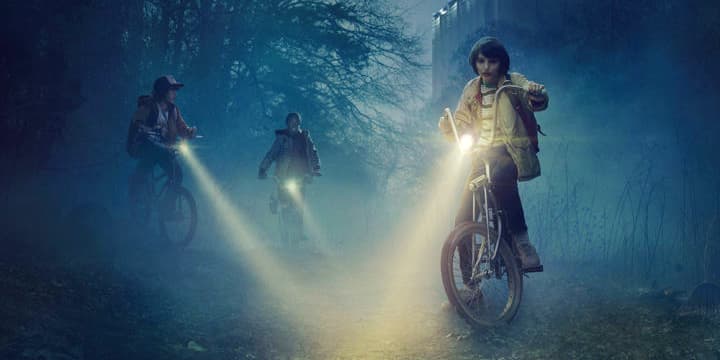
Enthusiastic notes on my Facebook news feed led me to check out the Duffer Brothers' new Netflix series STRANGER THINGS within a day or two of its July 15 premiere. Most uncommonly, my friends were pretty much unanimous in raving about it, at least one in caps, and another boasted that he had blasted his way through the entire eight-hour, first season run overnight, so tightly was he held in its grip. I have done similarly crazy things, watching "just one more" at 4:00 in the morning, which turns out to be two or three more, but I was surprised to find that STRANGER THINGS didn't even tempt me. It was good, passable entertainment, but not much more. In fact, two episodes (or "chapters," as they called it, evidently seeking a literary analogy) per night was as much interest as I could sustain for it. Now that I've finished all eight chapters, I'm trying to make sense of everyone else's unusually high enthusiasm for it.

I keep thinking there must be some underlying sociological reason I'm missing - possibly its ties to Stephen King, whose novels are certainly referenced here (even the title seems to pinion off of King's NEEDFUL THINGS), and whose body of work never held the fascination for me that it has for the rest of the world. It can't just be 1980s nostalgia because STRANGER THINGS borrows ideas and images from films as recent as UNDER THE SKIN and going as far back into the 1960s and '70s as THESE ARE THE DAMNED (with its government-sanctioned experiments on children) and SHIVERS (with its slug-like parasites vomited down bathroom drains). I could point to nearly every scene in the series and find not just a precedent for it but visual quotations in many. (My favorite was in the last episode, a wink at Joe Dante's THE HOWLING.) As I say, I thought it was alright but people had me all but running to my TV set to catch this before the spoilers caught up with me. That's what I don't understand. I can see people getting a kick out of a greatest hits album but not a greatest hits album of cover versions.

The E.T. shot.
The Drew Barrymore shot.
The GOONIES shot.
The POLTERGEIST shot.
The SHINING shot.
The WITCHBOARD shot.
The SCANNERS shot.
The ABYSS shot.
The ALTERED STATES shot.
To which you can also mentally add the ones I couldn't Google: the ALIEN shot, the THING shot, the UNDER THE SKIN shot, the X-FILES shot, the CARRIE shot, ad infinitum if not nauseum. That's STRANGER THINGS, ladies and gentlemen - "A Netflix Original Series."

Possibly, the way this series has been so warmly embraced may have something to do with its familiar, comfort food values. Set in 1983 and allowed to roll out in a manner consistent with that era (which is to say, without the usual attention-deficit editing that has become the norm for Millennials), it's not really a product of its time, but a straightforward, unpretentious Young Adult novel for television that tells us what we all want to know: that government is not just bad but evil, that family (however screwed-up it may be) is good and always there for us, and that the victors in any situation will hail from the Island of Misfit Toys - like the pre-adolescent Dungeons and Dragons players who are the chief protagonists of this show.  

Speaking of this group, I've seen the kids on this show (Finn Wolfhard, Gaten Materazzo and Caleb McLaughlin) compared to the kids in Joe Dante's movies, which begs a few responses. First of all, it's important to remember that Joe Dante invented 1980s Young Adult fantasy in cinema. If you want to see where smart kid protagonists began, the way they still are today (in movies like TOMORROWLAND and GOOSEBUMPS, for example), you have to go back to GREMLINS and EXPLORERS and EERIE, INDIANA. Secondly, people are saying this because... they have one token movie poster on their bedroom wall? And it's JAWS? C'mon. It takes a lot more layering than that to create a Dante picture. And one more thing: kids in a Dante film would never speak to each other, much less their parents and local police, the way these kids do. To yell "bullshit" at your parents, in most families circa 1983, would have invited serious consequences. In a lot of little ways, this film fails the 1983 test for me.

Millie Bobby Brown as Eleven.
Much of what carries the show is the central performance of young Millie Bobby Brown as "Eleven," the telekinetic child who escapes the clutches of Dr Martin Brenner's (Matthew Modine, now at the mad scientist stage of his career) MKULTRA-spawned, CIA-sanctioned, brain-tampering program and taken into our young heroes' protection. Looking remarkably like a pre-adolescent Mary Louise Parker with a buzzcut, Brown has both a calm and a feral intensity that commands even the slipperiest attention. David Harbour's Sheriff Jim Hopper, struggling with his own memories of loss while striving to help Winona Ryder's Joyce Byers find her missing son Will (Noah Schnapp), finds solid dramatic footing in a role whose kind we have seen many times, whose familiarity might have taken a less respectful actor down. Though I know it's a decent part in a series with broad visibility, but I can't help feeling that Cara Buono deserves much better than a bland, carrot-cutting mom role like this after playing Dr Faye Miller, one of the most memorable supporting roles on MAD MEN. My guess is that she could have played the hell out of the Joyce Byers role, but Netflix needed a bigger name. As for that bigger name, the aforementioned Winona Ryder, the script requires her to give what is essentially a wound-up, one-note performance, trying not too well to look like a practiced smoker while saying each of her lines five different ways. As in (paraphrasing) "I'm upset? You're telling me I'm upset? Well, hell yeah, I'm upset! You wanna hear how upset I am? My kid's missing and presumed dead, we just had a funeral for him, and he's communicating with me through the goddam Christmas lights - that's how upset I am!" As portrayed, Joyce is introduced on edge and she stays that way, which means that, in lieu of an actual arc in her energies, we get a flat line - no matter how ramped-up it may be.

We also get - not really because it's needed, but because it's de rigeur in such stories - a teenage sex angle. Mike's supposedly sensible older sister Nancy (Natalia Dyer) is hung up on high school bad boy Steve Harrington (Joe Keery - imagine a teenage William Campbell), as high school outsider Jonathan Byers (Charlie Heaton) - the older brother of the missing boy - suffers from a crush on her. This storyline has received some praise because it doesn't go quite the way these things usually do, but that's exactly why it doesn't work. Nancy is, in many ways, the de facto heroine of this piece, because the two mothers are kept to the sidelines and Eleven is naturally desexualized. For all that, she is portrayed throughout as selfish, lying, destructive, unrepentant and, generally speaking, someone we would not want for a friend much less a lover. At an early point in the story, she asks her best friend, a typical Beta female named Barbara (Shannon Purser), to accompany her to a party at Steve's, where he does everything he possibly can to look like a jackass, including knocking the girl who has sneaked out to be with him into a swimming pool fully clothed. Barbara urges Nancy to leave, but she's ready to have sex, so... later, babe. Thus sending her out into the dark where a Monster (Mark Steger) awaits. There is a reversal here of the traditional "If you have sex, you will die" law of 1970s and '80s horror pictures, but it's not replaced by anything more meaningful because Barbara's death is ultimately one too many to mourn in an eight-hour program. Not only is it all but swept under the rug, but Nancy willfully refuses to learn from her mistake, ultimately choosing the minimally redeemed asshole over the quiet guy who actually rallied to her defense when she needed to be pulled back to the rightside-up world from the gaping maw of Hell itself. So, even when the program attempts to do something new, its decisions are meaningless. Characters who do not grow, who do not change, are antithetical to drama. But giving us a scary world in which no one ever really changes, where we can feel secure in our knowledge of exactly who everyone is, may well be one of the aspects that has made this program so popular. 

It's my understanding that STRANGER THINGS was written as a self-contained mini-series, then retro-fitted with a modest cliffhanger or two when Netflix gave the show's creators an order for a second season. I guess we'll see what happens next, but on some level, we probably already have.


Tuesday, July 19, 2016

Where Are Those China Blues?


Annie Potts and John Laughlin share their sorrows in CRIMES OF PASSION.
Arrow Video recently issued, on both sides of the Atlantic, the best-looking and most revealing version of Ken Russell's CRIMES OF PASSION (1984) we've ever had - but while watching it, I had the persistent feeling that something was amiss. By the time the movie reached one of its most impressive scenes - a 5m 45s tour de force scene of Bobby Grady (John Laughlin) and his wife Amy (Annie Potts) confessing their marital frustrations and dissatisfaction to one another in bed - I thought I understood what was wrong: that the technicians in charge of the film's 2K restoration had somehow neglected to include the film's night filters, which had once suffused this and other night scenes in blue. As I watched the scene pictured above, my sense of the missing blue became acute; without it, the scene was suffused in an admittedly more naturalistic color bias of a weak sea green - and the light outside that imaginary window felt like afternoon light rather than the light of a full moon.

The more I thought about it, I began to remember how the color blue had clung to the film throughout, a chromatic illustration of how Joanna Crane's (Kathleen Turner) fantasy character of China Blue - indeed, how sexual fantasy itself - had permeated so many other lives and relationships. My feelings were further encouraged when, while revisiting the disc's audio commentary by Ken Russell and screenwriter Barry Sandler (originally recorded for the film's laserdisc release), I heard Russell himself pause for a moment to express admiration for cinematographer Dick Bush's work on the film, savoring his use of blue in this shot in particular! 

http://amzn.to/29LaMo5I took my question to James White, who supervised the restoration for Arrow. He wrote back: "What we sourced for this restoration was the original 35mm Interpos struck from the negative, which came with its basic grade already timed/baked-into the material, so I don’t believe there were any circumstances where we wrestled with the material to achieve a certain look, against what the material was naturally giving us once basic settings were applied to the scans. It’s odd as well as we were using reference sources throughout to match/improve upon previous grades from earlier DVD releases and I don’t recall a single situation where we veered away from the basic template provided by these reference sources." 
Determined to get to the root of this, I turned to reference material in my attic: Lumivision/Anchor Bay's DVD from 1998. I was surprised to discover that, apart from being non-anamorphic and far less detailed, the color bias and contrast were otherwise perfectly in tune with the decisions made at Arrow. James was right. Was it possible I had imagined this? But Ken Russell had seen it too!

Fortunately I still own a working high-end laserdisc player and had held onto Lumivision's CRIMES OF PASSION laserdisc, though I hadn't consulted it in more than 20 years. I loaded the disc up and shot ahead to the chapter where the scene resided. You can imagine my bafflement when I saw that here, too, the scene appeared brighter than I remembered it. Contrary to my beliefs, there was no night filter or blue gel lighting in evidence. However, to keep a record I snapped a series of photos off my TV screen, the only handy and expedient means I had of grabbing an image from a laserdisc. It wasn't until I compared the photo side-by-side with my image grab from the Arrow disc that I could actually see how striking the differences were.

Same image as above, from Lumivision laserdisc.

I should preface my comments by pointing out that the light levels seen here are misleading; the scene is somewhat darker when viewed on my TV screen than it appears here, where we are also seeing a certain amount of light pouring out of my plasma screen. Otherwise the image is accurately calibrated. As you can see, the flesh tones are much warmer on the laserdisc, and the shadows are indeed suffused with subtle blues. So: not exactly as I remembered it, but the cause of what I remembered is evident. Though I didn't document the laserdisc images overall, I noticed - as I spot-checked the disc, chapter by chapter - that the transfer was a step darker throughout, which had the effect of making the neon-and-foil colors in China Blue's hotel room pop like hothouse flowers and bringing a more noir look to the interior lighting and pale colors of the climactic scene in Joanna's apartment. The colors are very pretty on the Arrow disc, but the laserdisc coloration and brightness levels feel truer to the story being told. For instance, here is a comparison of grabs from the film's first bedroom scene, as it was respectively presented on an earlier Optimum DVD release of the film in the UK, and the Arrow BD. Notice how the blue drains away from Amy's nightgown.


Though the Arrow's 2K transfer and Anchor Bay laserdisc (and, I assume, the Optimum DVD) were both sourced from the 35mm interpositive struck from the film's original camera negative, their respective results are quite different. Materials age and aesthetic decisions are made, either by technicians or by the pre-settings on their equipment. Arrow's transfer - admittedly beautiful in many respects, and certainly no obstacle to appreciating one of the great American films of the 1980s - seems calibrated to favor on-set realism whereas the original laserdisc transfer ("digitally transferred from Orion Pictures' master interpositive print in consultation with Cinematographer Dick Bush") retains his brushstrokes, as it were, depicting lives more drenched in, and torn by, fantasy. And the record shows which version the director and cinematographer approved. Unfortunately, Ken Russell and Dick Bush are no longer with us, and records of transfers they once endorsed have receded from easy retrieval as we have advanced further into the digital age. So it is important to speak up for their intentions when we become aware of them.

Below is an assortment of grabs from the Arrow disc, which - despite what I believe to be some fundamental inaccuracies - is nonetheless by far the sharpest and best-sounding presentation the film has had to date. One of the many surprising revelations I had from this viewing was the important role played in the film by perspiration: we see it oozing from the pores of the drug-addled Reverend Peter Shayne (Anthony Perkins, in the role of a lifetime), we see it on the otherwise immaculate face of China Blue in the aftermath of her first tryst with Bobby Grady (as proof that he's touched something in her that no other man has ever reached), and we see it on the brows of both Gradys as they struggle to hold their failing marriage together. Its shifting of the film's color bias and the brightening of its night scenes also have the overall effect of making Barry Sandler's memorable, sharp-tongued characters feel that much more exposed and the world they inhabit feel more like a stage play.


CRIMES OF PASSION was previously released on home video in its R-rated theatrical and Unrated video versions, but Arrow ups the ante by pairing the Unrated version (106m 46s) with a Director's Cut (112m 35s) that noticeably extends a hostile conversation between Bobby and Amy when she visits him unexpectedly at work. Arrow also complements the film with a fine assortment of extras, including new video interviews with Barry Sandler (22m 7s), composer Rick Wakeman (28m 54s - a really heart-warming memoir of his collaborations with Ken Russell), and the "It's A Lovely Life" music video with vocals by Maggie Bell. The laserdisc release included two deleted scenes, but the Arrow disc bumps the number up to seven (19m 55s) - including one in which we finally see (a pre-blonde) Pamela Anderson, who has always been credited in the end titles as "Hooker" but never actually seen until now. The extra scenes are all welcome satellites to the film, deepening our appreciation of the key characters - particularly Annie Potts' Amy, much of whose fine work had to be cut because (as Sandler admits) the film really isn't her story.

I'll be writing more about the film itself in an upcoming VIDEO WATCHDOG but wanted to make this subtle color issue better known - not to discourage anyone from buying this disc or discovering this wonderful film, but in the hope that something better approximating the film's intended look might happen in the event of a future release. 

Reading THE LOST WORLD

Meta fiction, anyone? Photo insert from the first edition of THE LOST WORLD, playfully picturing Professor Challenger (portrayed by Sir Arthur Conan Doyle himself) and other members of his fabled expedition.
I'm presently in the midst of reading Sir Arthur Conan Doyle's THE LOST WORLD (1912) for the first time - very slowly, perhaps a chapter each night before bed, or perhaps two if I've skipped a night. The way the book is written, as a series of time-released missives, actually lends itself to such an approach surprisingly well. What has thus far most surprised me about the book is that, 1) despite however many adaptations and rip-offs there have been, its story has yet to be faithfully filmed, and 2) the still-startling imagination that went into its descriptions of live dinosaurs, written before the movies and stop-motion animation began lending themselves to the task, conveys some startling imagery we've never seen onscreen, perhaps because it is somewhat at odds with what we think we know of dinosaurs now. In short, if you love dinosaurs and have never read this book because you've seen the films and assume you know it, you're missing an important experience. That is, eavesdropping on a time when all that existed of dinosaurs was some bones, some Charles R. Knight paintings, and the eureka of a writer's raw imagination.