Monday, July 11, 2016

The Game's Afoot: Hammer's HOUND OF THE BASKERVILLES


It's always a pleasure to see a Hammer film released with respect in this country. Too often (especially when the major companies are involved) they seem packed off to market with a sense of haste, and perhaps a little shame, in bundles - as though the studio wanted to be rid of all their holdings in one stroke. This is why it's so gratifying to see the affection invested in Twilight Time's release of Terence Fisher's THE HOUND OF THE BASKERVILLES (1959), which was recently issued with a wealth of extras in the company's usual strictly limited edition of 3000 units. I'm not sure how many copies of this MGM/UA acquisition currently remain, but suffice to say, grab it soon or forever hold your peace.

HOUND was arguably Fisher's most visually sumptuous collaboration with cinematographer Jack Asher, his chief collaborator on all his early Hammer horror titles, from THE CURSE OF FRANKENSTEIN (1957) through THE MAN WHO COULD CHEAT DEATH (1961). Not only does Twilight Time's disc present the film in all its vivid Technicolor beauty, but - as the company's brand dictates - it also includes an isolated music (James Bernard) and effects track. It is not the first time this has happened on disc with a Hammer film - Synapse Films did this with TWINS OF EVIL, which had also been so issued back in the 1990s on LaserDisc - but it is still uncommon indulgence for a Hammer title, and - shockingly at this late stage - a home video first for both Fisher and Bernard. One may wish that Twilight Time had been able to provide the actual session tracks, as they do with many other releases, but those original recordings presumably no longer survive.

This HOUND OF THE BASKERVILLES was one of the most eye-popping matinee treats of my movie-going youth, and it was fascinating for me to revisit the film in such clarity, to compare its ripe present tense with the memories of my racing young imagination. For example, the main title cards unfold over a series of three paintings; I couldn't help but remember that, as a kid, I accepted these paintings without question as authentic scenic views. I wanted to believe in the story I was about to be told, and I did from the get-go. Seeing them again, they are actually a bit crude but their handmade quality still feels admirable.


As the director's credit fades, we are treated to our first and only unobstructed view of one of these paintings, depicting the exterior of Baskerville Hall in the 17th century, when it was presided over by the cruel Sir Hugo Baskerville. Fisher transitions to reality with a (rather bumpy) camera track toward a stained-glass window, which suddenly smashes as a man is hurled through it. This launches us into a ravishing early example of what would, only a few years later, become finessed into the "extended pre-credits sequence": a narrator takes us back to the evening of one of Sir Hugo's bacchanals for neighboring land barons (all adorned in complementary colors), when their violent revels built to a lustful head, which Sir Hugo (David Oxley) intended to reward by offering his "herd of rams" the services of the abducted daughter (Judi Moyens) of an impoverished man in his debt.

The sequence, still a bit shocking for its blunt inferences, is one of Fisher's (and therefore Hammer's) greatest, and it gets the film off to a start that's equal to anything in THE CURSE OF FRANKENSTEIN or HORROR OF DRACULA. Peter Bryan's dialogue is ripe with pop and crackle, and Jack Asher's cinematography is similarly fraught with bristling effects, adding to Oxley's fearsome performance with slightly unfocused close-ups and a surprisingly rugged focus rack as he crosses the room that make his off-the-rails energy seem truly uncontainable. 


That blue you see behind Sir Hugo, on the ceiling, is flickering with a coming storm but it's also luminous in ways that only the best Technicolor cinematography can be. What he is saying here is that "the bitch" (shocking for 1959) has escaped. She has made her way off into the Hall's surrounding, treacherous moors, where - against the advice of his saner fellows - Sir Hugo determines to retrieve her by turning loose his hunting dogs.


"LET LOOSE THE PACK!"

Here on the moors, Hammer's art department, led by the heroic production designer Bernard Robinson, turn an obviously interior "exterior" set into a splendidly dimensional outpost of the imagination, whorling with nearly three-dimensional fog as the aristocracy mercilessly descends upon the working class. The depth of field in these shots can never be as adequately conveyed on DVD as it is here.


Startlingly, considering the effort put forth to present the young woman as a real and vulnerable character in a remarkably brief amount of time, Sir Hugo is successful in finding her, whereupon he decides to take his satisfaction not by raping her, but by stabbing her to death. The contact of knife and torso occurs below the camera range, as it would in a rape sequence of this period, and the imagery of the blood-covered blade as it is raised into view is double-charged with significance.


But it is Sir Hugo's last night on earth as well, as his act of murder is answered by a hellish howling on the moors, followed by the arrival of its fabled inhabitant, who attacks him and sends the murder weapon bouncing overground, where it settles in a nicely decorative arrangement - rather like the shot of the mask that ends Fisher's THE PHANTOM OF THE OPERA (1962).


From this shot, we dissolve to the present, where we are surprised to learn that our narrator is not one of those storytelling conventions of the cinema, but far more practical: the legend of the Hound of the Baskervilles is being read to Sherlock Holmes (Peter Cushing) and his associate Dr. Watson (Andre Morell) as a prelude to enticing them to accept the challenge of unmasking its mystery. As storytelling devices go, this one still works like gangbusters.

As a whole, the sequence is comparable to much in Hammer - the introductory backstory of the beggar in the Marquis' palace in CURSE OF THE WEREWOLF (1961), for instance - but here its colorful, compact execution is a veritable fireball, worthy of Powell and Pressburger at their most impassioned.

And yet, for all this, the moment in the picture that most stands out for me now is the quieter, painterly perfection of the meeting of Dr. Watson, who's out poking around the moors, and Cecile (Marla Landi), the sullen daughter of the Baskerville family's groundskeeper Stapleton (Ewen Solan). I seem to recall David Pirie, in his invaluable book A HERITAGE OF HORROR: THE BRITISH HORROR CINEMA 1945-1972, comparing the shot to the imagery of John Keats' 1884 poem "La Belle Dame sans Merci," which is not at all off-base. Pirie may have also invoked the painter Thomas Gainsborough; I can see his hand in the brushstrokes but Gainsborough didn't usually waste his time on likenesses of the peasantry. The same goes for John Singer Sargent, but if either of them had taken a brush to Keats' poem, the result could not have looked much different.


And the textures! Thankfully, Twilight Time's disc gives us all the textures and fine details that have stayed with me over a lifetime, from the rough tweed of Holmes' overcoat to the uncanny blue hues of Watson's pipe smoke.


And feast your eyes on this marvelous, wholly unnatural use of emerald green! Irrational color was one of Jack Asher's great signature traits, which can also be seen in his weaving of the color lavender throughout THE BRIDES OF DRACULA (1960), where is appears consistently in advance of every appearance or attack by a vampire.


Finally, though I don't recall this particular shot popping out at me in any previous viewing, I was struck anew by this shot of Christopher Lee as Sir Henry Baskerville, surprised in one of Baskerville Hall's closed-off rooms. The color here is less ostentatious than in the aforementioned green, but admire, if you will, the contrast of the rich blue limning Lee's shoulders and the quietly hellish reds burning up from the bottom right, just enough to delineate the equine profile of that rocking horse. Mario Bava could do no better.


In addition to this exquisite 1.66:1 presentation, the disc treats to two audio commentaries, one by film historian David Del Valle and filmmaker Steven Peros, and another by CINEMA RETRO's Paul Scrabo, Lee Pfeiffer and Hank Reineke; a pair of Christopher Lee featurettes (in one, he lends his resonant baritone to Conan Doyle's original text); an interview with Bernard Robinson's widow Margaret about the creation of the mask worn by the Hound in the film's climax; and an original theatrical trailer. An accompanying eight-page booklet includes appreciative liner notes by Julie Kirgo that touch on the original story, the film's original release, its grace notes and its place in the realm of what she calls "British Romanticism" and rightly allies with the best of Powell and Pressburger.

I should also mention that Hammer's HOUND OF THE BASKERVILLES is also available as a handsome Region B disc from Arrow Video in the UK. The presentations are perfectly comparable but there is some variety in the extras. While the supplements are largely shared by both releases (with Arrow uniquely adding an Andre Morell profile), the music and effects track is exclusive to Twilight Time. The commentaries offered by the two companies are likewise exclusive, with Arrow offering an animated and informative discussion between the always-welcome Hammer authorities Marcus Hearn and Jonathan Rigby. 

Twilight Time's disc is available directly from Screen Archives Entertainment, or use this handy link. 


Sunday, July 10, 2016

Welcoming A New Classic: THE BFG

Though I'm not much of a Steven Spielberg fan, I was charmed by THE BFG from start to finish. There's enough salt in Roald Dahl's original story to keep Spielberg's cloying tendencies at bay, but the film is also a textbook demonstration of how to properly use CGI - always to serve the story, never to drown it out. (Donna complained that the CG work wasn't 100% realistic, but I don't think this was one of its goals, nor should it have been. Imperfections lend a handmade quality; they are character.) Mark Rylance and Ruby Barnhill, both excellent - in fact, I hope that Rylance's splendid characterization will be acknowledged under his makeup when award season begins. He brings a preposterous character completely and warmly to life. One of Spielberg's finest films, a choice addition to the Dahl filmography. Time may well prove it among the most accomplished fantasy films in the English language.

Saturday, July 09, 2016

Turn the Blue One!

Set decoration from Dario Argento's SUSPIRIA.
This is an explanatory note pertaining to a long-overdue change I have decided to make here at Video WatchBlog. As you go back over the postings till the end of last year, you will notice that the initial mentions of the film or book titles in each entry are rendered in the color BLUE. If you click on these, they will take you directly to the pertinent sales pages at Amazon. This will help you to further research your purchases before you make them. I hope you will make use of these handy links, particularly if I've written something to inspire you to buy one or more particular titles.

Friday, July 08, 2016

Responding to THE LEGEND OF TARZAN

Warner Bros. promotional image.

I haven't heard any in-between opinions concerning David Yates' THE LEGEND OF TARZAN but I'm afraid that's where I stand.

Yes, it gives us the John Clayton/Tarzan of the novels, a triumph in itself, and Alexander Skarsgard makes a beautiful Tarzan - his flashback meeting with Jane (Margot Robbie) is perfectly staged. Likewise his reunion with the lions, and the stampede climax is thrilling. But my two complaints are writ large.

Say what you will about the Weissmuller films; they brought a live actor into contact with live animals. Even when he was wrestling with that stuffed alligator, he was actually grappling with something and using Olympian swimming chops to do it. We may be too quick to overlook the fact that imbuing a prop with life is called ACTING. If an actor is replaced, mid-leap, by a computerized replica of himself, manipulated to do what he cannot, I don't know that it can. As a result of LEGEND's emphasis on CGI animals and jungle backdrops and Tarzan action (too closely modeled on Spider-Man, I felt), the film never imparted to me a genuine sense of conflict or risk, nor thus any sense of suspense or anxiety; and it didn't help that the real conflict of the story, the vendetta of the African chief (Djimon Hounsou) over the death of his son, was overshadowed by the increasingly de rigeur villain Christoph Waltz and his smirky quest for the Opar diamonds.

Margot Robbie and Alexander Skarsgard.
But my biggest gripe concerns the film's much-too-contemporary dialogue, which I feel flies in the face of the extraordinary measures taken by the art and effects departments to evoke and sustain a Victorian time frame. Jane's "I don't THINK so, wild man!" made me wince (there's only so much female empowerment that is seemly in a situation like that) and there was still worse to come, not least of all from Samuel L. Jackson. So I suspect the film's determination to "play" to a modern audience is going to be the very element responsible for making it look dated within the next 10 years while films like TARZAN AND HIS MATE, TARZAN ESCAPES, TARZAN'S NEW YORK ADVENTURE, TARZAN'S GREATEST ADVENTURE, TARZAN THE MAGNIFICENT and TARZAN'S THREE CHALLENGES will continue to play as well as they ever have - the latter few standing out, even now, especially now, as the series' real, enduring triumphs of authenticity.

That said, I certainly don't mean to discourage anyone from seeing THE LEGEND OF TARZAN - in fact, I would encourage you to see it. I think you'll enjoy it; I enjoyed it more than these blog notes may indicate. It was only in discussion afterwards that its cons began to outdistance its pluses for me. Its greatest achievement may be that it is actually paced (highly unusual in this day and age) like a real movie - which is sure to drive any ADHD-rattled stimulus junkies in the audience nuts. 

I just wish I could say, whole-heartedly, "See this one, it's great" - rather than "See this one, it's good - and you'll be sending a message to Hollywood that we'd like more of the same, hopefully better."

Tuesday, July 05, 2016

TL Interviewed by Octavio Caruso

Recently, Brazilian film critic Octavio Caruso asked me if I would mind answering some questions concerning Mario Bava and my views about his films, and I agreed. Yesterday, the interview was posted on his blog Devo Tudo ao Cinema, but only in Portuguese. With Octavio's kind permission I am reproducing the original English text of our discussion here. I encourage my bilingual readers to follow the link to his blog, follow his enthusiasm and share his findings.
                                         __________________________________

OCTAVIO CARUSO: 1 - Tim, the work of Mario Bava has suffered and still suffers from the prejudice of much of the movie critics, who often do not appreciate genre cinema. In Brazil we are still fighting. Teachers at brazilian film schools undervalue genre movies. I write about the gialli since I started acting professionally in the area, colleagues like Fernando Brito, curator and movie critic, responsible for releasing most of Bava’s work on DVD, even taught courses on him. What do you think about the importance of genre cinema (horror most of all) for the formation of a film industry?

TIM LUCAS: We do not allow for prejudices in life, so why introduce them into our perceptions of art? Genre film is really just an academic term for popular cinema - the cinema loved by most people, the cinema whose revenues allow so-called "higher" kinds of cinema to exist. For some reason, the horror genre seems to excite greater passion among viewers than any other kind of film, perhaps because it is the most liberating of the imagination and the most politically pointed. You do not find film conventions dedicated to dramas or musicals or even art cinema. One of the key reasons I began to explore Bava's work in the first place, when I was very young, was because I had seen the same character in Bava's film OPERAZIONE PAURA and in Fellini's TOBY DAMMIT - I found both films marvelous, but the established critics insisted that the Fellini film was brilliant and the Bava film (if it was mentioned at all) was trash. It has taken decades for these preconceptions and prejudices to begin to collapse. Much depends on the persuasive powers of individual critics, and there were not many valiant defenders of genre film writing in English before the 1990s. I am delighted that we now live in a time when even ALL kinds of movies can exist on Blu-ray in 2K and 4K restorations.  

2 – As a passionate advocate of Bava, what are the aspects of his films that make it so unique and timeless? And what makes Bava so appealing to you?

The first thing that appealed to me about Bava's work was its look, which was aggressively artistic and often metaphysical, in the same way that Steve Ditko's artwork for the Marvel comic "Doctor Strange" was metaphysical. As I learned more about Bava, I discovered that his family was deeply rooted in the arts, that he had come to the cinema not from the editing room but from painting. He was a filmmaker who was drawn to horror films for personal reasons of self-expression, to confront and analyze his own fears, and he did so in a very spontaneous and artistic way, in which you can see the influences of his grounding in painting, classical music and great literature. There is a great Dostoevskian streak in Mario Bava, but he also embraced great pulp writing. When I discovered his work in the early 1970s, I was astonished to learn that he was born in 1914 because his work seemed like the expression of a much younger man.

3 – Bava had good taste, which put him at odds with the Italian industrial system, as when he rejected some of the producer Alfredo Leone exploitative ideas. Can you talk about his lifelong fight to balance the market needs with his artistic interests?

Bava's great battle was that he was only permitted to make derivative films. It was all the Italian market would allow. He tried to get a horror genre started in Italy as early as 1955, but it was not until Hammer's DRACULA IL VAMPIRO became a surprise hit in Italy that he was allowed to make BLACK SUNDAY. Many of his film titles are deliberate parodies of more successful pictures - like ERCOLE AL CENTRO DELLA TERRA, which refers to JOURNEY TO THE CENTER OF THE EARTH. But he made films so cheaply, so economically, that no one policed what he was doing - the films couldn't help but make money internationally - so he was free to be artistic, even experimental. And yet he denied this till his dying breath and said in interviews that his own movies were terrible, that they made him feel like throwing up. It was how he continued to find work and to work with some measure of freedom. 

4 – I think that “Rabid Dogs” is a true masterpiece, one of the greatest movies of it’s decade. It’s a rough cut assembled, an unfinished but powerful punch in the guts. What are your passional thoughts about it?

I agree that it's one of his best movies, even in its rough form. A fan of Bava's previous work could never have identified him as the director - it was a completely new, aggressive, reinvention of his persona. It proved that he could do anything he set his mind to. As action/crime pictures go, it is far better than anything that younger American directors like Wes Craven or John Carpenter were making at the time. 

5 – Do you believe that there is room in the modern film industry for a professional as authentic as Bava? Can you see some of that creative sparkle on any director of this generation?

Bava's "sparkle" was that he had a complete understanding of the basic mechanics of cinema. He was a complete filmmaker: he directed, wrote, photographed, edited and created the special effects for his films. He could do all of this without ever spreading himself too thin creatively, and without ever looking like an egomaniac because, if anything, he was a Garbo-like figure who hid himself away from critical discovery. Today's cinema is not about that kind of efficiency; it is more about the respect that is commanded by bigger and bigger expense and wastefulness. I do not think you can have another Mario Bava today because 1) film is no longer film, and film had a different texture - video is like painting on glass rather than on canvas, if you can appreciate the analogy, and 2) today's filmmakers tend to be informed only by recent movies, and do not make films in which you can discern the influence of all the seven arts.  

6 – What do you think about the horror movies made nowadays, films like “The Babadook”, “The Conjuring”, “The Witch”... ? Can you see Bava’s influence on some of these pictures?

I see references to Bava, but no real influence. The most exciting work being done now along his lines are the films being made by the Belgians Helene Cattet and Bruno Forzani, which acknowledge the Italian horror tradition while forging excitingly new, progressive work. 

7 – Do you remember your first contact with a movie from Bava? What movie? And try to describe, not as a movie critic, but passionately, what this movie made you feel.

I saw BLACK SABBATH (I TRE VOLTI DELLA PAURA) and KILL, BABY... KILL! (OPERAZIONE PAURA) on television in 1970, when I was 14. BLACK SABBATH I liked very much in general but it had a few moments that scared me in ways I wasn't used to being scared - as when the undead child kneels outside the door and calls for his mother, whose maternal feelings become so dominant that she murders her own husband to answer his cries. So, it was horror with an adult, sophisticated, poetical touch. There was something very deep, unusually so, going on in both of them - and OPERAZIONE PAURA really changed my life, in showing me how film could be used to express the metaphysical side of life. I wrote my first piece of professional film criticism for CINEFANTASTIQUE within a few weeks of my seeing it. And when they were over, I couldn't remember them as I remembered other movies I saw - to think about them was more like trying to remember a dream or nightmare that I'd had. 

8 – My favorite Bava’s movies are: Il rosso segno della follia / 5 bambole per la luna d'agosto. What are your favorites, and why?

I have a complex response. I believe that I TRE VOLTI DELLA PAURA and SEI DONNE PER L'ASSASSINO are his finest formal achievements. However, OPERAZIONE PAURA is my absolute favorite, for the reasons I have given - a small but very precious film. To call something a favorite is to isolate it and I prefer to regard Bava's work as a gallery of marvels rather than as a single masterpiece. I am very fond of the two you mention, which are very inventive stylistically, in ways I don't think they have yet to be fully discussed. They are continuing to reveal themselves to me, while the formal achievements feel already fully disclosed. 

9 - A question out of topic: Do you think the film critic profession is endangered? How can we combat the declining interest of people to read texts with more than three paragraphs?

There are many, many kinds of professional film critic. There are people who write about film because it's an easy living, and then there are others - like me, perhaps like you, Octavio - who write about film because it's bloody hard work! We do it because it's a way to better know ourselves and to become a more aware individual. All art is a mirror, but as in Cocteau's ORPHEE, the mirrors are portals to a connecting network that leads us to our kindred spirits, our spirit guides. Since the beginning of time, there have been sleepwalkers and the cognoscenti. Both die, and there might be arguments about which of the two spends their life more alive - because living is not just being conscious, but being active and adventurous. I guess what I am trying to say is that truly committed film critics will continue to write, regardless of publication, and there are now more outlets for such writing than ever. Perhaps this is the lesson to be taken from this lifetime - the importance of continuing to do what matters to us, what defines us, regardless of profit, regardless of reward, even regardless of an audience. But I believe that good work always finds response. 

10 – Tim, thanks a lot for you generous time. Please, send a special final message for my readers, the Brazilian cinephiles.

One of the most exciting memories of my early theater-going was being, perhaps, 10 years old and seeing a trailer for Marcel Camus' ORPHEU NEGRO. The music and colors exploded from the screen, showing me a world so different to mine that it might have been scenes from life on Neptune or Jupiter. I waited a long time for that movie to come to my local theater and it never did. For years after, I would sometimes wake up in the morning with the memory of that trailer in my consciousness. I finally saw it, many years later, for the first of many times - and thanks to it, Brazil holds a special place in my creative consciousness, particularly my musical consciousness, as I love samba and bossa nova music. I often listen to it when I write. Also, Brazil seems to be the home of an emotion that I often write from, and to which I always respond very emotionally in art, that emotion called "saudade." I feel it when I look to the cinema of Brazil or the French new wave or when I hear a song like "Telstar" by The Tornados - a feeling that these abstract things might be my truest home.

Friday, July 01, 2016

Heidi In Oz

Shirley Temple and Judy Garland, 1940.
It is fairly well known that Judy Garland was not MGM's first choice to star as Dorothy Gale in 1939's THE WIZARD OF OZ. They wanted Shirley Temple. I've sometimes pondered how different a film this beloved classic might have been with proud and pouty little Shirley leading its dances down the Yellow Brick Road, and have always thought that, while she probably could have played some scenes better than Judy did, it ultimately comes down to who could have better sold "Over the Rainbow" - and, of that, there's no question.

However, in the course of last night's random relaxation viewing, I found myself face-to-face with the ultimate reason why Shirley Temple didn't have to make THE WIZARD OF OZ. Simply put, she had already told that story at least once before - when Allan Dwan directed her in HEIDI (1937), based on Johanna Spyri's classic book.
Jean Hersholt and Shirley Temple in HEIDI.
In the early 1960s, HEIDI had been my introduction to Shirley Temple and one of the earliest movies to bait me with the similarities of a young protagonist's plight to my own. My own story was much like that of Heidi, who was placed in the care of a grandparent for reasons obscure to her, only to be plucked away again once she finally settled into some semblance of hearth and home, and placed with a foster family in whose care she was not entirely safe. It was in such a home that I first saw HEIDI on Channel 12's "Early Home Theater" circa 1962; it rolled around often and I watched it every time. Its story teased me cruelly but it was always worth it to reach its happy ending, which took Heidi back to her grandfather (Jean Hersholt).

Klara (Marcia Mae Jones) tries to walk.
Revisiting HEIDI, it is easy to see why MGM initially wanted Shirley Temple: she had already told a very similar story very well! In both films, a little girl (presumably orphaned) lives with elderly relatives until the machinations of an evil spinster leads to her being removed from her home and placed with a different family of sorts. In both cases, this family is distinguished by disability, an absent father figure, and a looming evil female driven by personal ambition. While Dorothy finds herself giving hope to a scarecrow without a brain, a tin man without a heart, and a lion sans courage, Heidi is placed as a chipper companion to Klara (Marcia Mae Jones), who is wheelchair-bound.

Klara's businessman father Herr Sesemann (Sidney Blackmer) travels a lot, leaving her in the care of the aptly-named Fraulein Rottenmeier (Mary Nash), a strict and creepy spinster who secretly aspires to become the lady of the house.

The similarities between the two films becomes still more blatant when, on Christmas Eve, Heidi is given a snow globe containing a serendipitous likeness of her grandfather's farmhouse with a miniature old man outside it, leaning into the harsh weather while carrying a bundle on his back - providing the child with a visual connection to the life stolen from her. This scene evokes the same emotions as when Dorothy uses the crystal ball in the Wicked Witch's dungeon to summon a sepia image of her Auntie Em. Due to the spitefulness of the witchy Fraulein Rottenmeier, Heidi's snow globe is smashed - a traumatic moment mirroring the shock when Auntie Em's cries are suddenly replaced and mocked by those of the Witch.

The crystal balls that torment Heidi and Dorothy.
Both films also feature climaxes in which, after the young protagonist proves successful at helping her companion(s) to become whole, she falls into the clutches of the established villainess and having to escape her domain. And though Heidi and Dorothy are separated from their respective farms by a different sort of distance, both films end with the two girls back at home. Much as Dorothy recognizes her Oz companions in her aunt and uncle's farmhands, Heidi returns to her grandfather's farm only to discover that the local parson and lovely parishioner whom she has always mistaken for a couple have finally become one.
Shirley's costume for HEIDI's Little Dutch Girl number.
As you see, there is quite a lot to connect the two films - and I haven't even mentioned the Munchkin-like costume that Shirley wears in HEIDI's musical number "In Our Little Wooden Shoes", or the costumed monkey that comes in through the Sesemanns' town house window!


Thursday, June 30, 2016

Dr. Orloff's Cold Compulsion

Dean Stockwell, Bradford Dillman and Orson Welles in COMPULSION.
I recently saw Richard Fleischer's COMPULSION (1959) - a fictionalized recap of the Leopold & Loeb murder case - for the first time - or perhaps for the first time in a long time. The scene between Ruth (Diane Varsi) and Judd (Dean Stockwell) - in which Judd tries to "attack" Ruth (seemingly a bargaining chip word to replace the less-acceptable-to-the-censors term "rape," which is uttered once and only once) because Judd's insane mentor Artie (Bradford Dillman) commanded it - rang somewhat familiar.

I was very much surprised by how much the film resembled Richard Brooks' IN COLD BLOOD (1968), from the dynamic of its two killers to its B&W CinemaScope photography, though it was based on a completely different murder case. Almost 50 years since its initial release, IN COLD BLOOD still feels uncomfortably realistic while COMPULSION, despite its best intentions, has the feel of earnest but white-washed, 20th Century Fox bombast.

According to ONE MAN BAND, Simon Callow's latest installment in his Orson Welles biography, after a day of failed attempts, Welles was finally only able to deliver a complete take of his jury summation speech (so popular that it was issued on record!) by asking that everyone on the set in his line of vision close their eyes or look away from him as he spoke. You can see some of this in the scene, and it actually works well in terms of showing how the speech against capital punishment arouses the public's self-loathing. However, as the speech appears in the film, it's a composite of many different takes, making the anecdote a bit unrewarding to investigate.

And one more thing. Because I recently completed an audio commentary for a forthcoming Redemption release of Jess Franco's DR. ORLOFF'S MONSTER, that film was fresh in my mind as I watched COMPULSION. Consequently, I was struck by how very much the Argentinian actor Hugo Blanco, who plays the radio-controlled murder zombie Andros in the ORLOFF film, resembles Stockwell's Judd, who is himself programmed by a dominant personality to kill.

It's the sort of thing no one ever thought to ask Jess Franco about (not that he would have admitted it, anyway), but COMPULSION was widely released in Europe. In fact, according to the IMDb, it was released in Franco's home town of Madrid on October 21, 1963 - and DR. ORLOFF'S MONSTER went into production in February 1964, so COMPULSION's Spanish release would have coincided with Franco's conceiving the idea for the film. No hard evidence, but it's sometimes revealing to look into which films happened to be "in the air" as other films were being conceived. I wish I'd known this as I was preparing my commentary - and since it's not coming out for awhile, perhaps there is still time to sneak it in.

Wednesday, June 22, 2016

The Genius of Mario Bava, Revisited


Yesterday I found this gif over at Giphy and it helped me to focus on the makings of a shot I've long known but always looked past, seeing it as a bridge to action rather than as action itself.

It's a shot from Mario Bava's HATCHET FOR THE HONEYMOON (Il rosso segno della follia, 1969) and features Stephen Forsyth as the murderous John Harrington and Femi Benussi as his ill-fated wedding gown model. If you haven't seen the film, shame on you, but it's about the owner of a wedding gown salon who leads a double life as a serial killer - but he's a serial killer with a quest. He doesn't kill out of anger, nor even for destructive reasons. Each time this closet narcissist kills, he finds that he is able to recall more of the traumatic childhood incident that caused him to embark on this twisted lifestyle in the first place.

Here is the full scene as it appears in context. Note that the shots in question all take place in the first five seconds of this montage.


Look closely at the mechanics of this shock effect. Viewed in a loop via the gif (I wish Blogger would allow me to present it as a looping accompaniment to my notes), one can only gasp at how simply and effectively Bava was able to illustrate the inner workings of his anti-hero's psychosis. As the cleaver slams down, we see no blood, no cleaving. Instead, it blacks out the violence in metaphor. Bava cuts to a split red-saturated (make that a double metaphor) graphic of Benussi's eyes, which is then pulled apart to uncover more of the trauma buried in John's unconscious - an image from the incident that started it all. So original, so dynamic, so uniquely cinematic!

While it shows the influence of 1960s graphic art storytelling (ie., comics), it's hard to imagine narrative cinema getting at this information any other way. It's just as hard to imagine such a narrative conveying such a moment as effectively in a static art setting. In its own way, it's as revolutionary as it was for Quentin Tarantino to relate backstory in KILL BILL, VOLUME 1 in an anime format. More than 40 years further on, this moment still looks fresh - and because it was never the point of the scene it helps to play out, it hasn't been remade to death.

The idea of going from a hot red image to a cool grey-blue one alone - without cuts - shows such a profound understanding of color and cinema. Today's films are wall-to-wall with rich color so that it rarely has a chance to have meaning or effect.

Every time I look at this gif (which - as you see in the clip - happens so quickly in the film, it doesn't give us the opportunity to deconstruct it), I see something different. At the moment, I find myself deeply impressed by how Bava's zoom lens appears to be zooming in and back in a single reflexive movement, though it unfolds on three separate layers and had to be edited together from at least two separate zooms - one for live action, one for the graphics.

And I keep wondering about that second layer - it doesn't appear to be an optical, so was it printed out on saturated red photo paper and pulled apart by hand? Or was it pre-scored and affixed to some weighted mechanical contraption that, with the pulling of a lever, dropped the two vertical halves to horizontal rest? Notice how the abrupt change in color is produced on the level of the printing of the image and not by lighting. So impressive!

How many people working in film today would even think to involve printed static images to produce a shock effect? The more we agree to continue moving toward a "post-print" society, the fewer the opportunities there will be for movies to become anything other than what we have seen before.

Monday, June 20, 2016

The Story Behind FLIES - My "Lost" FLY Sequel

Geena Davis and Jeff Goldblum in THE FLY (1986).
In response to this article on Geoff Todd's One Perfect Shot blog, I wrote the following reminiscence  for my Facebook page, where it attracted some interest. The article ponders a once-announced, no-show sequel to David Cronenberg's THE FLY, entitled FLIES, that Geena Davis was said to be producing at some point in the 1990s - and what I wrote relates to my own involvement with a proposed sequel that I originated, in late 1986, which was also called FLIES. Knowing that my reminiscence would only scroll away quickly on FB, I thought I should post it here, on the record. Not that it scores me any points in particular, but it does render more accurate a certain chain of events, if anyone cares.

When THE FLY came out to great success in 1986, I approached David Cronenberg to ask if I might submit a storyline for a possible sequel. (I had been writing on-set reports about the making of his films since 1981 and had just spent two weeks on the set of THE FLY for CINEFEX and AMERICAN CINEMATOGRAPHER, so I figured I knew the characters as well as anybody.) David said sure, but that to bear in mind that the inside word was that the studio was looking for a vehicle for Geena Davis - for Jeff Goldblum not so much, though he might consent to a guest appearance to help Geena's career.

I wrote a storyline in which (I'm working from a distant memory here) Geena's character Veronica Quaife, while recovering from the traumatic loss of her lover Seth Brundle, resumed her journalism career and began researching for Stathis Borans a profile of the Bartok Company, who had acquired Brundle's orphaned research and equipment in the wake of his death. She meets with Anton Brink, the head of Bartok (a kind of proto-Apple) and he presents her with items from the company's "new spring line" (VIDEODROME reference) to test drive, including a fancy new computer. Her research continues and, one night, as she hits a wall, lacking certain information, she stares in amazement as the Bartok computer automatically fills in the information she doesn't know. Long story short, the ghost in her machine opens a real-time, intimate dialogue with her and turns out to be Brundle - his "ghost in the machine," as it were. He explains that, when he teleported himself, the telepod received an analog, not his original self, which was destroyed in the first telepod and translated into information stored within the computer - which is what is communicating with her now. Veronica realizes that the system, then, is not just a teleportation unit but a true, instantaneous cloning device and that her beloved COULD live again. Brundle explains that this is true; however, the Bartok Company is holding him hostage in the machine, using his intelligence to direct their future product developments. "Help me, Ronnie..."

That is basically the pitch I made to producer Stuart Cornfeld on a trip to LA. I went in without representation, feeling myself to be among friends. In all fairness, he DID caution me about this - but I didn't know anything about finding an agent. Stuart told me to write up a treatment with my idea and to get it to him ASAP, which I did. The title I gave to my treatment was FLIES, playing off the cloning angle, but also the recent Fox success of ALIENS. I also sent a copy to David, who made me very happy when he told me that he liked my idea better than other proposals run past him, and that he was submitting it, with his personal recommendation, to Fox.

The next thing I heard, from David, was that Stuart didn't consider my treatment "cinematic," but David had argued the point, reminding him that such things were ultimately decided in the filming and editing anyway. He thought I had written the basis of a really SMART movie. (Maybe THAT'S what killed it.) Anyway, the next thing I heard, or read, was that Mick Garris, who had been doing a lot of work with Spielberg, was writing it - and that HIS script had David's approval. Well, that's that, I figured.

I've managed to avoid seeing THE FLY II all these years, but I am aware that the Bartok Company setting and a form of my name for said company's director, Anton Brink (conflating Anton Leader, the director of CHILDREN OF THE DAMNED, with Joseph Losey's original title for THESE ARE THE DAMNED, "The Brink"), somehow ended up in the picture's plasma pool - Anton Brink becoming Anton Bartok - and I am OK with that. Those were just ideas; nobody nicked my story - which I imagine Geena Davis might also have liked. It would have given her a real dramatic performance vehicle, much like the one Jeff Goldblum had, and actresses are always saying that they aren't offered enough of those.

I don't know anyone who was involved in the "gorefest" they made who looks back on it with pleasure. My proposed third act would have also made some commercial concessions to gore. It would have found Brundle infiltrating Bartok's security system to allow Ronnie to get inside the facility to follow his directions and reintegrate him. As she tried to reach the well-protected core of the facility, Brundle literally turned the building's security resources against Bartok's security goons.

Some years later, I read in FANGORIA that Fox (who also produced a movie during this period called GHOST IN THE MACHINE - maybe it was just something in the ether back then) had announced a possible third FLY film, a vehicle just for Geena called FLIES... but since my name has never been mentioned in relation to it, it must have nothing to do with me.

But the above will tell you a bit more about another FLIES that might have been.

Tuesday, May 17, 2016

The BLOOD AND ROSES Mystery Explained

Last week, I was surprised to discover that - in addition to such horror hits of the early 1960s as KONGA, REPTILICUS and BRIDES OF DRACULA - Roger Vadim's BLOOD AND ROSES had been the subject of a movie tie-in novelization.

Such a venture seems a bit redundant, as BLOOD AND ROSES was at least theoretically based on J. Sheridan Le Fanu's 1872 novella CARMILLA, which might just as easily have been printed between these soft covers. Instead, the job of translating Vadim and Roger Vailland's screenplay* into prose fell to someone credited as Robin Carlisle. The name might well be a pseudonym, as no other publishing credits could be located for this writer. Their work, certainly for hire, was copyrighted in 1960 by Paramount Pictures Corporation and published by Hillman Books, a subsidiary of Hillman Periodicals Inc. that same year, several months to a full year before the release of the film in North America. The only personal note left by the author is his/her dedication "To R.M., who knows why." (*Newspaper reports from January 1960 credit Peter Viertel as a contributor to the screenplay.)

One thing known to collectors of movie novelizations is that - because they require a certain amount of lead time to write, and are generally undertaken before the film in question has arrived at a final cut - such books habitually contain scenes, dialogue, even entire characters nowhere to be found in the movies they are associated with. 

When I first learned of this book's existence, my first reaction was to bring it to the attention of John-Paul Checkett, whose two-part coverage of Le Fanu's CARMILLA and its many film adaptations (including BLOOD AND ROSES) appears in VIDEO WATCHDOG 183 and the forthcoming 184. I thought he would find its redundancy amusing. Then it struck me that there was something potentially far more attractive about the book than mere irony. For the past 56 years, there has been a mystery associated with this film that its novelization - I realized - stood a good chance of clearing up.  

Said mystery concerns the above photograph, which was part of Paramount's original promotional stills set for the picture. It pictures some kind of amorphous blob with eyes creeping up the night dress of a brunette, who could only be Georgia, the secondary female lead played in the picture by Elsa Martinelli. However, no such scene appears in the film.

I've long felt that such a bizarre image could only belong in the film's delirious dream sequence, which occurs quite late in the film. The sequence plays a bit choppily in the both the European cut (available on German DVD as ... Und vor Lust zu Sterben, which I covered at some length in VIDEO WATCHDOG # 177) and the substantially different US cut - which, surprisingly for an American studio release of 1960 forbidden to no particular age group, contains some female nudity. 

I promptly ordered one of the few affordable copies of the paperback left at abebooks.com. (I'm afraid the only copy remaining there now is going - or staying - for $75!) My purchase arrived today - and I'm delighted to report that the mystery of this image is indeed solved in Chapter Nineteen, on pages 137 and 138.

As John-Paul Checkett describes in his detailed description of Le Fanu's original tale, CARMILLA reaches a climax of illumination in a scene where the General Spielsdorf secrets himself inside the bedroom of his niece Bertha to determine the secret cause of the lethargy that has beset her since the arrival of their house guest, Millarca. There he witnesses Millarca (who is, in fact, the vampiric Carmilla Karnstein) steal inside his niece's bed chamber, where to his astonishment she metamorphoses into a cat, creeping up Bertha's nightclothes to feed upon her life's blood. The monster we see in this production photograph - which looks to me like an early work of Carlo Rambaldi, quite possible as Vadim's film was produced in Italy - serves as a Lovecraftian metaphor of this cat and, indeed, the evil essence of the vampiric ancestor Mircalla Karnstein that is possessing Carmilla.

In Vadim's film as it presentlystands, Georgia rouses from her lethargy to discover Carmilla (Annette Stroyberg Vadim) standing at the foot of her bed as the film itself drains of all color. Color, in the form of red blood, then begins to seep from Carmilla's monochromatic form, from both her throat and her heart. The blood assumes an unseen living form that Georgia touches, transporting her into the surreal dream that embodies the film's climax. The dream itself is in black-and-white with only red objects represented in color - like the surgical gloves in the operating theater scene where a topless female patient is spread-eagled on a table, her identity obscured by a towel. The novelization makes sense of this mystery, as well.


In the book, Carmilla waits for the men in the villa to slumber until she goes to Georgia's room. When Georgia rouses from her languors, it is not the image of Carmilla that she sees at the foot of her bed.
Here is the relevant text from the novelization by Robin Carlisle:

Georgia wakened with a violent start. The daze that had engulfed her all that day in bed was completely gone, and her mind felt crystal-clear and alert. Pervading her, however, was a sharp sensation of fear. She could not imagine what caused it, but she had the impression it was the fear that had wakened her so suddenly. Perhaps, also, it was the fear that had cleared her head. She lay there staring at the foot of her bed, wondering how she would sleep away the rest of the night in this funny mood.


A wide, flat, wet-skinned creature, very black in color, appeared over the bottom edge of the bed and began slowly to creep up over her feet. It watched her with two elongated eyes. Moving in waves like a snail it came on so gradually that for a long minute she took it rather calmly. Then she became aware that she could not move her feet. The monster had crawled over them – they seemed paralyzed. The odd fear she had been feeling suddenly focused on this apparition. It was as though her fear had been waiting for its arrival. She wanted desperately to cry out but the cry choked in her throat. She could not make a sound.


The monster was now up to her knees. It felt like a very warm, very heavy blanket. With an enormous effort she pulled her legs up to her chest and pressed herself up against the backboard of the bed. She felt curiously helpless and lethargic. As it came closer, she saw that it was really a dark green, not black at all.


There was a tapping at the window the distracted her for a moment. In the water outside the window she caught sight of Lisa swimming, her hair trailing about her head like seaweed. Lisa tapped at the window to get Georgia's attention. She pointed to the monster and urgently beckoned her to get out of bed.


The dark green horror was now only inches away from her.


It was almost touching her.


It touched her. 


With the jolting start Georgia wrenched yourself free of its spell and fled to the window and opened it. Lisa reached her hand out of the water that flowed by across the face of the window and took Georgia by the wrist. She pulled her out through the window into the water with her. It was cool and pleasant, the water, and easy to move about in.

That is all we get of the monster. Lisa, the young girl killed earlier in the film by Carmilla, guides Georgia to the operating theater, where Carmilla appears dressed as the chief surgeon. The topless patient is meant to be Georgia, who greets Carmilla warmly. However, Carmilla denies her identity and removes her surgical mask to prove the point, revealing a face that has begun to yellow and shrivel with age. 

"I killed Carmilla," she explains. "I am Millarca. You are in love with me, Georgia. I have made you in love with me, and now I will have what is mine."

The crone that was Carmilla then poises her scalpel over Georgia's neck and plunges it in, sawing away at her tender flesh as the operating theater begins to spin vertiginously in a flourish of horror. Georgia screams at the horrid yellow face, the violence of the surgery against her, and the spinning room, crying out "Darling! Darling! Darling!" - until she recovers to find herself in the arms of her fiancé, Carmilla's beloved Leopoldo.

Thus the sequence is not really a nightmare at all, as it seems in the two extant versions of the film, but rather a visual metaphor for the metaphysical transposition of souls that takes place as the Mircalla possessing Carmilla trades souls with Georgia. The lingering questions are 1) was this just a dream? and 2) is this transposition successful? If so, it would mean that when Carmilla dies in the subsequent scene by falling onto the spike of a fence in the fields, she is not Carmilla at all, but rather Georgia. It is worth mentioning that the novelization contains no final scene aboard the jet, as we get in the US release, in which a voice-over by a triumphant Mircalla informs us that she has quietly taken possession of Georgia's body.

What all this conflicting information suggests is this: at some point during the editing of BLOOD AND ROSES, Vadim must come to the conclusion that including graphic horror imagery in his film would make it more difficult to rationalize on the adult art-house circuit. I doubt this would have been Paramount's concern, though they may well have had problems with the otherwise oblique lesbian aspects of the Carmilla/Georgia relationship becoming more obvious with a declaration of love, not to mention the breast nudity of Elsa Martinelli. It is also possible that the most horrific material was only shot to appease Vadim's producers, who may have had to real intention of using it - but it cuts a bit too deeply into the meaning of the scenes in which these things appear, so it's my feeling that, when Vadim saw the material cut together, he decided that his picture would be better served by leaving certain questions unanswered, to err on the side of ambiguity.

The film premiered in Paris in September 1960 and finally opened in America one year later, in the first week of September 1961. For further reading on the subject, I direct you to my detailed review of the German import DVD in VIDEO WATCHDOG # 177. 


Friday, April 29, 2016

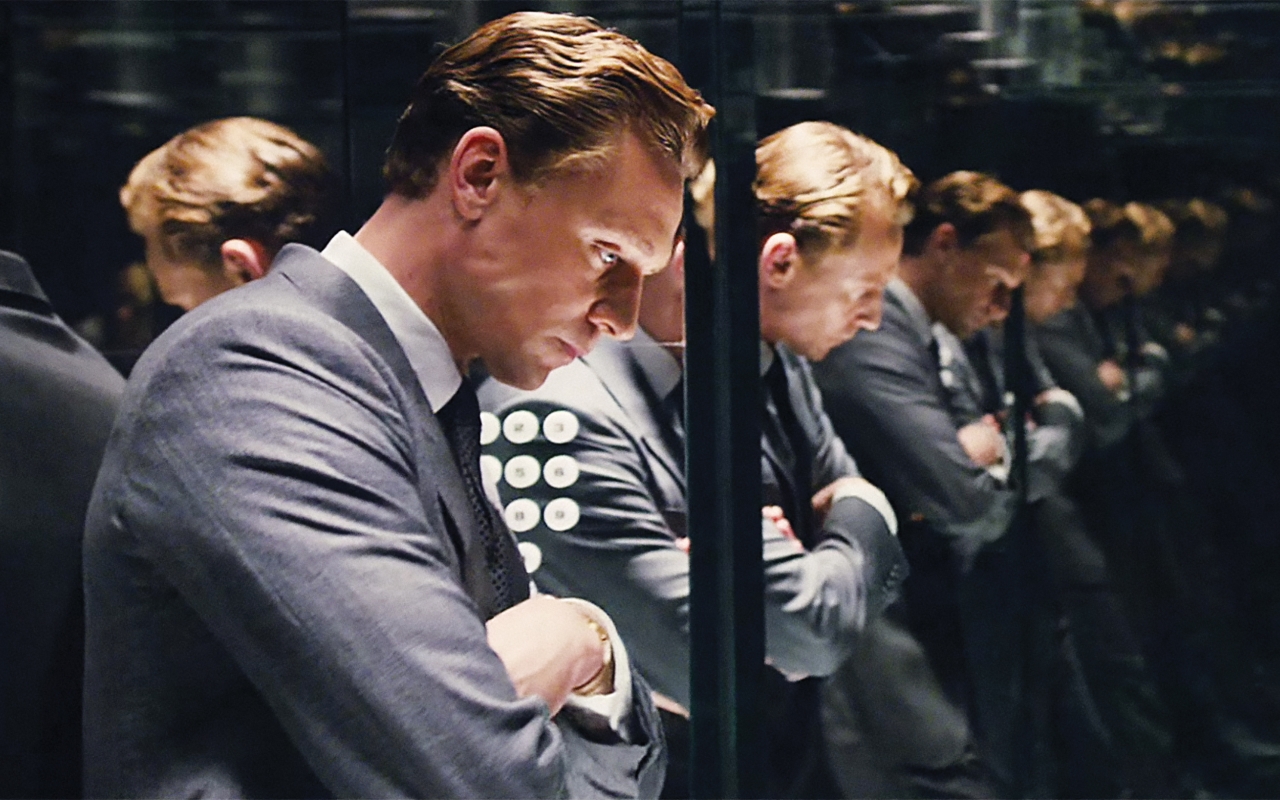
Mise en Abyme: Ben Wheatley's HIGH-RISE

Tom Hiddleston in HIGH-RISE.
I re-read J.G. Ballard's HIGH-RISE for the first time since the Seventies some months ago and felt somewhat disappointed by it. He's one of my favorite novelists and I prefer his most challenging material, so it's not that I was put off by its subject matter or its most lurid highlights; I was frankly exhausted by the book because it contained almost no dialogue, which made Ballard's austere, clinical writing all the more concentrated and wearing. Also, when all was said and done, I felt its ideas had been more definitively handled by William Golding's LORD OF THE FLIES and Luis Buñuel's 1962 film THE EXTERMINATING ANGEL, and I'm not accustomed to Ballard being bested by anyone at his own game.
I was very much looking forward to Ben Wheatley's film - it premiered yesterday on iTunes, Amazon Video and other streaming outlets before its US theatrical premiere in mid May - which I found disappointing for an entirely different set of reasons. Unlike the novel, it contains a lot of dialogue (some of it funny, as when one character rules "This is my party, these are my guests, and I will decide who is to be lobotomized!" - but mostly not) and introduced a plethora of characters, vignettes and situations not in the novel besides. While superbly well cast (Tom Hiddleston as Laing, Jeremy Irons as the architect Anthony Royal, Luke Evans as Wilder, also Elisabeth Moss and Sienna Miller), it's too freely adapted by Amy Jump, whose interpretation is immersive and Dionysian rather than remote and obsessed as Ballard is in his storytelling, not sharing his interest in the slow and systematic breakdown of human psychologies divorced from nature and imprisoned in the most abstract extremes of luxury.

Luke Evans.
I sensed it was on the wrong track from the opening shot, which jumps ahead to where the tenants' reversion to savagery is headed, making that our baseline before cutting to a more civilized time "three months earlier." This gave me the uneasy feeling that Wheatley and Jump would not be approaching the story as Ballard did, as a satirical work of surrealism, because surrealism - like any form of fantasy - needs a certain grounding in realism before it can take flight. Here the high-rise itself is a psychotic derangement, a towering beard trimmer that its designer likens to an open hand. The film concludes with a tape recording of Margaret Thatcher defining the differences between state and private capitalism, summarizing all that has come before as possibly the most remote thing from surrealism: social allegory.

At no time does the material remind us, as Ballard does, how our interactions with the rest of the world decide how presentably we live from day to day, how easily our standards of living can deteriorate if we have only to please ourselves - into not making the bed, not changing our clothes for days or weeks at a time, and the psychological cost that comes with such self-neglect. (Writers and other business people working from home, as Ballard did, will hear me.) Even the needle drops of the music score, pulling "Spoon" from CAN's EGE BAMYASI and commissioning a post-traumatic re-recording of ABBA's "S.O.S." by Portishead, evoke a scramble for hipster cred rather than a serious attempt to venture where Ballard had gone, which would have called for something closer far less counter-cultural and much more akin to 1970s supermarket Muzak.

THE EXTERMINATING ANGEL is in many ways the better and more faithful adaptation, though it was conceived at least a dozen years before the novel was written. The Ballard film to beat remains Jonathan Weiss's uncompromising THE ATROCITY EXHIBITION (2000).